Notice: تابع WP_Block_Type_Registry::register به طورنادرست فراخوانی شد. نامهای نوع بلوک نباید حروف بزرگ داشته باشند. لطفاً برای اطلاعات بیشتر، اشکال زدایی در وردپرس را مشاهده کنید. (این پیام در نگارش 5.0.0 افزوده شده است.) in /home/ethicsho/public_html/wp-includes/functions.php on line 5313
Warning: Use of undefined constant TDC_PATH_LEGACY - assumed 'TDC_PATH_LEGACY' (this will throw an Error in a future version of PHP) in /home/ethicsho/public_html/wp-content/plugins/td-composer/td-composer.php on line 109
Warning: Use of undefined constant TDSP_THEME_PATH - assumed 'TDSP_THEME_PATH' (this will throw an Error in a future version of PHP) in /home/ethicsho/public_html/wp-content/plugins/td-composer/td-composer.php on line 113 بایگانیهای Embryonic Stem Cells - Research - Moral And Ethical Aspects - خانه اخلاق پژوهان جوان Notice: Trying to access array offset on value of type bool in /home/ethicsho/public_html/wp-content/plugins/wp-ulike/inc/general-functions.php on line 807
“Petrified Intelligence offers the first comprehensive treatment of Hegel’s “Philosophy of Nature, exploring its central place within his system, including its relation to his “Logic, Philosophy of Mind, and moral and political thought. It highlights the contemporary relevance of Hegel’s approach to nature, particularly with respect to environmental issues. Challenging the standard view that Hegel devalues nature relative to mind and culture, Alison Stone revels the deep concern to re-enchant the natural world that pervades his entire philosophical project. Written in clear and nontechnical language, the book also provides a critical introducing to Hegel’s metaphysics.
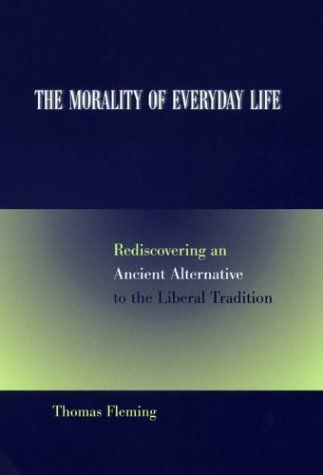
In The Morality of Everyday Life, Thomas Fleming offers an alternative to the enlightened liberalism espoused by thinkers as different as Kant, Mill, Rand, and Rawls. These thinkers maintain that a problem should be looked at from an objective point of view and a decision made from a distant perspective that is both rational and universally applied to all comparable cases. Fleming instead places importance on the particular, the local, and moral complexity. For Fleming, postmodernism, which began with Nietzsche, is not the answer to moral dilemmas either. Fleming advocates a return to premodern traditions, such as those exemplified in the texts of Aristotle, the Talmud, and the folk wisdom in ancient Greek literature, for a solution to ethical predicaments. In his view, liberalism and postmodernism ignore the fact that human beings by their very nature refuse to live in a world of universal abstractions wherein the attachments of friends, neighbors, family, and country make no difference. Premodern thinkers, unlike those since the seventeenth century, recognized that particular obligations arise from specific circumstances and experiences. While such modern philosophers as Kant and Kohlberg have regarded a mother’s self-sacrificing love for her children as beneath their level of morality, folk wisdom tells us it is nearly the highest morality, taking precedence over the duties of citizenship or the claims of humanity. Fleming believes that a modern type of “casuistry” should be applied to these hard cases–moral conflicts in which thee is no clear right or wrong. Casuistry, as it was practiced in the Middle Ages, was a case-by-case analysis of each dilemma. Genuine casuistry is based ontwo principles: that there are general and universally applicable moral laws governing human conduct, and that these laws may not be applied simplistically and uniformly to the great variety of human circumstances and situa
Jesse Prinz argues that recent work in philosophy, neuroscience, and anthropology supports two radical hypotheses about the nature of morality: moral values are based on emotional responses, and these emotional responses are inculcated by culture, not hard-wired through natural selection. In the first half of the book, Jesse Prinz defends the hypothesis that morality has an emotional foundation. Evidence from brain imaging, social psychology, and psychopathology suggest that, when we judge something to be right or wrong, we are merely expressing our emotions. Prinz argues that these emotions do not track objective features of reality; rather, the rightness and wrongness of an act consists in the fact that people are disposed to have certain emotions towards it. In the second half of the book, he turns to a defense of moral relativism. Moral facts depend on emotional responses, and emotional responses vary from culture to culture. Prinz surveys the anthropological record to establish moral variation, and he draws on cultural history to show how attitudes toward practices such as cannibalism and marriage change over time. He also criticizes evidence from animal behavior and child development that has been taken to support the claim that moral attitudes are hard-wired by natural selection. Prinz concludes that there is no single true morality, but he also argues that some moral values are better than others; moral progress is possible. Throughout the book, Prinz relates his views to contemporary and historical work in philosophical ethics. His views echo themes in the writings of David Hume and Friedrich Nietzsche, but Prinz supports, extends, and revises these classic theories using the resources of cutting-edge cognitive science. The Emotional Construction of Morals will stimulate and challenge anyone who is curious about the nature and origin of moral values.
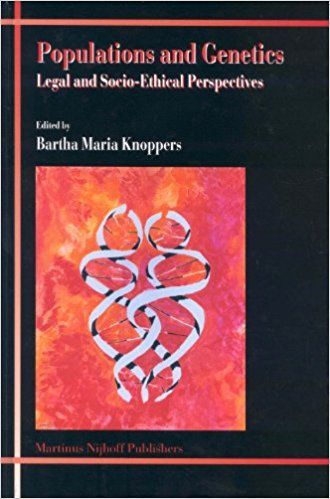
Genetic research and testing is not limited to individuals and their families. Increasingly, there is focus on communities and even whole populations. This raises legal and socio-ethical and issues that have not been addressed. In this age of international biobanking involving populations, are current legal and ethical approaches sufficient? This book of selected papers covers population research and banking as well as accompanying confidentiality, and governance concerns. Possible commercialization, patents, benefit sharing, discrimination, and the role of patient organizations and of developing countries are also discussed. New perspectives and models are provided. The book concludes with a “Statement of Principles on the Ethical Conduct of Human Genetic Research Involving Populations,” Policymakers, academics, legislators and researchers will find this book to be current and controversial. The human genome may be mapped but the legal and socio-ethical debate is far from over.
ما از اخلاق چه انتظاری داریم؟ این سوال شاید تاحدودی برای عموم مردم و یا متخصصان این رشته قابل پاسخ باشد؛ اینکه خوب بودن را به ما بیاموزد و در تنظیم روابط فردی م...

جشن کتاب تهران به ایستگاه سی و یکم رسیده است. حال و احوال نشر کتاب خوب نیست و باید فرهنگدوستان را به خرید و هدیه دادن کتاب ترغیب نمود. خانه اخلاقپژوهان جوان ب...

بنیاد کتابهای اخلاق اسلامی عمدتا پالایش جان از آلودگیها و آراستن آن به زیباییها است. اندیشه محوری این قبیل کتابها آن است که انسان فعلی آنی نیست که باید باشد...

-
0 Comments