Notice: تابع WP_Block_Type_Registry::register به طورنادرست فراخوانی شد. نامهای نوع بلوک نباید حروف بزرگ داشته باشند. لطفاً برای اطلاعات بیشتر، اشکال زدایی در وردپرس را مشاهده کنید. (این پیام در نگارش 5.0.0 افزوده شده است.) in /home/ethicsho/public_html/wp-includes/functions.php on line 5313
Warning: Use of undefined constant TDC_PATH_LEGACY - assumed 'TDC_PATH_LEGACY' (this will throw an Error in a future version of PHP) in /home/ethicsho/public_html/wp-content/plugins/td-composer/td-composer.php on line 109
Warning: Use of undefined constant TDSP_THEME_PATH - assumed 'TDSP_THEME_PATH' (this will throw an Error in a future version of PHP) in /home/ethicsho/public_html/wp-content/plugins/td-composer/td-composer.php on line 113 بایگانیهای Customary Law - خانه اخلاق پژوهان جوان Notice: Trying to access array offset on value of type bool in /home/ethicsho/public_html/wp-content/plugins/wp-ulike/inc/general-functions.php on line 807
Sullivan and Kymlicka seek to provide an alternative to post-9/11 pessimism about the ability of serious ethical dialogue to resolve disagreements and conflict across national, religious, and cultural differences. It begins by acknowledging the gravity of the problem: on our tightly interconnected planet, entire populations look for moral guidance to a variety of religious and cultural traditions, and these often stiffen, rather than soften, opposing moral perceptions. How, then, to set minimal standards for the treatment of persons while developing moral bases for coexistence and cooperation across different ethical traditions? The Globalization of Ethics argues for a tempered optimism in approaching these questions. Its distinguished contributors report on some of the most globally influential traditions of ethical thought in order to identify the resources within each tradition for working toward consensus and accommodation among the ethical traditions that shape the contemporary world.
Setting the Moral Compass brings together the (largely unpublished) work of nineteen women moral philosophers whose powerful and innovative work has contributed to the “re-setting of the compass” of moral philosophy over the past two decades. The contributors, who include many of the top names in this field, tackle several wide-ranging projects: they develop an ethics for ordinary life and vulnerable persons; they examine the question of what we ought to do for each other; they highlight the moral significance of inhabiting a shared social world; they reveal the complexities of moral negotiations; and finally they show us the place of emotion in moral life.
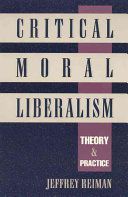
In this important book, Jeffrey Reiman responds to recent assaults on liberal theory by proposing a “critical moral liberalism.” It is liberal in maintaining the emphasis of classical liberalism on individual freedom, moral in adhering to a distinctive vision of the good life rather than professing neutrality, and critical in taking seriously the objection-raised by feminists and Marxists, among others-that liberal theories often serve as ideological cover for oppression of one group by others. Critical moral liberalism has a conception of ideology, and resources for testing the suspicion that arrangements that look free are really oppressive. Reiman sets forth the basic arguments for the liberal moral obligation to maximize people’s ability to govern their own lives, and for the conception of the good life that goes with this. He considers and answers objections to the liberal project, and defends liberal conceptions of privacy, moral virtue, economic justice, and Constitutional interpretation. Reiman then takes up specific policy issues, among them abortion, infanticide, euthanasia, moral education, capital punishment, and threats to privacy from modern information technology. Critical Moral Liberalism will be of interest to scholars and students of ethics, social and political philosophy, political theory, and public policy.
Despite the pharmaceutical industry’s notable contributions to human progress, including the development of miracle drugs for treating cancer, AIDS, and heart disease, there is a growing tension between the industry and the public. Debates are raging over how the industry can and should be expected to act. In this volume leading figures in industry, government, NGOs, the medical community, and academia discuss and propose solutions to the ethical dilemmas of drug industry behavior. They examine such aspects as the role of intellectual property rights and patent protection, the moral and economic requisites of research and clinical trials, drug pricing, marketing and advertising. . Michael Santoro is Associate Professor with tenure in the Business Environment Department at Rutgers Business School, where he teaches courses on business ethics, public policy, labor and human rights, law, ethical issues in the pharmaceutical industry and China business strategy. As a Research Associate at Harvard Business School, he wrote or co-authored nearly thirty case studies and teaching notes on ethical and legal topics such as global protection of intellectual property, insider trading, the Federal Sentencing Guidelines and Fair Credit Reporting Act. Thomas Gorrie is Corporate Vice President, Government Affairs & Policy, at Johnson & Johnson, with responsiblity for all federal, state and international government affairs and policy. He completed post-doctoral studies at the Swiss Federal Institute of Technology in Zurich, following the receipt of his doctorate at Princeton University. Gorrie has over 30 years of worldwide health care experience and has worked with various Johnson & Johnson companies in research and development, marketing and sales, business development, strategic planning, general management, international, venture capital, and health policy.
Finding the love of your life and holding onto that relationship is more difficult than ever. The problem hasn’t gone unnoticed. From relationship therapists to speed-dating, self-help books to online matchmaking, an entire industry has developed to help us navigate the bumpy road of relationships. Yet in spite of the availability of all these resources, many of us still struggle to discover and keep the love of our lives. That is, until now. This groundbreaking book from the frontiers of psychology offers startling new research about the one missing factor that is vital to relationships—forgiveness. A national bestselling author and leading expert on forgiveness, Dr. Fred Luskin shows that no matter how much two people may love each other, their relationship will not succeed unless they practice forgiveness—an approach that most relationship experts continue to ignore. Why is forgiveness an essential tool for relationships? Studies reveal that 70 percent for what we argue about at the beginning of our relationships will never be fully resolved. In other words, our basic needs and behaviors don’t change over time. The issues are endless: the socks that always end up on the floor, how often to have sex, the ESPN obsession, working hours, and, of course, friends and family. Without forgiveness, these issues, however big or small, too easily turn into relationship-eroding grudges. Forgive for Love is the solution for your relationship woes, providing the tools you need to find and hold onto the love of your life. Dr. Luskin delivers a proven seven-step program for creating and maintaining loving and lasting relationships, teaching easy-to-learn forgiveness skills that will not only resolve immediate conflicts but improve the overall happiness and longevity of your relationships. Simply put: people in healthy relationships figure out how to forgive their partners for being themselves. They do so because it is nearly impossible to change other people and because none of us are perfect. Forgiveness is the key, and Forgive for Love has the answers.
ما از اخلاق چه انتظاری داریم؟ این سوال شاید تاحدودی برای عموم مردم و یا متخصصان این رشته قابل پاسخ باشد؛ اینکه خوب بودن را به ما بیاموزد و در تنظیم روابط فردی م...

جشن کتاب تهران به ایستگاه سی و یکم رسیده است. حال و احوال نشر کتاب خوب نیست و باید فرهنگدوستان را به خرید و هدیه دادن کتاب ترغیب نمود. خانه اخلاقپژوهان جوان ب...

بنیاد کتابهای اخلاق اسلامی عمدتا پالایش جان از آلودگیها و آراستن آن به زیباییها است. اندیشه محوری این قبیل کتابها آن است که انسان فعلی آنی نیست که باید باشد...

-
0 Comments