Notice: تابع WP_Block_Type_Registry::register به طورنادرست فراخوانی شد. نامهای نوع بلوک نباید حروف بزرگ داشته باشند. لطفاً برای اطلاعات بیشتر، اشکال زدایی در وردپرس را مشاهده کنید. (این پیام در نگارش 5.0.0 افزوده شده است.) in /home/ethicsho/public_html/wp-includes/functions.php on line 5313
Warning: Use of undefined constant TDC_PATH_LEGACY - assumed 'TDC_PATH_LEGACY' (this will throw an Error in a future version of PHP) in /home/ethicsho/public_html/wp-content/plugins/td-composer/td-composer.php on line 109
Warning: Use of undefined constant TDSP_THEME_PATH - assumed 'TDSP_THEME_PATH' (this will throw an Error in a future version of PHP) in /home/ethicsho/public_html/wp-content/plugins/td-composer/td-composer.php on line 113 بایگانیهای Cultural Diversity - خانه اخلاق پژوهان جوان Notice: Trying to access array offset on value of type bool in /home/ethicsho/public_html/wp-content/plugins/wp-ulike/inc/general-functions.php on line 807
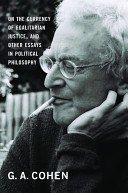
G. A. Cohen was one of the most gifted, influential, and progressive voices in contemporary political philosophy. At the time of his death in 2009, he had plans to bring together a number of his most significant papers. This is the first of three volumes to realize those plans. Drawing on three decades of work, it contains previously uncollected articles that have shaped many of the central debates in political philosophy, as well as papers published here for the first time. In these pieces, Cohen asks what egalitarians have most reason to equalize, he considers the relationship between freedom and property, and he reflects upon ideal theory and political practice.Included here are classic essays such as “Equality of What?” and “Capitalism, Freedom, and the Proletariat,” along with more recent contributions such as “Fairness and Legitimacy in Justice,” “Freedom and Money,” and the previously unpublished “How to Do Political Philosophy.” On ample display throughout are the clarity, rigor, conviction, and wit for which Cohen was renowned. Together, these essays demonstrate how his work provides a powerful account of liberty and equality to the left of Ronald Dworkin, John Rawls, Amartya Sen, and Isaiah Berlin.
The Ethics of Teaching provides a frank discussion of the most frequently encountered ethical dilemmas that can arise in educational settings, as well as tips on how to avoid these predicaments and how to deal with them when they do occur. The goal is to stimulate discussion and raise faculties’ consciousness about ethical issues. Ethical dilemmas are presented as short, engaging case scenarios, most of which are based on actual situations, so as to furnish more realistic and interesting stimuli for individual reflection and group discussion. These scenarios offer the opportunity to consider the subtle complexities inherent in the social and psychological contexts in which educator-student interactions occur and the effects of those complexities on ethical decision making. Each case is followed by a detailed analysis and advice. The book’s 195 cases are grouped into 22 chapters representing topics, such as the controversial classroom presentations and assignments, debatable testing and grading practices, problematic student-faculty interactions, dual-role relationships with students, collegial conflicts, managing very difficult students, and confidentiality dilemmas. The Ethics of Teaching: A Casebook, Second Edition: *focuses on commonly encountered ethical “gray areas” that have no clear solution; *includes questions to stimulate discussion of related ethical issues; *concludes with a chapter on prevention, peer mentoring, and intervention; and *serves as excellent “assigned reading” to stimulate group discussion in teaching workshops and faculty development programs. The first edition of this book evolved by collecting a variety of teaching situations that commonly occur in college and university settings. The authors then created responses to the situations and circulated both the cases and the responses to reviewers from a number of departments across the country. As a result, the vast majority of the cases are “discipline free.” The second edition features many new cases to reflect recent trends and events related to academic ethics. Questions were added to stimulate discussion and to further elaborate the issues. The Ethics of Teaching: A Casebook is ideal for college and university faculty, graduate assistants, and administrators involved in workshops, graduate teaching assistant courses, and faculty development and new faculty orientation programs. As a result of the book’s cross-disciplinary development, it will be beneficial to faculty from a broad spectrum of disciplines.
Change in Viewoffers an entirely original approach to the philosophical study of reasoning by identifying principles of reasoning with principles for revising one’s beliefs and intentions and not with principles of logic. This crucial observation leads to a number of important and interesting consequences that impinge on psychology and artificial intelligence as well as on various branches of philosophy, from epistemology to ethics and action theory. Gilbert Harman is Professor of Philosophy at Princeton University. A Bradford Book.
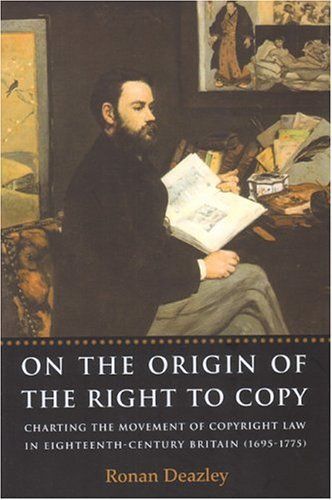
Taking as its point of departure the lapse of the Licensing Act 1662 in 1695, this book examines the lead up to the passage of the Statute of Anne 1709 and charts the movement of copyright law throughout the eighteenth century, culminating in the House of Lords decision in Donaldson v Becket (1774). The established reading of copyright’s development throughout this period, from the 1709 Act to the pronouncement in Donaldson, is that it was transformed from a publisher’s right to an author’s right; that is, legislation initially designed to regulate the marketplace of the bookseller and publisher evolved into an instrument that functioned to recognise the proprietary inevitability of an author’s intellectual labours. The historical narrative which unfolds within this book presents a challenge to that accepted orthodoxy. The traditional analysis of the development of copyright in eighteenth-century Britain is revealed as exhibiting the character of long-standing myth, and the centrality of the modern proprietary author as the raison d’être of the copyright regime is displaced.
ما از اخلاق چه انتظاری داریم؟ این سوال شاید تاحدودی برای عموم مردم و یا متخصصان این رشته قابل پاسخ باشد؛ اینکه خوب بودن را به ما بیاموزد و در تنظیم روابط فردی م...

جشن کتاب تهران به ایستگاه سی و یکم رسیده است. حال و احوال نشر کتاب خوب نیست و باید فرهنگدوستان را به خرید و هدیه دادن کتاب ترغیب نمود. خانه اخلاقپژوهان جوان ب...

بنیاد کتابهای اخلاق اسلامی عمدتا پالایش جان از آلودگیها و آراستن آن به زیباییها است. اندیشه محوری این قبیل کتابها آن است که انسان فعلی آنی نیست که باید باشد...

-
0 Comments