Notice: تابع WP_Block_Type_Registry::register به طورنادرست فراخوانی شد. نامهای نوع بلوک نباید حروف بزرگ داشته باشند. لطفاً برای اطلاعات بیشتر، اشکال زدایی در وردپرس را مشاهده کنید. (این پیام در نگارش 5.0.0 افزوده شده است.) in /home/ethicsho/public_html/wp-includes/functions.php on line 5313
Warning: Use of undefined constant TDC_PATH_LEGACY - assumed 'TDC_PATH_LEGACY' (this will throw an Error in a future version of PHP) in /home/ethicsho/public_html/wp-content/plugins/td-composer/td-composer.php on line 109
Warning: Use of undefined constant TDSP_THEME_PATH - assumed 'TDSP_THEME_PATH' (this will throw an Error in a future version of PHP) in /home/ethicsho/public_html/wp-content/plugins/td-composer/td-composer.php on line 113 بایگانیهای Cruelty - خانه اخلاق پژوهان جوان Notice: Trying to access array offset on value of type bool in /home/ethicsho/public_html/wp-content/plugins/wp-ulike/inc/general-functions.php on line 807
This book presents an ethical theory that uniquely integrates naturalistic and rationalistic elements. Robert Audi develops his theory in four areas: moral epistemology, the metaphysics of ethics, moral psychology, and the foundations of ethics. Comprising both new and published work, the book sets forth a moderate intuitionism, clarifies the relation between reason and motivation, constructs a theory of intrinsic value and its place in moral obligation, and presents a sophisticated account of moral justification. The concluding chapter articulates a new normative framework built from both Kantian and intuitionist elements. Connecting ethics in novel ways to both the theory of value and the philosophy of action, the essays explore topics such as ethical intuition, reason and judgement, and virtue. Audi also considers major views in the history of ethics, including those of Aristotle, Hume, Kant, Mill, Moore, and W. D. Ross, and engages contemporary work on autonomy, responsibility, objectivity, reasons, and other issues. Clear and conceptually rich, this book makes vital reading for students and scholars of ethics.
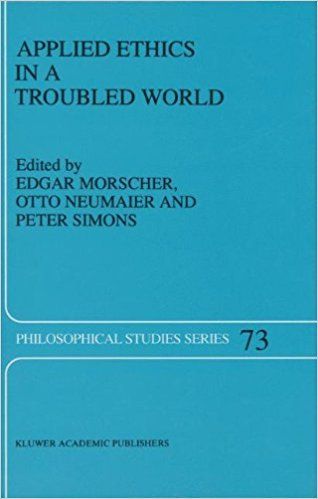
During the last two decades, applied ethics has not only developed into one of the most important philosophical disciplines but has also differentiated into so many subdisciplines that it is becoming increasingly difficult to survey it. A much-needed overview is provided by the eighteen contributions to this volume, in which internationally renowned experts deal with central questions of environmental ethics, bioethics and medical ethics, professional and business ethics, social, political, and legal ethics as well as with the aims and foundations of applied ethics in general. Thanks to a philosophical introduction and selected bibliographical references added to each chapter, the book is very well suited as a basis for courses in applied ethics. It is directed not only to philosophers and to ethicists from other disciplines but to scientists in general and to all people who are interested in the rational discussion of moral principles and their application to concrete problems in the sciences and in everyday life.
This book studies education and curriculum from the perspective of the teacher’s stance in the classroom. Writing through the lenses offered by autobiography, a lifetime in the classroom serving as teacher, and drawing heavily on Jewish and secular scholarly texts, Block offers a vision of education that serves as an alternative to the increasingly instrumentalist, managerial, standards-driven impersonal nature of contemporary schools. He advocates not for a pedagogy of ethics, but for the original ethical stance every teacher already assumes by entering into the classroom. It is from this stance in ethics, he argues, that all pedagogy derives.
Larry Alexander offers a skeptical appraisal of the claim that freedom of expression is a human right. He examines the various contexts in which a right to freedom of expression might be asserted and concludes that it cannot be supported in any of these contexts. Alexander argues that the legal protection affording freedom of expression is definitely of value, although the form such protection takes will vary with historical and cultural circumstances–and, ultimately, is not a matter of human rights.
ما از اخلاق چه انتظاری داریم؟ این سوال شاید تاحدودی برای عموم مردم و یا متخصصان این رشته قابل پاسخ باشد؛ اینکه خوب بودن را به ما بیاموزد و در تنظیم روابط فردی م...

جشن کتاب تهران به ایستگاه سی و یکم رسیده است. حال و احوال نشر کتاب خوب نیست و باید فرهنگدوستان را به خرید و هدیه دادن کتاب ترغیب نمود. خانه اخلاقپژوهان جوان ب...

بنیاد کتابهای اخلاق اسلامی عمدتا پالایش جان از آلودگیها و آراستن آن به زیباییها است. اندیشه محوری این قبیل کتابها آن است که انسان فعلی آنی نیست که باید باشد...

-
0 Comments