Notice: تابع WP_Block_Type_Registry::register به طورنادرست فراخوانی شد. نامهای نوع بلوک نباید حروف بزرگ داشته باشند. لطفاً برای اطلاعات بیشتر، اشکال زدایی در وردپرس را مشاهده کنید. (این پیام در نگارش 5.0.0 افزوده شده است.) in /home/ethicsho/public_html/wp-includes/functions.php on line 5313
Warning: Use of undefined constant TDC_PATH_LEGACY - assumed 'TDC_PATH_LEGACY' (this will throw an Error in a future version of PHP) in /home/ethicsho/public_html/wp-content/plugins/td-composer/td-composer.php on line 109
Warning: Use of undefined constant TDSP_THEME_PATH - assumed 'TDSP_THEME_PATH' (this will throw an Error in a future version of PHP) in /home/ethicsho/public_html/wp-content/plugins/td-composer/td-composer.php on line 113 بایگانیهای Business/ Religious Aspects/ Christianity - خانه اخلاق پژوهان جوان Notice: Trying to access array offset on value of type bool in /home/ethicsho/public_html/wp-content/plugins/wp-ulike/inc/general-functions.php on line 807
Understanding human beings and their distinctive rational and volitional capacities is one of the central tasks of philosophy. The task requires a clear account of such things as reasons, desires, emotions and motives, and of how they combine to produce and explain human behaviour. In Kinds of Reasons, Maria Alvarez offers a fresh and incisive treatment of these issues, focusing in particular on reasons as they feature in contexts of agency. Her account builds on some important recent work in the area; but she takes her main inspiration from the tradition that receives its seminal contemporary expression in the writings of G.E.M. Anscombe, a tradition that runs counter to the broadly Humean orthodoxy that has dominated the theory of action for the past forty years. Alvarez’s conclusions are therefore likely to be controversial; and her bold and painstaking arguments will be found provocative by participants on every side of the debates with which she engages. Clear and directly written, Kinds of Reasons aims to stake out a distinctive position within one of the most hotly contested areas of contemporary philosophy.
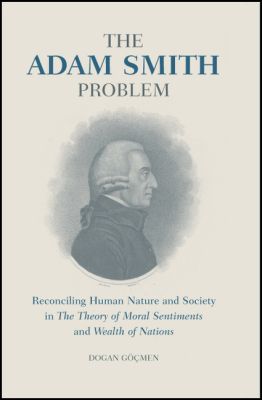
This is the first scholarly work to deal solely with the ‘Adam Smith problem’, namely the apparent contradiction between Adam Smith’s most famous works, The Theory of Moral Sentiments and The Nature and Causes of the Wealth of Nations. Since the 1840s scholars have puzzled over and attempted to explain the fact that these works offer two fundamentally different and contradictory concepts of human nature. In this radical new approach Dogan Göçmen makes a major contribution to the debate. Accepting that Smith does indeed put forward two different and varied ideas, he argues that the ethical position articulated in The Theory of Moral Sentiments can be, and was intended by Smith to be, applied as a basis for criticising the commercial society analysed in the Wealth of Nations. Göçmen argues that this ethical position points to the character of an ideal future society, Adam Smith’s Utopia, a society in which its social components are completely in sympathy – and therefore harmonious – with each other.
This book uses Viktor Frankl’s Existential Psychology (logotherapy) to explore the ways some professors use unusually personal scholarship to discover meaning in personal adversity. A psychiatrist imprisoned for three years in Nazi concentration camps, Frankl believed the search for meaning is a powerful motivator, and that its discovery can be profoundly therapeutic. Part I begins with four stories of professors finding meaning. Using the case studies as a foundation, Part II investigates issues of epistemology and ethics in unusually personal research from an existential perspective. The book offers advice for graduate students and faculty who want to live and work more meaningfully in the academy.
As the use of human body parts has become increasingly commercialized, a need has arisen for new approaches to regulation that move beyond the paradigm of altruism. In the course of this discussion, the notion of property has become a key concept. This volume focuses on practical and conceptual perspectives to set standards for a detailed and innovative discussion in the regulation of research on human tissue. The authors, a multidisciplinary research group combining specialists from philosophy, law, sociology, biology and medicine have come together with practicing lawyers to consider both legal provisions and patterns of regulation in countries across Europe. The authors identify divergences between the different legal traditions, and explore various conceptual models which could be used to improve and to guide policy making. With this twin focus on practical and conceptual perspectives the volume sets standards for a detailed and innovative discussion of problems in the regulation of research on human tissue.
ما از اخلاق چه انتظاری داریم؟ این سوال شاید تاحدودی برای عموم مردم و یا متخصصان این رشته قابل پاسخ باشد؛ اینکه خوب بودن را به ما بیاموزد و در تنظیم روابط فردی م...

جشن کتاب تهران به ایستگاه سی و یکم رسیده است. حال و احوال نشر کتاب خوب نیست و باید فرهنگدوستان را به خرید و هدیه دادن کتاب ترغیب نمود. خانه اخلاقپژوهان جوان ب...

بنیاد کتابهای اخلاق اسلامی عمدتا پالایش جان از آلودگیها و آراستن آن به زیباییها است. اندیشه محوری این قبیل کتابها آن است که انسان فعلی آنی نیست که باید باشد...

-
0 Comments