Notice: تابع WP_Block_Type_Registry::register به طورنادرست فراخوانی شد. نامهای نوع بلوک نباید حروف بزرگ داشته باشند. لطفاً برای اطلاعات بیشتر، اشکال زدایی در وردپرس را مشاهده کنید. (این پیام در نگارش 5.0.0 افزوده شده است.) in /home/ethicsho/public_html/wp-includes/functions.php on line 5313
Warning: Use of undefined constant TDC_PATH_LEGACY - assumed 'TDC_PATH_LEGACY' (this will throw an Error in a future version of PHP) in /home/ethicsho/public_html/wp-content/plugins/td-composer/td-composer.php on line 109
Warning: Use of undefined constant TDSP_THEME_PATH - assumed 'TDSP_THEME_PATH' (this will throw an Error in a future version of PHP) in /home/ethicsho/public_html/wp-content/plugins/td-composer/td-composer.php on line 113 بایگانیهای Banks And Banking - خانه اخلاق پژوهان جوان Notice: Trying to access array offset on value of type bool in /home/ethicsho/public_html/wp-content/plugins/wp-ulike/inc/general-functions.php on line 807
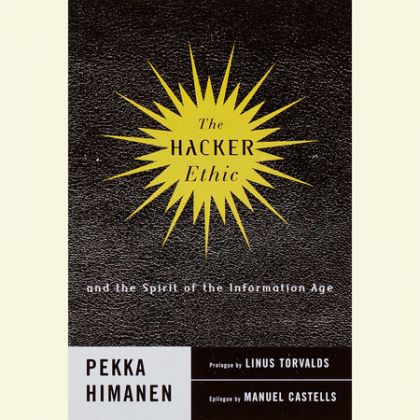
You may be a hacker and not even know it. Being a hacker has nothing to do with cyberterrorism, and it doesn’t even necessarily relate to the open-source movement. Being a hacker has more to do with your underlying assumptions about stress, time management, work, and play. It’s about harmonizing the rhythms of your creative work with the rhythms of the rest of your life so that they amplify each other. It is a fundamentally new work ethic that is revolutionizing the way business is being done around the world.Without hackers there would be no universal access to e-mail, no Internet, no World Wide Web, but the hacker ethic has spread far beyond the world of computers. It is a mind-set, a philosophy, based on the values of play, passion, sharing, and creativity, that has the potential to enhance every individual’s and company’s productivity and competitiveness. Now there is a greater need than ever for entrepreneurial versatility of the sort that has made hackers the most important innovators of our day. Pekka Himanen shows how we all can make use of this ongoing transformation in the way we approach our working lives.
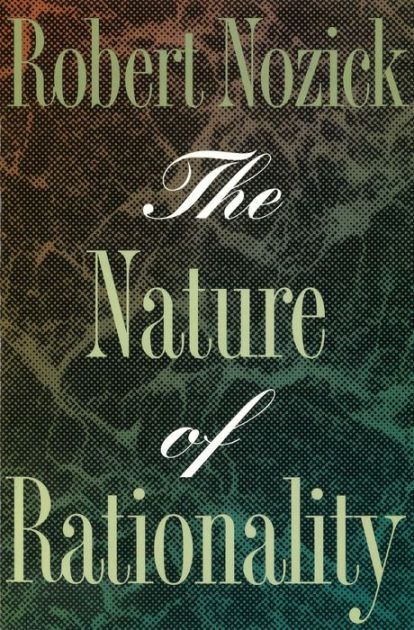
Repeatedly and successfully, the celebrated Harvard philosopher Robert Nozick has reached out to a broad audience beyond the confines of his discipline, addressing ethical and social problems that matter to every thoughtful person. Here Nozick continues his search for the connections between philosophy and “ordinary” experience. In the lively and accessible style that his readers have come to expect, he offers a bold theory of rationality, the one characteristic deemed to fix humanity’s “specialness”. What are principles for? asks Nozick. We could act simply on whim, or maximize our self-interest and recommend that others do the same. As Nozick explores rationality of decision and rationality of belief, he shows how principles actually function in our day-to-day thinking and in our efforts to live peacefully and productively with one another. In Nozick’s view, misconceptions of rationality have resulted in many intractable philosophical problems. For example, the Kantian attempt to make principled behavior the sole ultimate standard of conduct extends rationality beyond its bounds. In this provocative volume, Nozick reformulates current decision theory to include the symbolic meaning of actions in areas from controlling impulses to fighting society’s war against drugs. The author proposes a new rule of rational decision, “maximizing decision-value”, which is a weighted sum of causal, evidential, and symbolic utility. In a particularly fascinating section of the book he traces the implications of this rule for the famous Prisoner’s Dilemma and for Newcomb’s Problem. Rationality of belief, according to Nozick, involves two aspects: support by reasons that make the belief credible, andgeneration by a process that reliably produces true beliefs. A new evolutionary account explains how some factual connections are instilled in us as seemingly self-evident, thus reversing the direction of Kant’s “Copernican Revolution”. Proposing a theory of rational belief that includes both the intellectual credibility of the belief and the practical consequences of believing it, Nozick also provides a fresh resolution of the “lottery paradox”. Finally, Nozick explores the scope and limits of instrumental rationality, or the effective and efficient pursuit of given goals, and suggests some new conditions on the rationality of goals. Throughout, the book combines daring speculations with detailed investigations to portray the nature and status of rationality and the essential role that imagination plays in this singular human aptitude.
Perfect for introductory ethics courses, this popular anthology encourages a critical examination of contemporary moral problems by presenting differing viewpoints on issues like the death penalty; euthanasia; hate speech and censorship; world hunger and global justice; and the environment. The readings, of which over 40% are new to this Sixth Edition, include relevant legal opinions, as well as selections from the work of some of the most respected contemporary writers and thinkers.
Richard Brandt is one of the most eminent and influential of contemporary moral philosophers. His work has been concerned with how to justify what is good or right not by reliance on intuitions or theories about what moral words mean but by the explanation of moral psychology and the description of what it is to value something, or to think it immoral. His approach thus stands in marked contrast to the influential theories of John Rawls. The essays reprinted in this collection span a period of almost 30 years and include many classic pieces in metaethical and normative ethical theory. The collection is aimed at both those moral philosophers familiar with Brandt’s work and at those philosophers who may be largely unfamiliar with his work. The latter group will be struck by the lucid unpretentious style and the cumulative weight of Brandt’s contributions to topics that remain at the forefront of moral philosophy.
ما از اخلاق چه انتظاری داریم؟ این سوال شاید تاحدودی برای عموم مردم و یا متخصصان این رشته قابل پاسخ باشد؛ اینکه خوب بودن را به ما بیاموزد و در تنظیم روابط فردی م...

جشن کتاب تهران به ایستگاه سی و یکم رسیده است. حال و احوال نشر کتاب خوب نیست و باید فرهنگدوستان را به خرید و هدیه دادن کتاب ترغیب نمود. خانه اخلاقپژوهان جوان ب...

بنیاد کتابهای اخلاق اسلامی عمدتا پالایش جان از آلودگیها و آراستن آن به زیباییها است. اندیشه محوری این قبیل کتابها آن است که انسان فعلی آنی نیست که باید باشد...

-
0 Comments