Notice: تابع WP_Block_Type_Registry::register به طورنادرست فراخوانی شد. نامهای نوع بلوک نباید حروف بزرگ داشته باشند. لطفاً برای اطلاعات بیشتر، اشکال زدایی در وردپرس را مشاهده کنید. (این پیام در نگارش 5.0.0 افزوده شده است.) in /home/ethicsho/public_html/wp-includes/functions.php on line 5313
Warning: Use of undefined constant TDC_PATH_LEGACY - assumed 'TDC_PATH_LEGACY' (this will throw an Error in a future version of PHP) in /home/ethicsho/public_html/wp-content/plugins/td-composer/td-composer.php on line 109
Warning: Use of undefined constant TDSP_THEME_PATH - assumed 'TDSP_THEME_PATH' (this will throw an Error in a future version of PHP) in /home/ethicsho/public_html/wp-content/plugins/td-composer/td-composer.php on line 113 بایگانیهای Melbourne University Press on behalf of the University of Adelaide - خانه اخلاق پژوهان جوان Notice: Trying to access array offset on value of type bool in /home/ethicsho/public_html/wp-content/plugins/wp-ulike/inc/general-functions.php on line 807
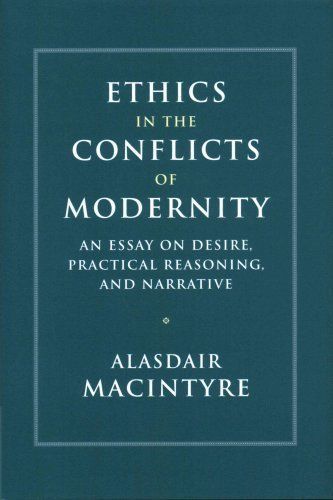
“This essay is divided into five chapters. In the first the questions initially posed about our desires and how we should think about them are questions that plain non philosophical persons often find themselves asking. When however they carry their attempt to answer these questions a little further, they find that they have, perhaps inadvertently, become philosophers, and that they need some at least of the conceptual and argumentative resources which professional philosophers provide. So their enquiry, like this one, becomes philosophical. But philosophy in our culture has become an almost exclusively specialized academic discipline whose practitioners for the most part address only each other rather than the educated lay person. Moreover those same practitioners have for the last fifty years been harassed by the academic system into publishing more and more as a condition for academic survival, so that on most topics of philosophical interest there is by now an increasingly large, an often unmanageable large body of literature that has to be read as a prologue before adding to it one more item. Readers should be warned that my references to this literature are selective and few. Had I conscientiously attempted not only to find my way through all the relevant published writing in the philosophy of mind and in ethics, but then also explained how I had come to terms with the claims advanced by its authors, I would have had to write at impossible length and in a format that would have made this essay inaccessible to the lay reader for whom it is written”–
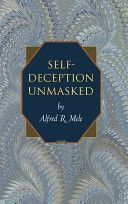
Self-deception raises complex questions about the nature of belief and the structure of the human mind. In this book, Alfred Mele addresses four of the most critical of these questions: What is it to deceive oneself? How do we deceive ourselves? Why do we deceive ourselves? Is self-deception really possible?Drawing on cutting-edge empirical research on everyday reasoning and biases, Mele takes issue with commonplace attempts to equate the processes of self-deception with those of stereotypical interpersonal deception. Such attempts, he demonstrates, are fundamentally misguided, particularly in the assumption that self-deception is intentional. In their place, Mele proposes a compelling, empirically informed account of the motivational causes of biased beliefs. At the heart of this theory is an appreciation of how emotion and motivation may, without our knowing it, bias our assessment of evidence for beliefs. Highlighting motivation and emotion, Mele develops a pair of approaches for explaining the two forms of self-deception: the “straight” form, in which we believe what we want to be true, and the “twisted” form, in which we believe what we wish to be false.Underlying Mele’s work is an abiding interest in understanding and explaining the behavior of real human beings. The result is a comprehensive, elegant, empirically grounded theory of everyday self-deception that should engage philosophers and social scientists alike.
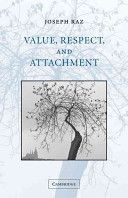
Joseph Raz is one of the world’s leading philosophers of law, and in his Seeley Lectures he reflects critically on one of the central tenets of ethical thought, the view that values are universal. He concludes that we should try to understand what is and what is not entailed by the universality of values, with such an understanding central to the future hopes of mankind, rather than abandoning the belief altogether. This is a concise humane account of some fundamental questions of social existence.
ما از اخلاق چه انتظاری داریم؟ این سوال شاید تاحدودی برای عموم مردم و یا متخصصان این رشته قابل پاسخ باشد؛ اینکه خوب بودن را به ما بیاموزد و در تنظیم روابط فردی م...

جشن کتاب تهران به ایستگاه سی و یکم رسیده است. حال و احوال نشر کتاب خوب نیست و باید فرهنگدوستان را به خرید و هدیه دادن کتاب ترغیب نمود. خانه اخلاقپژوهان جوان ب...

بنیاد کتابهای اخلاق اسلامی عمدتا پالایش جان از آلودگیها و آراستن آن به زیباییها است. اندیشه محوری این قبیل کتابها آن است که انسان فعلی آنی نیست که باید باشد...

-
0 Comments