Notice: تابع WP_Block_Type_Registry::register به طورنادرست فراخوانی شد. نامهای نوع بلوک نباید حروف بزرگ داشته باشند. لطفاً برای اطلاعات بیشتر، اشکال زدایی در وردپرس را مشاهده کنید. (این پیام در نگارش 5.0.0 افزوده شده است.) in /home/ethicsho/public_html/wp-includes/functions.php on line 5313
Warning: Use of undefined constant TDC_PATH_LEGACY - assumed 'TDC_PATH_LEGACY' (this will throw an Error in a future version of PHP) in /home/ethicsho/public_html/wp-content/plugins/td-composer/td-composer.php on line 109
Warning: Use of undefined constant TDSP_THEME_PATH - assumed 'TDSP_THEME_PATH' (this will throw an Error in a future version of PHP) in /home/ethicsho/public_html/wp-content/plugins/td-composer/td-composer.php on line 113 بایگانیهای Maktabat al-Nahdah al-Misriyah - خانه اخلاق پژوهان جوان Notice: Trying to access array offset on value of type bool in /home/ethicsho/public_html/wp-content/plugins/wp-ulike/inc/general-functions.php on line 807
John Broome’s work has always combined sophisticated economic and philosophical expertise, and Ethics Out of Economics brings together some of his most important essays, augmented by a new introduction. This book examines some of the practical issues that lie between economics and ethics, and shows how utility theory can contribute to ethics, as many economic problems are also ethical problems. Professor Broome raises some fundamental questions about economic equality, preserving the environment, and the allocation of medical resources, and powerfully shows how economic methods can contribute to moral philosophy.
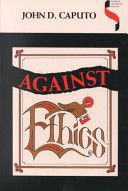
” . . . one of the most important works on philosophical ethics written in recent years. . . . Caputo speaks with a passion and a concern that are rare in academic philosophy. His profound sense of humor deepens the passion of the viewpoints he develops.Oacute; Ntilde;Mark C. Taylor Ograve; . . . a counterethics whose multiple voices will be heard long after the trivializing arguments of many analytic ethicists have vanished and the arcane formulations of many postmoderns jettisoned. . . . The either/or of this dialogue is shown as the topos of a postmodern ethics.Oacute; Ntilde;Edith Wyschogrod In Against Ethics John D. Caputo undertakes a passionate, poetic, and satiric search for the basis of an ethics in the postmodern situation. Restaging Fear and Trembling, Caputo defends the notion of obligation without ethics, of responsibility without the support of ethical foundations. Retelling the story of Abraham and Isaac, Caputo strikes the pose of a postmodern-day Johannes de Silentio, accompanied by communications from such startling figures as Johanna de Silentio, Felix Sineculpa, and Magdalena de la Cruz. In dialogue with the thought of Kierkegaard, Nietzsche, Levinas, Derrida, and Lyotard, Caputo forges a challenging, original account of what is possible and what is not possible for a continentalist ethics today.
Expanding on the theory of ethics first posited by Brentano in The Origin of our Knowledge of Right and Wrong this re-issued work, first published posthumously in 1952, is based on series of lectures on practical philosophy, given at the university of Vienna from 1876 to 1894.The English-speaking reader will find it interesting to examine the step-by-step development of Brentano’s ethical theory, his extensive critique of British moral philosophers, and his unusually detailed section on casuistry.
Epistemology has for a long time focused on the concept of knowledge and tried to answer questions such as whether knowledge is possible and how much of it there is. Often missing from this inquiry, however, is a discussion on the value of knowledge. In The Value of Knowledge and the Pursuit of Understanding Jonathan Kvanvig argues that epistemology properly conceived cannot ignore the question of the value of knowledge. He also questions one of the most fundamental assumptions in epistemology, namely that knowledge is always more valuable than the value of its subparts. Taking Platos’ Meno as a starting point of his discussion, Kvanvig tackles the different arguments about the value of knowledge and comes to the conclusion that knowledge is less valuable than generally assumed. Clearly written and well argued, the book will appeal to students and professionals in epistemology.
ما از اخلاق چه انتظاری داریم؟ این سوال شاید تاحدودی برای عموم مردم و یا متخصصان این رشته قابل پاسخ باشد؛ اینکه خوب بودن را به ما بیاموزد و در تنظیم روابط فردی م...

جشن کتاب تهران به ایستگاه سی و یکم رسیده است. حال و احوال نشر کتاب خوب نیست و باید فرهنگدوستان را به خرید و هدیه دادن کتاب ترغیب نمود. خانه اخلاقپژوهان جوان ب...

بنیاد کتابهای اخلاق اسلامی عمدتا پالایش جان از آلودگیها و آراستن آن به زیباییها است. اندیشه محوری این قبیل کتابها آن است که انسان فعلی آنی نیست که باید باشد...

-
0 Comments