Notice: تابع WP_Block_Type_Registry::register به طورنادرست فراخوانی شد. نامهای نوع بلوک نباید حروف بزرگ داشته باشند. لطفاً برای اطلاعات بیشتر، اشکال زدایی در وردپرس را مشاهده کنید. (این پیام در نگارش 5.0.0 افزوده شده است.) in /home/ethicsho/public_html/wp-includes/functions.php on line 5313
Warning: Use of undefined constant TDC_PATH_LEGACY - assumed 'TDC_PATH_LEGACY' (this will throw an Error in a future version of PHP) in /home/ethicsho/public_html/wp-content/plugins/td-composer/td-composer.php on line 109
Warning: Use of undefined constant TDSP_THEME_PATH - assumed 'TDSP_THEME_PATH' (this will throw an Error in a future version of PHP) in /home/ethicsho/public_html/wp-content/plugins/td-composer/td-composer.php on line 113 بایگانیهای Carpenter Press - خانه اخلاق پژوهان جوان Notice: Trying to access array offset on value of type bool in /home/ethicsho/public_html/wp-content/plugins/wp-ulike/inc/general-functions.php on line 807
How do our feelings for others shape our attitudes and conduct towards them? Is morality primarily a matter of rational choice, or instinctual feeling? Joseph Duke Filonowicz takes the reader on an engaging, informative tour of some of the main issues in philosophical ethics, explaining and defending the ideas of the early-modern British sentimentalists. These philosophers – Shaftesbury, Hutcheson, Hume, and Smith – argued that it is our feelings, and not our ‘reason’, which ultimately determine how we judge what is good or bad, right or wrong, and how we choose to act towards our fellow human beings. Filonowicz draws on contemporary sociology and evolutionary biology as well as present-day moral theory to examine and defend the sentimentalist view and to challenge the rationalistic character of contemporary ethics. His book will appeal to readers interested in both history of philosophy and current ethical debates.
Determinism is, roughly, the thesis that facts about the past and the laws of nature entail all truths. A venerable, age-old dilemma concerning responsibility distils to this: if either determinism is true or it is not true, we lack “”responsibility-grounding”” control. Either determinism is true or it is not true. So, we lack responsibility-grounding control. Deprived of such control, no one is ever morally responsible for anything. A number of the freshly-minted essays in this collection addr…
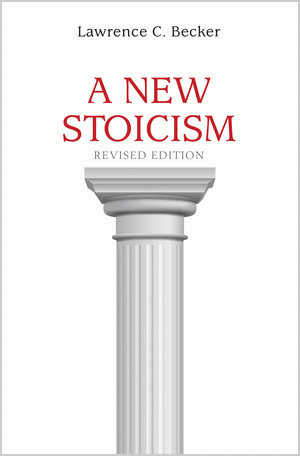
What would stoic ethics be like today if stoicism had survived as a systematic approach to ethical theory, if it had coped successfully with the challenges of modern philosophy and experimental science? A New Stoicism proposes an answer to that question, offered from within the stoic tradition but without the metaphysical and psychological assumptions that modem philosophy and science have abandoned. Lawrence Becker argues that a secular version of the stoic ethical project, based on contemporary cosmology and developmental psychology; provides the basis for a sophisticated form of ethics naturalism, in which virtually all the hard doctrines of the ancient Stoics can be clearly restated and defended.”From the beginning to the end of this compact but lucid book, Becker skillfully brings to life both the arguments and the intuitive appeal of stoicism…. In its essentials (the new stoicism is recognizable, with its particularly astringent rational charm enhanced by Becker’s focused and self-disciplined argumentation.
The innovation cycle and creative destruction — The rise of the intellectual property system — Creative tension : the right to exclude and the accessible domain — The innovation forest : intellectual property rights and how they grow — The ABCDs of intellectual property : flow and infringement of IP rights — The global diversity of innovation communities — The role of the innovation chief — Becoming strategic — Strategy tools : policies and practices for managing IP — A menu of strategy options — Evaluating internal resources and the external environment — Placing a financial value on IP assets — Accessing innovations of others — Protecting and enforcing IP rights — Transferring IP rights — IP strategies for different organizations — A comparison of national IP laws — Global challenges and opportunities — Intellectual property, innovation, and freedom.
Morality: An Anthropological Perspective provides the first account of anthropological approaches to the question of morality. By considering how morality is viewed and enacted in different cultures, and how it is related to key social institutions such as religion, law, gender, sexuality and medical practice, Morality takes a closer look at some of the most central questions of the morality debates of our time. The book is accessibly written and combines theory with practical case studies for student use. Drawing on anthropological, philosophical and general social scientific literature, the book will be useful for both undergraduate students and researchers.
ما از اخلاق چه انتظاری داریم؟ این سوال شاید تاحدودی برای عموم مردم و یا متخصصان این رشته قابل پاسخ باشد؛ اینکه خوب بودن را به ما بیاموزد و در تنظیم روابط فردی م...

جشن کتاب تهران به ایستگاه سی و یکم رسیده است. حال و احوال نشر کتاب خوب نیست و باید فرهنگدوستان را به خرید و هدیه دادن کتاب ترغیب نمود. خانه اخلاقپژوهان جوان ب...

بنیاد کتابهای اخلاق اسلامی عمدتا پالایش جان از آلودگیها و آراستن آن به زیباییها است. اندیشه محوری این قبیل کتابها آن است که انسان فعلی آنی نیست که باید باشد...

-
0 Comments