Notice: تابع WP_Block_Type_Registry::register به طورنادرست فراخوانی شد. نامهای نوع بلوک نباید حروف بزرگ داشته باشند. لطفاً برای اطلاعات بیشتر، اشکال زدایی در وردپرس را مشاهده کنید. (این پیام در نگارش 5.0.0 افزوده شده است.) in /home/ethicsho/public_html/wp-includes/functions.php on line 5313
Warning: Use of undefined constant TDC_PATH_LEGACY - assumed 'TDC_PATH_LEGACY' (this will throw an Error in a future version of PHP) in /home/ethicsho/public_html/wp-content/plugins/td-composer/td-composer.php on line 109
Warning: Use of undefined constant TDSP_THEME_PATH - assumed 'TDSP_THEME_PATH' (this will throw an Error in a future version of PHP) in /home/ethicsho/public_html/wp-content/plugins/td-composer/td-composer.php on line 113 بایگانیهای 10 - خانه اخلاق پژوهان جوان Notice: Trying to access array offset on value of type bool in /home/ethicsho/public_html/wp-content/plugins/wp-ulike/inc/general-functions.php on line 807
Epistemology, or “the theory of knowledge,” is concerned with how we know what we know, what justifies us in believing what we believe, and what standards of evidence we should use in seeking truths about the world and human experience. This comprehensive introduction to the field of epistemology explains the concepts and theories central to understanding knowledge. Along with covering the traditional topics of the discipline in detail, Epistemology explores emerging areas of research. The third edition features new sections on such topics as the nature of intuition, the skeptical challenge of rational disagreement, and “the value problem” – the range of questions concerning why knowledge and justified true belief have value beyond that of merely true belief. Updated and expanded, Epistemology remains a superb introduction to one of the most fundamental fields of philosophy. Special features of the third edition of Epistemology include: * a comprehensive survey of basic concepts, major theories, and emerging research in the field* enhanced treatment of key topics such as contextualism, perception (including perceptual content), scientific hypotheses, self-evidence and the a priori, testimony, understanding, and virtue epistemology* expanded discussion of the relation between epistemology and related fields, especially philosophy of mind, philosophy of science, and ethics * increased clarity and ease of understanding for an undergraduate audience* an updated list of key literature and annotated bibliography.
“Profound wisdom from noted writers on following forgiveness with making amends As indispensable as forgiveness has been to the healing process throughout history, there is another equally profound action that is needed for reconciliation, which Arun Gandhi, grandson of Mohandas Gandhi, calls “the other side of the coin.” Turning over the coin of forgiveness, we discover atonement, the half-hidden, much-overlooked other half of the reconciliation process Includes 15 essays and interviews by high-profile thinkers and activist including: Huston Smith, Jacob Needleman, Arun Gandhi, and Azim Khamisa Discussed atonement as a process that can enable us to become unstuck from the past and live in the present This rich and powerful book shows how acts of atonement can relieve us of the pain of the past and give us a hopeful future”–
How do we judge whether an action is morally right or wrong? If an action is wrong, what reason does that give us not to do it? Why should we give such reasons priority over our other concerns and values? In this book, T. M. Scanlon offers new answers to these questions, as they apply to the central part of morality that concerns what we owe to each other. According to his contractualist view, thinking about right and wrong is thinking about what we do in terms that could be justified to others and that they could not reasonably reject. He shows how the special authority of conclusions about right and wrong arises from the value of being related to others in this way, and he shows how familiar moral ideas such as fairness and responsibility can be understood through their role in this process of mutual justification and criticism.Scanlon bases his contractualism on a broader account of reasons, value, and individual well-being that challenges standard views about these crucial notions. He argues that desires do not provide us with reasons, that states of affairs are not the primary bearers of value, and that well-being is not as important for rational decision-making as it is commonly held to be. Scanlon is a pluralist about both moral and non-moral values. He argues that, taking this plurality of values into account, contractualism allows for most of the variability in moral requirements that relativists have claimed, while still accounting for the full force of our judgments of right and wrong.
It is well over a decade since John Fischer and Mark Ravizza – and before them, Jay Wallace and Daniel Dennett – defended responsibility from the threat of determinism. But defending responsibility from determinism is a potentially endless and largely negative enterprise; it can go on for as long as dissenting voices remain, and although such work strengthens the theoretical foundations of these theories, it won’t necessarily build anything on top of those foundations, nor will it move these theories into new territory or explain how to apply them to practical contexts.To this end, the papers in this volume address these more positive challenges by exploring how compatibilist responsibility theory can be extended and/or applied in a range of practical contexts. For instance, how is the narrow philosophical concept of responsibility that was defended from the threat of determinism related to the plural notions of responsibility present in everyday discourse, and how might this more fine-grained understanding of responsibility open up new vistas and challenges for compatibilist theory? What light might compatibilism shed, and what light might be shed upon it, by political debates about access to public welfare in the context of responsibility for one’s own health, and by legal debates about the impact of self-intoxication on responsibility. Does compatibilist theory, which was originally designed to cater for analysis of individual actions, scale to scenarios that involve group action and collective responsibility – e.g. for harms due to human-induced climate change? This book’s chapters deal with a range of theoretical problems discussed in classic compatibilist literature – e.g. the relationship between responsibility and capacity, the role of historical tracing in discounting the exculpatory value of incapacities, and the justifiability of retributive punishment. But instead of motivating their discussions by focusing on the alleged threat that determinism poses to responsibility, these chapters’ authors have animated their discussions by tackling important practical problems which crop up in contemporary debates about responsibility.
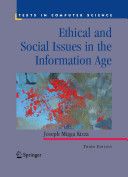
Ethical dilemmas have risen in number and intensity with the increasing dependence of contemporary society on computers and computer networks. Despite the proliferation of expert remedies, viable solutions to computer security issues remain too elusive, and society continues to suffer at the hands of cyber criminals, vandals, and hackers.This comprehensive third edition of the successful Ethical and Social Issues in the Information Age takes off where the second ended to examine ethical, social, and policy challenges stemming from the emergence of cyberspace, the convergence of telecommunication and computing technologies, and the miniaturalization of computing, telecommunication, and information-enabling devices. This accessible volume broadly surveys thought-provoking questions about the impact of these new technologies, with particular emphasis on the rapid growth of a multitude of computer networks, including the Internet. It assumes only a very modest familiarity with the basic computer literacy.Topics and features:• Describes how changes in information technology influence morality and the law• Provides fundamental discussion of network-security system design and operation to reveal vulnerable areas in computer network infrastructure (NEW chapter)• Surveys the history of computing and the evolution of computer crimes• Explores biometric techniques to system access control (NEW chapter)• Incorporates recent requirements for computer curricula• Introduces and explores techniques in electronic crime investigation (NEW chapter)• Assesses workplace concerns related to privacy, surveillance, and virtual offices• Offers a pertinent discussion on civil liberties, harassment, and discrimination• Contains chapter-ending exercises, and the author provides instructor classroom support materials and teaching guides at his websiteThis newly revised text/reference provides an updated discussion of the ethical and social issues that continue to evolve as computing and information technologies proliferate. Students at all levels who need to learn about computer ethics, the legal aspects of computing, network security, computer crime investigation, and biometrics will find this well documented work an invaluable resource. The book is also highly useful for practitioners needing such insights for their work.Supplementary material can be found at: www.utc.edu/faculty/Joseph-Kizza
ما از اخلاق چه انتظاری داریم؟ این سوال شاید تاحدودی برای عموم مردم و یا متخصصان این رشته قابل پاسخ باشد؛ اینکه خوب بودن را به ما بیاموزد و در تنظیم روابط فردی م...

جشن کتاب تهران به ایستگاه سی و یکم رسیده است. حال و احوال نشر کتاب خوب نیست و باید فرهنگدوستان را به خرید و هدیه دادن کتاب ترغیب نمود. خانه اخلاقپژوهان جوان ب...

بنیاد کتابهای اخلاق اسلامی عمدتا پالایش جان از آلودگیها و آراستن آن به زیباییها است. اندیشه محوری این قبیل کتابها آن است که انسان فعلی آنی نیست که باید باشد...

-
0 Comments