Notice: تابع WP_Block_Type_Registry::register به طورنادرست فراخوانی شد. نامهای نوع بلوک نباید حروف بزرگ داشته باشند. لطفاً برای اطلاعات بیشتر، اشکال زدایی در وردپرس را مشاهده کنید. (این پیام در نگارش 5.0.0 افزوده شده است.) in /home/ethicsho/public_html/wp-includes/functions.php on line 5313
Warning: Use of undefined constant TDC_PATH_LEGACY - assumed 'TDC_PATH_LEGACY' (this will throw an Error in a future version of PHP) in /home/ethicsho/public_html/wp-content/plugins/td-composer/td-composer.php on line 109
Warning: Use of undefined constant TDSP_THEME_PATH - assumed 'TDSP_THEME_PATH' (this will throw an Error in a future version of PHP) in /home/ethicsho/public_html/wp-content/plugins/td-composer/td-composer.php on line 113 بایگانیهای R726.8 .E5335 2008 - خانه اخلاق پژوهان جوان Notice: Trying to access array offset on value of type bool in /home/ethicsho/public_html/wp-content/plugins/wp-ulike/inc/general-functions.php on line 807
How can higher education today create a community of critical thinkers and searchers for truth that transcends the boundaries of class, gender, and nation? Martha C. Nussbaum, philosopher and classicist, argues that contemporary curricular reform is already producing such “citizens of the world” in its advocacy of diverse forms of cross-cultural studies. Her vigorous defense of “the new education” is rooted in Seneca’s ideal of the citizen who scrutinizes tradition critically and who respects the ability to reason wherever it is found–in rich or poor, native or foreigner, female or male.Drawing on Socrates and the Stoics, Nussbaum establishes three core values of liberal education–critical self-examination, the ideal of the world citizen, and the development of the narrative imagination. Then, taking us into classrooms and campuses across the nation, including prominent research universities, small independent colleges, and religious institutions, she shows how these values are (and in some instances are not) being embodied in particular courses. She defends such burgeoning subject areas as gender, minority, and gay studies against charges of moral relativism and low standards, and underscores their dynamic and fundamental contribution to critical reasoning and world citizenship.For Nussbaum, liberal education is alive and well on American campuses in the late twentieth century. It is not only viable, promising, and constructive, but it is essential to a democratic society. Taking up the challenge of conservative critics of academe, she argues persuasively that sustained reform in the aim and content of liberal education is the most vital and invigorating force in higher education today.
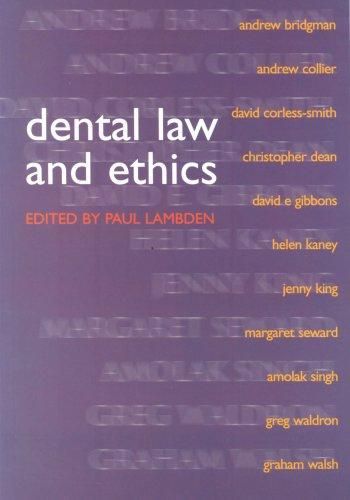
Invaluable book for practitioners and students alike. Readable and authoritative, subjects range from confidentiality, consent, mental disabilities and negligence, and the practical aspects of managing complaints and claims. Where differences occur, as in Scotland, these are fully explained. Developments in revalidation and continuing professional education make this a timely publication which should be readily available to every dentist and dental student. It provides clear and comprehensive guidance on key legal and ethical issues, and emphasises the standards which are now expected by patients and the profession.
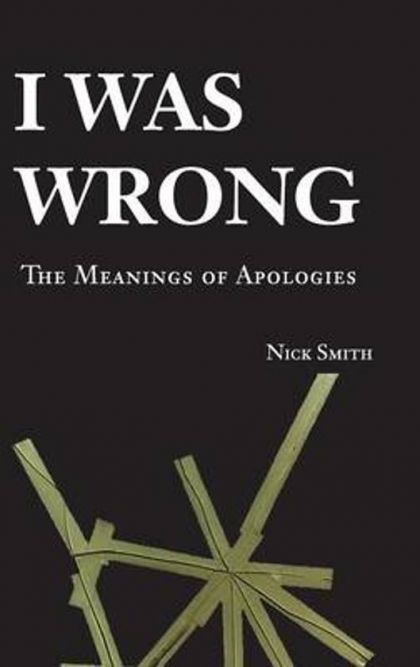
Apologies pervade our news headlines and our private affairs, but how should we evaluate these often vague and deceptive rituals? Discussing numerous examples from ancient and recent history, I Was Wrong: On The Meanings of Apologies argues that we suffer from considerable confusion about the moral meanings and social functions of these complex interactions. Rather than asking whether a speech act “is or is not” an apology, Smith offers a nuanced theory of apologetic meaning. Smith leads us with a clear voice though a series of rich philosophical and interdisciplinary questions, arguing that apologies have evolved from a confluence of diverse cultural and religious practices that do not translate easily into pluralistic secular discourse. After describing several varieties of apologies between individuals, Smith turns to collectives. Although apologies from corporations, governments, and other groups can be profoundly significant, Smith guides readers to appreciate the kinds of meaning that collective apologies often do not convey and warns of the dangers of collective acts of contrition that allow individual wrongdoers to obscure their personal blame. Dr. Smith is an assistant professor of philosophy at the University of New Hampshire. A graduate of Vassar College, he earned a law degree from SUNY at Buffalo and a Ph.D. in philosophy from Vanderbilt University. Before coming to UNH, he worked as a litigator for LeBoeuf, Lamb, Greene, and MacRae and as a judicial clerk for the Honorable R.L. Nygaard of the United States Court of Appeals for the Third Circuit. He specializes in the philosophy of Law, Politics, and Society and he writes on and teaches aesthetics. He is working with Cambridge University Press on the sequel to I Was Wrong, applying his framework for apologetic meanings to examples in criminal and civil law. His writings have appeared in journals such as Continental Philosophy Review, Social Theory and Practice, The Journal of Social Philosophy, Culture, Theory & Critique, The Rutgers Law Journal, and The Buffalo Law Review.
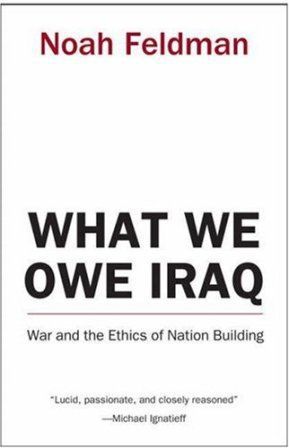
What do we owe Iraq? America is up to its neck in nation building–but the public debate, focused on getting the troops home, devotes little attention to why we are building a new Iraqi nation, what success would look like, or what principles should guide us.What We Owe Iraqsets out to shift the terms of the debate, acknowledging that we are nation building to protect ourselves while demanding that we put the interests of the people being governed–whether in Iraq, Afghanistan, Kosovo, or elsewhere–ahead of our own when we exercise power over them. Noah Feldman argues that to prevent nation building from turning into a paternalistic, colonialist charade, we urgently need a new, humbler approach. Nation builders should focus on providing security, without arrogantly claiming any special expertise in how successful nation-states should be made. Drawing on his personal experiences in Iraq as a constitutional adviser, Feldman offers enduring insights into the power dynamics between the American occupiers and the Iraqis, and tackles issues such as Iraqi elections, the prospect of successful democratization, and the way home. Elections do not end the occupier’s responsibility. Unless asked to leave, we must resist the temptation of a military pullout before a legitimately elected government can maintain order and govern effectively. But elections that create a legitimate democracy are also the only way a nation builder can put itself out of business and–eventually–send its troops home. Feldman’s new afterword brings the Iraq story up-to-date since the book’s original publication in 2004, and asks whether the United States has acted ethically in pushing the political process in Iraq while failing to control the security situation; it also revisits the question of when, and how, to withdraw.
ما از اخلاق چه انتظاری داریم؟ این سوال شاید تاحدودی برای عموم مردم و یا متخصصان این رشته قابل پاسخ باشد؛ اینکه خوب بودن را به ما بیاموزد و در تنظیم روابط فردی م...

جشن کتاب تهران به ایستگاه سی و یکم رسیده است. حال و احوال نشر کتاب خوب نیست و باید فرهنگدوستان را به خرید و هدیه دادن کتاب ترغیب نمود. خانه اخلاقپژوهان جوان ب...

بنیاد کتابهای اخلاق اسلامی عمدتا پالایش جان از آلودگیها و آراستن آن به زیباییها است. اندیشه محوری این قبیل کتابها آن است که انسان فعلی آنی نیست که باید باشد...

-
0 Comments