Notice: تابع WP_Block_Type_Registry::register به طورنادرست فراخوانی شد. نامهای نوع بلوک نباید حروف بزرگ داشته باشند. لطفاً برای اطلاعات بیشتر، اشکال زدایی در وردپرس را مشاهده کنید. (این پیام در نگارش 5.0.0 افزوده شده است.) in /home/ethicsho/public_html/wp-includes/functions.php on line 5313
Warning: Use of undefined constant TDC_PATH_LEGACY - assumed 'TDC_PATH_LEGACY' (this will throw an Error in a future version of PHP) in /home/ethicsho/public_html/wp-content/plugins/td-composer/td-composer.php on line 109
Warning: Use of undefined constant TDSP_THEME_PATH - assumed 'TDSP_THEME_PATH' (this will throw an Error in a future version of PHP) in /home/ethicsho/public_html/wp-content/plugins/td-composer/td-composer.php on line 113 بایگانیهای R724 .S97 1977 - خانه اخلاق پژوهان جوان Notice: Trying to access array offset on value of type bool in /home/ethicsho/public_html/wp-content/plugins/wp-ulike/inc/general-functions.php on line 807
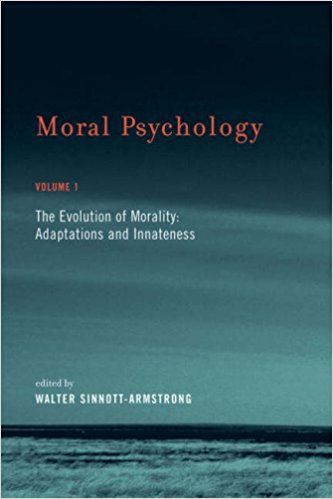
For much of the twentieth century, philosophy and science went their separate ways. In moral philosophy, fear of the so-called naturalistic fallacy kept moral philosophers from incorporating developments in biology and psychology. Since the 1990s, however, many philosophers have drawn on recent advances in cognitive psychology, brain science, and evolutionary psychology to inform their work. This collaborative trend is especially strong in moral philosophy, and these three volumes bring together some of the most innovative work by both philosophers and psychologists in this emerging interdisciplinary field.Contributors to Volume 1:William Casebeer (Air Force Academy), Leda Cosmides (University of California, Santa Barbara), Oliver Curry (London School of Economics), Michael Dietrich (Dartmouth College), Catherine Driscoll (North Carolina State University), Susan Dwyer (University of Maryland, Baltimore County), Owen Flanagan (Duke University), Gilbert Harman (Princeton University), Richard Joyce (Australian National University Research School of Social Science), Debra Lieberman (University of Hawaii), Ron Mallon (University of Utah), John Mikhail (Georgetown Law School), Geoffrey Miller (University of New Mexico), Jesse Prinz (University of North Carolina at Chapel Hill), Peter Railton (University of Michigan), Michael Ruse (Florida State University) Hagop Sarkissian (Duke University), Walter Sinnott-Armstrong (Dartmouth College), Chandra Sekhar Sripada (University of Michigan) Valerie Tiberius (University of Minnesota), John Tooby (University of California, Santa Barbara), Peter Tse (Dartmouth College) Kathleen Wallace (Hofstra University), Arthur Wolf (Stanford University), David Wong (Duke University).
This book is the first comprehensive study of Rousseau’s rich and complex theory of the type of self-love (amour propre ) that, for him, marks the central difference between humans and the beasts. Amour propre is the passion that drives human individuals to seek the esteem, approval, admiration, or love–the recognition –of their fellow beings. Neuhouser reconstructs Rousseau’s understanding of what the drive for recognition is, why it is so problematic, and how its presence opens up far-reaching developmental possibilities for creatures that possess it. One of Rousseau’s central theses is that amour propre in its corrupted, manifestations–pride or vanity–is the principal source of an array of evils so widespread that they can easily appear to be necessary features of the human condition: enslavement, conflict, vice, misery, and self-estrangement. Yet Rousseau also argues that solving these problems depends not on suppressing or overcoming the drive for recognition but on cultivating it so that it contributes positively to the achievement of freedom, peace, virtue, happiness, and unalienated selfhood. Indeed, Rousseau goes so far as to claim that, despite its many dangers, the need for recognition is a condition of nearly everything that makes human life valuable and that elevates it above mere animal existence: rationality, morality, freedom–subjectivity itself–would be impossible for humans if it were not for amour propre and the relations to others it impels us to establish.
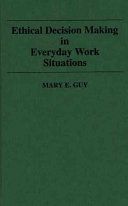
This book takes a new approach to ethics by focusing on the kinds of dilemmas that confront people almost daily on the job. The author’s unique contribution is to meld philosophy with everyday decisionmaking, offering the reader a common sense approach to making ethical decisions. Mary Guy introduces ten core values which surround ethical dilemmas, demonstrating the way in which personnel can sensitize themselves to the values involved in a problem and reach a solution which maximizes the important values. Real-life case examples illustrate ethical dilemmas that involve personnel practices, organizing strategies, reporting functions, supervisory practices, whistleblowing, and more. Throughout, the author emphasizes the kinds of concerns which confront the vast majority of employees–from ambitious entry-level personnel to top executives. Realistic in tone, the discussion acknowledges the inevitable need to make compromises, showing how to optimize ethical values situations that arise on the job and for which no formal rules exist. In her introductory chapter, Guy defines ethics, clarifies the relationship between ethical behavior and morality, and presents the ten guiding values that serve as the foundation for ethical decisions. Turning to a focus on decisionmaking, she explores such issues as the theoretical framework for rational decisionmaking, rational decisionmaking in real life, the application of ethical analysis to decisionmaking, and the definition of ethical decisionmaking. The four subsequent chapters present case studies of problems that personnel commonly encounter. In each case, Guy examines the ethical issues involved, applies various scenarios for reaching an ethical decision, and demonstrates the tension that exists among ethical decisionmaking, coping with daily exigencies, and accommodating the preferences of stakeholders. The concluding chapter summarizes the relationship between ethics and decisionmaking and offers a prescription for ensuring ethical decisionmaking throughout the organization. Must reading for managers in business, government, and not-for-profit organizations, this book is also an excellent supplemental text for advanced undergraduate and graduate level courses in business and public administration.
ما از اخلاق چه انتظاری داریم؟ این سوال شاید تاحدودی برای عموم مردم و یا متخصصان این رشته قابل پاسخ باشد؛ اینکه خوب بودن را به ما بیاموزد و در تنظیم روابط فردی م...

جشن کتاب تهران به ایستگاه سی و یکم رسیده است. حال و احوال نشر کتاب خوب نیست و باید فرهنگدوستان را به خرید و هدیه دادن کتاب ترغیب نمود. خانه اخلاقپژوهان جوان ب...

بنیاد کتابهای اخلاق اسلامی عمدتا پالایش جان از آلودگیها و آراستن آن به زیباییها است. اندیشه محوری این قبیل کتابها آن است که انسان فعلی آنی نیست که باید باشد...

-
0 Comments