Notice: تابع WP_Block_Type_Registry::register به طورنادرست فراخوانی شد. نامهای نوع بلوک نباید حروف بزرگ داشته باشند. لطفاً برای اطلاعات بیشتر، اشکال زدایی در وردپرس را مشاهده کنید. (این پیام در نگارش 5.0.0 افزوده شده است.) in /home/ethicsho/public_html/wp-includes/functions.php on line 5313
Warning: Use of undefined constant TDC_PATH_LEGACY - assumed 'TDC_PATH_LEGACY' (this will throw an Error in a future version of PHP) in /home/ethicsho/public_html/wp-content/plugins/td-composer/td-composer.php on line 109
Warning: Use of undefined constant TDSP_THEME_PATH - assumed 'TDSP_THEME_PATH' (this will throw an Error in a future version of PHP) in /home/ethicsho/public_html/wp-content/plugins/td-composer/td-composer.php on line 113 بایگانیهای PS1310 .A1 1996 - خانه اخلاق پژوهان جوان Notice: Trying to access array offset on value of type bool in /home/ethicsho/public_html/wp-content/plugins/wp-ulike/inc/general-functions.php on line 807
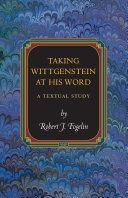
Taking Wittgenstein at His Word is an experiment in reading organized around a central question: What kind of interpretation of Wittgenstein’s later philosophy emerges if we adhere strictly to his claims that he is not in the business of presenting and defending philosophical theses and that his only aim is to expose persistent conceptual misunderstandings that lead to deep philosophical perplexities? Robert Fogelin draws out the therapeutic aspects of Wittgenstein’s later work by closely examining his account of rule-following and how he applies the idea in the philosophy of mathematics.The first of the book’s two parts focuses on rule-following, Wittgenstein’s “paradox of interpretation,” and his naturalistic response to this paradox, all of which are persistent and crucial features of his later philosophy. Fogelin offers a corrective to the frequent misunderstanding that the paradox of interpretation is a paradox about meaning, and he emphasizes the importance of Wittgenstein’s often undervalued appeals to natural responses. The second half of the book examines how Wittgenstein applies his reflections on rule-following to the status of mathematical propositions, proofs, and objects, leading to remarkable, demystifying results.Taking Wittgenstein at His Word shows that what Wittgenstein claims to be doing and what he actually does are much closer than is often recognized. In doing so, the book underscores fundamental–but frequently underappreciated–insights about Wittgenstein’s later philosophy.
Film & Ethics considers a range of films and texts of film criticism alongside disparate philosophical discourses of ethics by Levinas, Derrida, Foucault, Lacanian psychoanalysts and postmodern theorists. While an ethics of looking is implicitly posited in most strands of cinema theory, there is no established body of work that might be called ethical film criticism. This book, therefore, redresses the reluctance of many existing works to address cinema from an explicitly ethical perspective. Readings range across popular Hollywood films such as Thelma and Louise, Alfred Hitchcock’s canonical corpus, and films from European and World cinemas, including Dreyer’s The Passion of Joan of Arc and the little-known African film Bamako. The book engages with debates concerning censorship and pornography; the ethical implications of ‘positive representation’; the ethics of making and viewing images of atrocity and suffering; and the relationship between ethics and aesthetics. Lisa Downing and Libby Saxton re-invigorate debates in film studies by foregrounding the ethical dimensions of the moving image, and create dialogues between ostensibly incompatible philosophical and political trends of thought, without seeking to reconcile their differences.
Kok-Chor Tan argues that the cosmopolitan idea of global justice may be understood in such a way that it can accept nationalist and patriotic commitments. Tan believes that cosmopolitan justice need not deny the worth of the ordinary non-impartial values even as it defends a vision of global egalitarianism. Properly understood, it can set the limits for nationalist and patriotic efforts without denying the moral independence of these partial pursuits.
John Rawls is the preeminent political philosopher of our time. His 1971 masterpiece, A Theory of Justice, permanently changed the landscape of moral political theory, revitalizing the normative study of social issues and taking stands about justice, ethics, rationality and philosophical method that continue to draw followers and critics today.In these five volumes, Henry S. Richardson and Paul Weithman draw together almost 90 of the most incisive and influential articles in that body of literature. The reprinted articles, many of them drawn from difficult-to-find sources, cover the gamut of controversies and conversations sparked by Rawls’s work and represent a wide range of philosophical points of view. The selection also includes articles that reflect Rawls’s reception in economics, law, and the social science more broadly.The publication of these five volumes will be welcomed by students and scholars of contemporary political philosophy, and by anyone interested in the most probing reactions to the premier political philosopher of our time.
ما از اخلاق چه انتظاری داریم؟ این سوال شاید تاحدودی برای عموم مردم و یا متخصصان این رشته قابل پاسخ باشد؛ اینکه خوب بودن را به ما بیاموزد و در تنظیم روابط فردی م...

جشن کتاب تهران به ایستگاه سی و یکم رسیده است. حال و احوال نشر کتاب خوب نیست و باید فرهنگدوستان را به خرید و هدیه دادن کتاب ترغیب نمود. خانه اخلاقپژوهان جوان ب...

بنیاد کتابهای اخلاق اسلامی عمدتا پالایش جان از آلودگیها و آراستن آن به زیباییها است. اندیشه محوری این قبیل کتابها آن است که انسان فعلی آنی نیست که باید باشد...

-
0 Comments