Notice: تابع WP_Block_Type_Registry::register به طورنادرست فراخوانی شد. نامهای نوع بلوک نباید حروف بزرگ داشته باشند. لطفاً برای اطلاعات بیشتر، اشکال زدایی در وردپرس را مشاهده کنید. (این پیام در نگارش 5.0.0 افزوده شده است.) in /home/ethicsho/public_html/wp-includes/functions.php on line 5313
Warning: Use of undefined constant TDC_PATH_LEGACY - assumed 'TDC_PATH_LEGACY' (this will throw an Error in a future version of PHP) in /home/ethicsho/public_html/wp-content/plugins/td-composer/td-composer.php on line 109
Warning: Use of undefined constant TDSP_THEME_PATH - assumed 'TDSP_THEME_PATH' (this will throw an Error in a future version of PHP) in /home/ethicsho/public_html/wp-content/plugins/td-composer/td-composer.php on line 113 بایگانیهای PR3001 .L69 1998 - خانه اخلاق پژوهان جوان Notice: Trying to access array offset on value of type bool in /home/ethicsho/public_html/wp-content/plugins/wp-ulike/inc/general-functions.php on line 807
Don Browning’s important work critically appropriates the distinctive insights of religious ethics and contemporary psychology to inform and reform both. Here he elaborates the moral context for pastoral care by formulating five levels of practical moral thinking, illustrates them in two case studies involving homosexuality, and integrates the levels into a method of theological practice. It is a helpful but not dominating ethical framework for pastoral care and counseling useful to students, pastors, and congregations alike. “Browning, in this book, continues efforts to teach religious ethics to those working as counselors…. It presents a clear argument and method for laying practical and workable foundations of religious ethics in pastoral work.” -Clergy Journal “[Browning] points out that much of our pastoral care is undergirded by unexamined or only partially examined moral and ethical thinking…. In our efforts to avoid moralism, we have moved more and more toward a stance of ethical neutrality which has done a disservice to the people who look to us for help. Pastoral care and counseling need to be grounded in a practical moral theology or theological ethics.” -Christian Century “Browning provides ample resources for pastors to begin a discipline of critical moral reflection, especially in their role as counselors…. His borrowings from moral philosophers and theological ethics are explicated in the context of case studies and should prove helpful for anyone engaged in the practice of ministry.” -Religious Studies Review Don S. Browning is Alexander Campbell Professor Emeritus of Ethics and the Social Sciences, Divinity School, University of Chicago. His work at the intersection of theological ethics and social sciences has led to such pioneering and influential works as Religious Thought and the Modern Psychologies and A Fundamental Practical Theology.
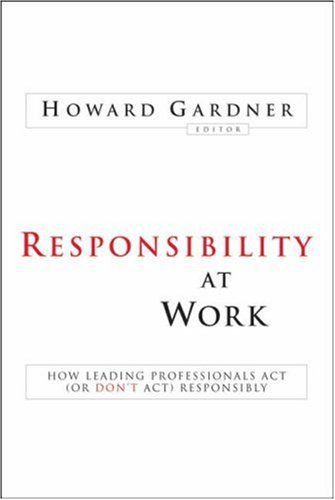
Responsibilityat WorkMost persons strive to produce work that is of excellent technical quality, is pursued in an ethical and socially responsible way, and has the qualities of being engaging and meaningful. How can we attain this ideal of good work in a world that changes so rapidly and all too often features an ethically compromised milieu? Filled with original essays by Howard Gardner, William Damon, Mihaly Csikszentmihalyi, and Jeanne Nakamura and based on a large-scale research project, the GoodWork(R) Project, Responsibility at Work reflects the information gleaned from in-depth interviews with more than 1,200 people from nine different professions–journalism, genetics, theatre, higher education, philanthropy, law, medicine, business, and precollegiate education. The book reveals how motivation, culture, and professional norms can intersect to produce work that is personally, socially, and economically beneficial.?At the heart of the study is the revelation that the key to good work is responsibilty–taking ownership for one’s work and its wider impact.The authors examine how responsibility for work is shaped by both personal and professional components and explore the factors that cause a sense of responsibility, the obstacles that lead to compromised work, and the educational interventions that can lead to a greater sense of responsibility. Most important, this volume provides strategies for cultivating greater responsibility in both seasoned workers as well as the young people who will one day enter the workplace.?
The dominance of nationalism as ideology and the resurgence of nationalist and ethnic conflict since the end of the Cold War, demands further analysis of the complex interplay between nation, state, sovereignty and self determination. Placing the phenomenon of nationalism squarely within the continuing modernist project, contrary to many commentators who regard nationalism today merely as an atavistic counter-modernist experience, Bradshaw brings together political theory, history, cultural studies and international relations in order to investigate both the appeal and the dangers of nationalism in contemporary world politics.
The ethics of literature, formalists have insisted, resides in the moral quality of a character, a story, perhaps the relation between author and reader. But in the wake of deconstruction and various forms of criticism focusing on difference, the ethical question has been freshly negotiated by literary studies, and to this approach Adam Newton brings a startling new thrust. His book makes a compelling case for understanding narrative as ethics. Assuming an intrinsic and necessary connection between the two, Newton explores the ethical consequences of telling stories and fictionalizing character, and the reciprocal claims binding teller, listener, witness, and reader in the process. He treats these relations as defining properties of prose fiction, of particular import in nineteenth- and twentieth-century texts.Newton’s fresh and nuanced readings cover a wide range of authors and periods, from Charles Dickens to Kazuo Ishiguro and Julian Barnes, from Herman Melville to Richard Wright, from Joseph Conrad and Henry James to Sherwood Anderson and Stephen Crane. An original work of theory as well as a deft critical performance, Narrative Ethics also stakes a claim for itself as moral inquiry. To that end, Newton braids together the ethical-philosophical projects of Emmanuel Levinas, Stanley Cavell, and Mikhail Bakhtin as a kind of chorus for his textual analyses–an elegant bridge between philosophy’s ear and literary criticism’s voice. His work will generate enormous interest among scholars and students of English and American literature, as well as specialists in narrative and literary theory, hermeneutics, and contemporary philosophy.
ما از اخلاق چه انتظاری داریم؟ این سوال شاید تاحدودی برای عموم مردم و یا متخصصان این رشته قابل پاسخ باشد؛ اینکه خوب بودن را به ما بیاموزد و در تنظیم روابط فردی م...

جشن کتاب تهران به ایستگاه سی و یکم رسیده است. حال و احوال نشر کتاب خوب نیست و باید فرهنگدوستان را به خرید و هدیه دادن کتاب ترغیب نمود. خانه اخلاقپژوهان جوان ب...

بنیاد کتابهای اخلاق اسلامی عمدتا پالایش جان از آلودگیها و آراستن آن به زیباییها است. اندیشه محوری این قبیل کتابها آن است که انسان فعلی آنی نیست که باید باشد...

-
0 Comments