Notice: تابع WP_Block_Type_Registry::register به طورنادرست فراخوانی شد. نامهای نوع بلوک نباید حروف بزرگ داشته باشند. لطفاً برای اطلاعات بیشتر، اشکال زدایی در وردپرس را مشاهده کنید. (این پیام در نگارش 5.0.0 افزوده شده است.) in /home/ethicsho/public_html/wp-includes/functions.php on line 5313
Warning: Use of undefined constant TDC_PATH_LEGACY - assumed 'TDC_PATH_LEGACY' (this will throw an Error in a future version of PHP) in /home/ethicsho/public_html/wp-content/plugins/td-composer/td-composer.php on line 109
Warning: Use of undefined constant TDSP_THEME_PATH - assumed 'TDSP_THEME_PATH' (this will throw an Error in a future version of PHP) in /home/ethicsho/public_html/wp-content/plugins/td-composer/td-composer.php on line 113 بایگانیهای K3239.3 .R67 1997 - خانه اخلاق پژوهان جوان Notice: Trying to access array offset on value of type bool in /home/ethicsho/public_html/wp-content/plugins/wp-ulike/inc/general-functions.php on line 807
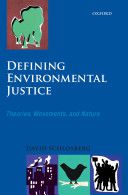
The basic task of this book is to explore what, exactly, is meant by ‘justice’ in definitions of environmental and ecological justice. It examines how the term is used in both self-described environmental justice movements and in theories of environmental and ecological justice. The central argument is that a theory and practice of environmental justice necessarily includes distributive conceptions of justice, but must also embrace notions of justice based in recognition, capabilities, and participation. Throughout, the goal is the development of a broad, multi-faceted, yet integrated notion of justice that can be applied to both relations regarding environmental risks in human populations and relations between human communities and non-human nature.
Although much human action serves as proof that irrational behavior is remarkably common, certain forms of irrationality–most notably, incontinent action and self-deception–pose such difficult theoretical problems that philosophers have rejected them as logically or psychologically impossible. Here, Mele shows that, and how, incontinent action and self-deception are indeed possible. Drawing upon recent experimental work in the psychology of action and inference, he advances naturalized explanations of akratic action and self-deception while resolving the paradoxes around which the philosophical literature revolves. In addition, he defends an account of self-control, argues that “strict” akratic action is an insurmountable obstacle for traditional belief-desire models of action-explanation, and explains how a considerably modified model accommodates action of this sort.
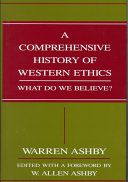
Our intellectual history spans more than 2,000 years, yet, surprisingly, we have had no adequate history of Western ethics. A Comprehensive History of Western Ethics fills this void by providing an engaging, thorough, and inclusive history that encompasses both classical and modern perspectives. Author Warren Ashby speaks both to students of history and ethics and to a needy public interested in but often perplexed by moral values in contemporary life — people who are looking for clearer personal and social bearings on what it means to be a person in today’s society. Ashby embraces all who are concerned with expanding human rights, finding new ways to think about moral experience, and discovering an ethical perspective appropriate for their lives. By exploring past ethical problems, we can prepare for the future’s challenges.Included with the commentary on the writings of great thinkers, are in-depth discussions of Greek, biblical, and Stoic ethics; Augustine, Aquinas, and medieval views; the Renaissance, the Reformation, and ethics in the age of science; as well as the Enlightenment, Romanticism, and the last Western century.
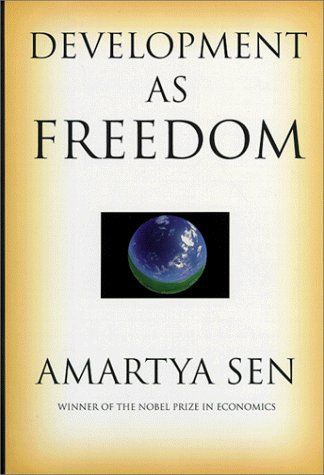
Development as Freedomis a general exposition of the economic ideas and analyses of Amartya Sen, winner of the 1998 Nobel Prize in Economic Science. This brilliant and indispensable treatise compellingly analyzes the nature of contemporary economic development from the perspective of human freedom. Freedom, Sen persuasively argues, is at once the ultimate goal of economic life and the most efficient means of realizing general welfare. It is a good to be enjoyed by the world’s entire population. Drawing on moral and political philosophy and technical economic analysis, this work gives the nonspecialist reader powerful access to Sen’s paradigm-altering vision and vividly shows how he, in the words of the Nobel Prize committee, has both “restored an ethical dimension to the discussion of economic problems” and “opened up new fields of study for subsequent generations of researchers.” To a world divided between those who fear the ruthlessness of the free market under prevailing conditions of global capitalism and those who fear the terror of authoritarian states that stifle indi- vidual liberty as well as initiative,Development as Freedompresents a necessary intellectual and moral framework of analysis and scrutiny. By rigorously addressing one of the largest questions of all–“What is the relation between our economic wealth and our ability to live as we would like?”–Sen allows economics once again, as it did in the time of Adam Smith, to address the social basis of individual well-being and freedom. He also confronts the human dilemma that “despite unprecedented increases in overall opulence, the contemporary world denies elementary freedoms to vast numbers–perhaps even the majority–of people.” This is a landmark work that shows how in individual human freedom–the exclusive possession, Sen shows, of no particular nation, region or historical, intellectual or religious tradition–lies the capacity for political participation, economic development and social progress.
ما از اخلاق چه انتظاری داریم؟ این سوال شاید تاحدودی برای عموم مردم و یا متخصصان این رشته قابل پاسخ باشد؛ اینکه خوب بودن را به ما بیاموزد و در تنظیم روابط فردی م...

جشن کتاب تهران به ایستگاه سی و یکم رسیده است. حال و احوال نشر کتاب خوب نیست و باید فرهنگدوستان را به خرید و هدیه دادن کتاب ترغیب نمود. خانه اخلاقپژوهان جوان ب...

بنیاد کتابهای اخلاق اسلامی عمدتا پالایش جان از آلودگیها و آراستن آن به زیباییها است. اندیشه محوری این قبیل کتابها آن است که انسان فعلی آنی نیست که باید باشد...

-
0 Comments