Notice: تابع WP_Block_Type_Registry::register به طورنادرست فراخوانی شد. نامهای نوع بلوک نباید حروف بزرگ داشته باشند. لطفاً برای اطلاعات بیشتر، اشکال زدایی در وردپرس را مشاهده کنید. (این پیام در نگارش 5.0.0 افزوده شده است.) in /home/ethicsho/public_html/wp-includes/functions.php on line 5313
Warning: Use of undefined constant TDC_PATH_LEGACY - assumed 'TDC_PATH_LEGACY' (this will throw an Error in a future version of PHP) in /home/ethicsho/public_html/wp-content/plugins/td-composer/td-composer.php on line 109
Warning: Use of undefined constant TDSP_THEME_PATH - assumed 'TDSP_THEME_PATH' (this will throw an Error in a future version of PHP) in /home/ethicsho/public_html/wp-content/plugins/td-composer/td-composer.php on line 113 بایگانیهای HQ728 .L75 1912 - خانه اخلاق پژوهان جوان Notice: Trying to access array offset on value of type bool in /home/ethicsho/public_html/wp-content/plugins/wp-ulike/inc/general-functions.php on line 807
Intellectual property (IP) is a crucial contributor to economic growth and competitiveness within the EU. This book offers a compact and accessible account of EU intellectual property law and policy, covering copyright, patents, designs, trademarks and the enforcement of rights. The author also addresses aspects of the free movement of goods and services, competition law, customs measures and anti-counterfeiting efforts. Setting EU intellectual property law in its wider international context, this work reveals the framework within which the national IP laws of member states operate. The book seeks to highlight the most important policy issues and arguments of relevance to the EU, both within the Union, and in its relations with the rest of the world. With its the detailed references, cross-referencing and suggestions for further readings, EU Intellectual Property Law and Policy is essential reading for postgraduate students and academic lawyers in IP and EU law. Practitioners seeking a broad account of the area will also appreciate this important contribution.
Russell Hardin presents a new explication of David Hume’s moral and political theory. With Hume, he holds that our normative views can be scientifically explained but they cannot be justified as true. Hume argued for the psychological basis of such views. In particular, he argued for sympathy as the mirroring of the psychological sensations and emotions of others. By placing Hume in the developing tradition of social science, as a strong forerunner of his younger friend Adam Smith, Hardin demonstrates Hume’s strong strategic sense, his nascent utilitarianism, his powerful theory of convention as a main source of social and political order, and his recognition of moral and political theory as a single enterprise.”Worthy of hearty recommendation.”–Lee Hardy, The Review of MetaphysicsRussell Hardin is Professor of Politics at New York University.Preface1. Hume’s Place in History2. Moral Psychology3. Strategic Analysis4. Convention5. Political Theory6. Justice As Order7. Utilitarianism8. Value Theory9. RetrospectiveReferencesEndnotes
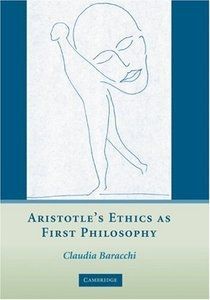
In Aristotle’s Ethics as First Philosophy, Claudia Baracchi demonstrates the indissoluble links between practical and theoretical wisdom in Aristotle’s thinking. Referring to a broad range of texts from the Aristotelian corpus, Baracchi shows how the theoretical is always informed by a set of practices, and, specifically, how one’s encounter with phenomena, the world, or nature in the broadest sense, is always a matter of ethos.
Canadian Intellectual Property Law and Strategy provides a comprehensive overview of the Canadian law relating to trademarks, copyright and industrial designs, along with strategic, practice-oriented commentary regarding how such laws can best be used for business advantage. The first part of the book is devoted to trademarks. The material in this section, in addition to providing an overview of Canadian trademark law, will deal with how a foreign trademark owner can use the system most advantageously. The initial focus will be on acquisition of rights-for example, an application can be filed in Canada based on foreign registration and use and a registration can be obtained without having to show any use of the trade mark in Canada-while latter sections will emphasize the best strategies to maintain and protect trademark rights in Canada. The second part of the book is devoted to copyright, with less emphasis on the specific industries-e.g., movie production-that typically rely on the copyright system than a broad, business-oriented treatment that reflects the potentially far-reaching impact of the law. (For example, copyright can subsist in a design trade mark if sufficiently original.) The approach will thus be of a general commercial nature, emphasizing how legislation can be used to protect rights in Canada, with specific attention paid to understanding which rights are available and the steps that should be taken to protect those rights, whether by means of the appropriate assignments and registrations, or on enforcement actions in the Canadian courts. The third part of the book focuses on industrial designs, and will explain what needs to be done and when by manufacturers to protect their products. The emphasis will initially be on understanding the system and the potential benefits available by obtaining registrations, with the rest of the section focusing on the steps required to protect and assert those rights against infringers.
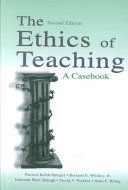
The Ethics of Teaching provides a frank discussion of the most frequently encountered ethical dilemmas that can arise in educational settings, as well as tips on how to avoid these predicaments and how to deal with them when they do occur. The goal is to stimulate discussion and raise faculties’ consciousness about ethical issues. Ethical dilemmas are presented as short, engaging case scenarios, most of which are based on actual situations, so as to furnish more realistic and interesting stimuli for individual reflection and group discussion. These scenarios offer the opportunity to consider the subtle complexities inherent in the social and psychological contexts in which educator-student interactions occur and the effects of those complexities on ethical decision making. Each case is followed by a detailed analysis and advice. The book’s 195 cases are grouped into 22 chapters representing topics, such as the controversial classroom presentations and assignments, debatable testing and grading practices, problematic student-faculty interactions, dual-role relationships with students, collegial conflicts, managing very difficult students, and confidentiality dilemmas. The Ethics of Teaching: A Casebook, Second Edition: *focuses on commonly encountered ethical “gray areas” that have no clear solution; *includes questions to stimulate discussion of related ethical issues; *concludes with a chapter on prevention, peer mentoring, and intervention; and *serves as excellent “assigned reading” to stimulate group discussion in teaching workshops and faculty development programs. The first edition of this book evolved by collecting a variety of teaching situations that commonly occur in college and university settings. The authors then created responses to the situations and circulated both the cases and the responses to reviewers from a number of departments across the country. As a result, the vast majority of the cases are “discipline free.” The second edition features many new cases to reflect recent trends and events related to academic ethics. Questions were added to stimulate discussion and to further elaborate the issues. The Ethics of Teaching: A Casebook is ideal for college and university faculty, graduate assistants, and administrators involved in workshops, graduate teaching assistant courses, and faculty development and new faculty orientation programs. As a result of the book’s cross-disciplinary development, it will be beneficial to faculty from a broad spectrum of disciplines.
ما از اخلاق چه انتظاری داریم؟ این سوال شاید تاحدودی برای عموم مردم و یا متخصصان این رشته قابل پاسخ باشد؛ اینکه خوب بودن را به ما بیاموزد و در تنظیم روابط فردی م...

جشن کتاب تهران به ایستگاه سی و یکم رسیده است. حال و احوال نشر کتاب خوب نیست و باید فرهنگدوستان را به خرید و هدیه دادن کتاب ترغیب نمود. خانه اخلاقپژوهان جوان ب...

بنیاد کتابهای اخلاق اسلامی عمدتا پالایش جان از آلودگیها و آراستن آن به زیباییها است. اندیشه محوری این قبیل کتابها آن است که انسان فعلی آنی نیست که باید باشد...

-
0 Comments