Notice: تابع WP_Block_Type_Registry::register به طورنادرست فراخوانی شد. نامهای نوع بلوک نباید حروف بزرگ داشته باشند. لطفاً برای اطلاعات بیشتر، اشکال زدایی در وردپرس را مشاهده کنید. (این پیام در نگارش 5.0.0 افزوده شده است.) in /home/ethicsho/public_html/wp-includes/functions.php on line 5313
Warning: Use of undefined constant TDC_PATH_LEGACY - assumed 'TDC_PATH_LEGACY' (this will throw an Error in a future version of PHP) in /home/ethicsho/public_html/wp-content/plugins/td-composer/td-composer.php on line 109
Warning: Use of undefined constant TDSP_THEME_PATH - assumed 'TDSP_THEME_PATH' (this will throw an Error in a future version of PHP) in /home/ethicsho/public_html/wp-content/plugins/td-composer/td-composer.php on line 113 بایگانیهای HM881 .E33 2010 - خانه اخلاق پژوهان جوان Notice: Trying to access array offset on value of type bool in /home/ethicsho/public_html/wp-content/plugins/wp-ulike/inc/general-functions.php on line 807
Ranging over central issues of morals and politics and the nature of freedom and authority, this study examines the role of value-neutrality, rights, equality, and the prevention of harm in the liberal tradition, and relates them to fundamental moral questions such as the relation of values to social forms, the comparability of values, and the significance of personal commitments.
We live our lives through our emotions, writes Robert Solomon, and it is our emotions that give our lives meaning. What interests or fascinates us, who we love, what angers us, what moves us, what bores us–all of this defines us, gives us character, constitutes who we are. In True to Our Feelings, Solomon illuminates the rich life of the emotions–why we don’t really understand them, what they really are, and how they make us human and give meaning to life. Emotions have recently become a highly fashionable area of research in the sciences, with brain imaging uncovering valuable clues as to how we experience our feelings. But while Solomon provides a guide to this cutting-edge research, as well as to what others–philosophers and psychologists–have said on the subject, he also emphasizes the personal and ethical character of our emotions. He shows that emotions are not something that happen to us, nor are they irrational in the literal sense–rather, they are judgements we make about the world, and they are strategies for living in it. Fear, anger, love, guilt, jealousy, compassion–they are all essential to our values, to living happily, healthily, and well. Solomon highlights some of the dramatic ways that emotions fit into our ethics and our sense of the good life, how we can make our emotional lives more coherent with our values and be more “true to our feelings” and cultivate emotional integrity. The story of our lives is the story of our passions. We fall in love, we are gripped by scientific curiosity and religious fervor, we fear death and grieve for others, we humble ourselves in envy, jealousy, and resentment. In this remarkable book, Robert Solomon shares his fascination with the emotions and illuminates our passions in an exciting new way.
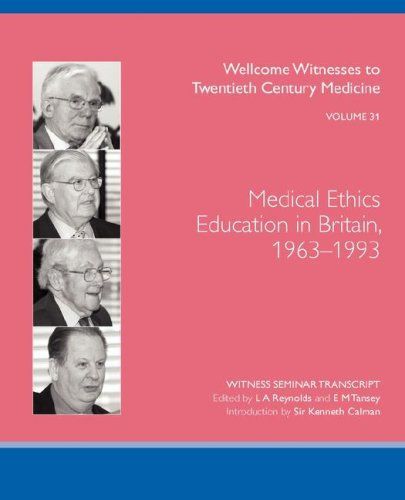
Changing attitudes toward human experimentation along with other controversial moral issues emerged after the Second World War and, in 1963, led to the establishment of the London Medical Group, organized by Ted Shotter, with similar Medical Groups elsewhere from 1967. These became forums for discussion and debate arising from dilemmas encountered in medical settings. Medical ethics did not become a recognized subject in the syllabus of Britain’s medical schools until 1993. This Witness Seminar transcript records the development of international ethical codes, the response to them over the period 1963-93 by students and doctors and the extent of resistance encountered from deans, hospital administrators and others; the Groups’ influence on medical practice; the impact on both Medical Group organizers and participants in their subsequent careers; the local and regional variations and their significant lasting contributions. The meeting was chaired by Dr Stephen Lock and included former Medical Group members, scientists, physicians and policy makers, such as Professors Kenneth Boyd, Bill Fulford, Roger Higgs, Sir Ian Kennedy, David Morton and Sir Malcolm Macnaughton. An introduction by Professor Sir Kenneth Calman and appendices of the Very Revd Edward Shotter’s reflections on the influence of the Medical Groups as a report for the Institute of Medical Ethics complete the transcript.
ما از اخلاق چه انتظاری داریم؟ این سوال شاید تاحدودی برای عموم مردم و یا متخصصان این رشته قابل پاسخ باشد؛ اینکه خوب بودن را به ما بیاموزد و در تنظیم روابط فردی م...

جشن کتاب تهران به ایستگاه سی و یکم رسیده است. حال و احوال نشر کتاب خوب نیست و باید فرهنگدوستان را به خرید و هدیه دادن کتاب ترغیب نمود. خانه اخلاقپژوهان جوان ب...

بنیاد کتابهای اخلاق اسلامی عمدتا پالایش جان از آلودگیها و آراستن آن به زیباییها است. اندیشه محوری این قبیل کتابها آن است که انسان فعلی آنی نیست که باید باشد...

-
0 Comments