Notice: تابع WP_Block_Type_Registry::register به طورنادرست فراخوانی شد. نامهای نوع بلوک نباید حروف بزرگ داشته باشند. لطفاً برای اطلاعات بیشتر، اشکال زدایی در وردپرس را مشاهده کنید. (این پیام در نگارش 5.0.0 افزوده شده است.) in /home/ethicsho/public_html/wp-includes/functions.php on line 5313
Warning: Use of undefined constant TDC_PATH_LEGACY - assumed 'TDC_PATH_LEGACY' (this will throw an Error in a future version of PHP) in /home/ethicsho/public_html/wp-content/plugins/td-composer/td-composer.php on line 109
Warning: Use of undefined constant TDSP_THEME_PATH - assumed 'TDSP_THEME_PATH' (this will throw an Error in a future version of PHP) in /home/ethicsho/public_html/wp-content/plugins/td-composer/td-composer.php on line 113 بایگانیهای HD31 .D377 2007 - خانه اخلاق پژوهان جوان Notice: Trying to access array offset on value of type bool in /home/ethicsho/public_html/wp-content/plugins/wp-ulike/inc/general-functions.php on line 807
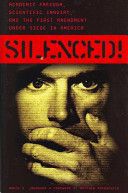
This book is about people whose beliefs and affiliations have opposed powerful interests in the present-day United States. This eclectic group of people and controversial issues, from climate-change scientists who have been censored by the Bush administration to Muslims accused of terrorism, have one thing in common. All of them straddle the limits of what Noam Chomsky has called permissible debate as defined by dominant political and economic institutions and individuals. The central thesis is that restriction of free inquiry is harmful to our culture because it inhibits the search for knowledge. Johansen presents case studies in the borderlands of free speech in a Jeffersonian cast-an intellectual framework assuming that open debate-even of unpopular ideas-is essential to accurate perception of reality. This book is about people whose ideological circumstances have found them opposing established beliefs in our times-scholars advocating the Palestinian cause in a very hostile intellectual environment, for example, as well as climate scientists defending themselves against the de-funding of their laboratories by defenders of fossil-fuel interests; opponents of creation science under assault for teaching what once was regarded as household-variety biology (a.k.a. Darwinism); Marxists in a political system dominated by neoconservatives. The central thesis that unites this diverse array of controversies is that shutting down free inquiry-most notably for points of view deemed unpopular-dumbs us all down by restraining the search for knowledge, which demands open inquiry. We have been told when going to war, as in Iraq, that freedom isn’t free, the unstated assumption being that our armed forces are fighting and dying to safeguard our civil rights at home and abroad. During recent years, however, freedom to inquire and debate without retribution has been under assault in the United States. This assault has been carried out under a distinctly Orwellian cast, under Newspeak titles such as the Patriot Act, parts of which might as well be described more honestly as the Restriction of Freedom of Inquiry Act. The information gathered here will interest (and probably anger) anyone who is concerned with protecting robust, free inquiry in a nation that takes seriously its freedom to speak out, and to define truth through open debate.
This accessible new book delivers in two key areas: first, a new way of thinking about copyright reform in countries which are engaged in the modernization of their copyright laws; and second, a new international approach to copyright regulation in the era of globalization. This volume draws specific attention to a number of special policy concerns which should inform post-socialist reform. These include the encouragement of creativity, innovation and entrepreneurship, the role of intellectual property in post-socialist modernization, the protection of cultural heritage and minority rights, and the close relationship between recognition of authors rights and the protection of fundamental human rights and freedoms. While these policy issues are generally important to intellectual property regulation, they are of special concern in the post-authoritarian context. This highly readable book will interest students and academics involved with copyright and intellectual property law and well astransitional studies.
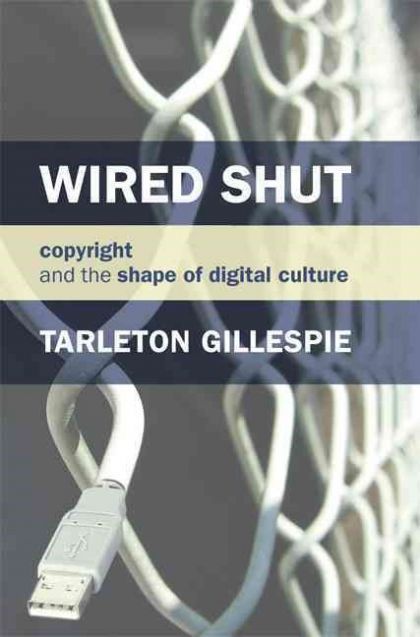
Winner, ICA 2009 Outstanding Book Award given by the International Communication Association. and Winner, 2009 CITASA Book Award given by the Communication and Information Technologies Section of the American Sociological AssociationWhile the public and the media have been distracted by the story of Napster, warnings about the evils of “piracy,” and lawsuits by the recording and film industries, the enforcement of copyright law in the digital world has quietly shifted from regulating copying to regulating the design of technology. Lawmakers and commercial interests are pursuing what might be called a technical fix: instead of specifying what can and cannot be done legally with a copyrighted work, this new approach calls for the strategic use of encryption technologies to build standards of copyright directly into digital devices so that some uses are possible and others rendered impossible. In Wired Shut, Tarleton Gillespie examines this shift to “technical copy protection” and its profound political, economic, and cultural implications.Gillespie reveals that the real story is not the technological controls themselves but the political, economic, and cultural arrangements being put in place to make them work. He shows that this approach to digital copyright depends on new kinds of alliances among content and technology industries, legislators, regulators, and the courts, and is changing the relationship between law and technology in the process. The film and music industries, he claims, are deploying copyright in order to funnel digital culture into increasingly commercial patterns that threaten to undermine the democratic potential of a network society.In this broad context, Gillespie examines three recent controversies over digital copyright: the failed effort to develop copy protection for portable music players with the Strategic Digital Music Initiative (SDMI); the encryption system used in DVDs, and the film industry’s legal response to the tools that challenged them; and the attempt by the FCC to mandate the “broadcast flag” copy protection system for digital television. In each, he argues that whether or not such technical constraints ever succeed, the political alignments required will profoundly shape the future of cultural expression in a digital age.
ما از اخلاق چه انتظاری داریم؟ این سوال شاید تاحدودی برای عموم مردم و یا متخصصان این رشته قابل پاسخ باشد؛ اینکه خوب بودن را به ما بیاموزد و در تنظیم روابط فردی م...

جشن کتاب تهران به ایستگاه سی و یکم رسیده است. حال و احوال نشر کتاب خوب نیست و باید فرهنگدوستان را به خرید و هدیه دادن کتاب ترغیب نمود. خانه اخلاقپژوهان جوان ب...

بنیاد کتابهای اخلاق اسلامی عمدتا پالایش جان از آلودگیها و آراستن آن به زیباییها است. اندیشه محوری این قبیل کتابها آن است که انسان فعلی آنی نیست که باید باشد...

-
0 Comments