Notice: تابع WP_Block_Type_Registry::register به طورنادرست فراخوانی شد. نامهای نوع بلوک نباید حروف بزرگ داشته باشند. لطفاً برای اطلاعات بیشتر، اشکال زدایی در وردپرس را مشاهده کنید. (این پیام در نگارش 5.0.0 افزوده شده است.) in /home/ethicsho/public_html/wp-includes/functions.php on line 5313
Warning: Use of undefined constant TDC_PATH_LEGACY - assumed 'TDC_PATH_LEGACY' (this will throw an Error in a future version of PHP) in /home/ethicsho/public_html/wp-content/plugins/td-composer/td-composer.php on line 109
Warning: Use of undefined constant TDSP_THEME_PATH - assumed 'TDSP_THEME_PATH' (this will throw an Error in a future version of PHP) in /home/ethicsho/public_html/wp-content/plugins/td-composer/td-composer.php on line 113 بایگانیهای BL1852 .V36 2007 - خانه اخلاق پژوهان جوان Notice: Trying to access array offset on value of type bool in /home/ethicsho/public_html/wp-content/plugins/wp-ulike/inc/general-functions.php on line 807
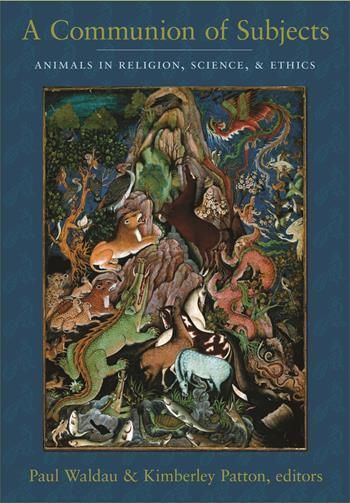
A Communion of Subjectsis the first comparative and interdisciplinary study of the conceptualization of animals in world religions. Scholars from a wide range of disciplines, including Thomas Berry (cultural history), Wendy Doniger (study of myth), Elizabeth Lawrence (veterinary medicine, ritual studies), Marc Bekoff (cognitive ethology), Marc Hauser (behavioral science), Steven Wise (animals and law), Peter Singer (animals and ethics), and Jane Goodall (primatology) consider how major religious traditions have incorporated animals into their belief systems, myths, rituals, and art. Their findings offer profound insights into humans’ relationships with animals and a deeper understanding of the social and ecological web in which we all live.Contributors examine Judaism, Christianity, Islam, Hinduism, Buddhism, Jainism, Daoism, Confucianism, African religions, traditions from ancient Egypt and early China, and Native American, indigenous Tibetan, and Australian Aboriginal traditions, among others. They explore issues such as animal consciousness, suffering, sacrifice, and stewardship in innovative methodological ways. They also address contemporary challenges relating to law, biotechnology, social justice, and the environment. By grappling with the nature and ideological features of various religious views, the contributors cast religious teachings and practices in a new light. They reveal how we either intentionally or inadvertently marginalize “others,” whether they are human or otherwise, reflecting on the ways in which we assign value to living beings.Though it is an ancient concern, the topic of “Religion and Animals” has yet to be systematically studied by modern scholars. This groundbreaking collection takes the first steps toward a meaningful analysis.
“In this fresh and comprehensive introduction to animal ethics, Lori Gruen weaves together poignant and provocative case studies with discussions of ethical theory, urging readers to engage critically and empathetically reflect on our treatment of other animals. In clear and accessible language, Gruen provides a survey of the issues central to human-animal relations and a reasoned new perspective on current key debates in the field. She analyses and explains a range of theoretical positions and poses challenging questions that directly encourage readers to hone their ethical reasoning skills and to develop a defensible position about their own practices. Her book will be an invaluable resource for students in a wide range of disciplines including ethics, environmental studies, veterinary science, women’s studies, and the emerging field of animal studies and is an engaging account of the subject for general readers with no prior background in philosophy”–
We remember the admonition of our mothers: “Treat others as you want them to treat you.” But what if being nice was something we were inclined by nature to do anyway? Renowned neuroscientist Donald Pfaff upends our entire understanding of ethics and social contracts with an intriguing proposition: the Golden Rule is hardwired into the human brain.Pfaff, the researcher who first discovered the connections between specific brain circuits and certain behaviors, contends that the basic ethics governing our everyday lives can be traced directly to brain circuitry. Writing with popular science journalist Sandra J. Ackerman, he explains in this clear and concise account how specific brain signals induce us to consider our actions as if they were directed at ourselves—and subsequently lead us to treat others as we wish to be treated. Brain hormones are a part of this complicated process, and The Neuroscience of Fair Play discusses how brain hormones can catalyze behaviors with moral implications in such areas as self-sacrifice, parental love, friendship, and violent aggression. Drawing on his own research and other recent studies in brain science, Pfaff offers a thought-provoking hypothesis for why certain ethical codes and ideas have remained constant across human societies and cultures throughout the world and over the centuries of history. An unprecedented and provocative investigation, The Neuroscience of Fair Play offers a new perspective on the increasingly important intersection of neuroscience and ethics.
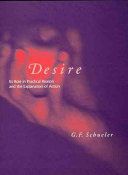
Does action always arise out of desire? G. F. Schueler examines this hotly debated topic in philosophy of action and moral philosophy, arguing that once two senses of “desire” are distinguished – roughly, genuine desires and pro attitudes – apparently plausible explanations of action in terms of the agent’s desires can be seen to be mistaken.Desire probes a fundamental issue in philosophy of mind, the nature of desires and how, if at all, they motivate and justify our actions. At least since Hume argued that reason “is and of right ought to be the slave of the passions,” many philosophers have held that desires play an essential role both in practical reason and in the explanation of intentional action. G. F. Schueler looks at contemporary accounts of both roles in various belief-desire models of reasons and explanation and argues that the usual belief-desire accounts need to be replaced.Schueler contends that the plausibility of the standard belief-desire accounts rests largely on a failure to distinguish “desires proper,” like a craving for sushi, from so-called “pro attitudes,” which may take the form of beliefs and other cognitive states as well as desires proper. Schueler’s “deliberative model” of practical reasoning suggests a different view of the place of desire in practical reason and the explanation of action. He holds that we can arrive at an intention to act by weighing the relevant considerations and that these may not include desires proper at all.A Bradford Book
ما از اخلاق چه انتظاری داریم؟ این سوال شاید تاحدودی برای عموم مردم و یا متخصصان این رشته قابل پاسخ باشد؛ اینکه خوب بودن را به ما بیاموزد و در تنظیم روابط فردی م...

جشن کتاب تهران به ایستگاه سی و یکم رسیده است. حال و احوال نشر کتاب خوب نیست و باید فرهنگدوستان را به خرید و هدیه دادن کتاب ترغیب نمود. خانه اخلاقپژوهان جوان ب...

بنیاد کتابهای اخلاق اسلامی عمدتا پالایش جان از آلودگیها و آراستن آن به زیباییها است. اندیشه محوری این قبیل کتابها آن است که انسان فعلی آنی نیست که باید باشد...

-
0 Comments