Notice: تابع WP_Block_Type_Registry::register به طورنادرست فراخوانی شد. نامهای نوع بلوک نباید حروف بزرگ داشته باشند. لطفاً برای اطلاعات بیشتر، اشکال زدایی در وردپرس را مشاهده کنید. (این پیام در نگارش 5.0.0 افزوده شده است.) in /home/ethicsho/public_html/wp-includes/functions.php on line 5313
Warning: Use of undefined constant TDC_PATH_LEGACY - assumed 'TDC_PATH_LEGACY' (this will throw an Error in a future version of PHP) in /home/ethicsho/public_html/wp-content/plugins/td-composer/td-composer.php on line 109
Warning: Use of undefined constant TDSP_THEME_PATH - assumed 'TDSP_THEME_PATH' (this will throw an Error in a future version of PHP) in /home/ethicsho/public_html/wp-content/plugins/td-composer/td-composer.php on line 113 بایگانیهای BJ1250 .G53 1984 - خانه اخلاق پژوهان جوان Notice: Trying to access array offset on value of type bool in /home/ethicsho/public_html/wp-content/plugins/wp-ulike/inc/general-functions.php on line 807
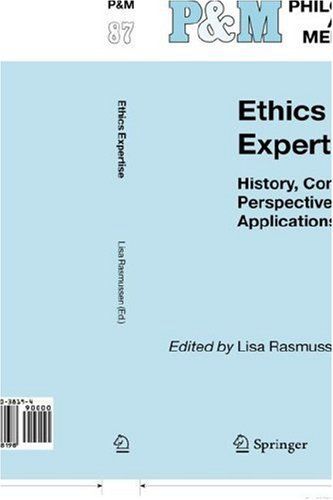
Section I examines historical philosophical understandings of expertise in order to situate the current institution of bioethics. Section II focuses on philosophical analyses of the concept of expertise, asking, among other things, how it should be understood, how it can be acquired, and what such expertise warrants. Finally, section III addresses topics in bioethics and how ethics expertise should or should not be brought to bear in these areas, including expertise in the court room, in the hospital room, in the media, and in making policy. 2. A GUIDED HISTORICAL TOUR As Scott LaBarge points out, Plato’s dialogues can be viewed as an extended treatment of the concept of moral expertise, so it is fitting to begin the volume with an examination of “Socrates and Moral Expertise”. Given Socrates’ protestations (the Oracle at Delphi notwithstanding) that he knows nothing, LaBarge observes that it would be interesting to determine both what a Socratic theory of moral expertise might be and whether Socrates qualified as such an expert. Plato’s model of moral expertise is what LaBarge calls “demonstrable expertise”, which is concerned mainly with the ability to attain a goal and to explain how one did it. The problem with this account is that when one tries to solve the various problems in the model – for example, allowing that moral expertise is not an all-or-nothing skill – then one is immediately faced with the “credentials problem”. As LaBarge puts it, “. . .
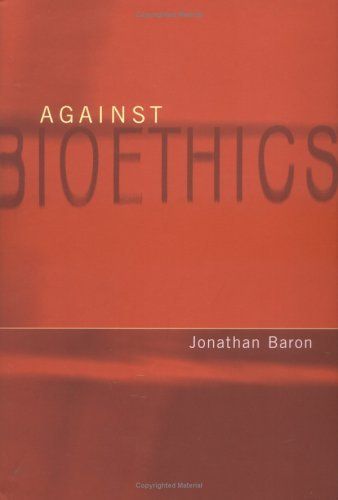
Governments, health professionals, patients, research institutions, and research subjects look to bioethicists for guidance in making important decisions about medical treatment and research. And yet, argues Jonathan Baron in Against Bioethics, applied bioethics lacks the authority of a coherent guiding theory and is based largely on intuitive judgments. Baron proposes an alternative, arguing that bioethics could have a coherent theory based on utilitarianism and decision analysis. Utilitarianism holds that the best option is the one that does the most expected good. Decision analysis provides a way of thinking about the risks and trade-offs of specific options. Like economics, utilitarian decision analysis makes predictions of expected good in complex situations, using data when possible, and focusing human judgment on the issues relevant to consequences. With such a guiding theory, bioethics would never yield decisions that clearly go against the expected good of those involved, as some do now. Baron discusses issues in bioethics that can be illuminated by such analysis, including “enhancements” to nature in the form of genetics, drugs, and mind control; reproduction; death and end-of-life issues, including advance directives, euthanasia, and organ donation; coercion and consent; conflict of interest and the reform of internal review boards; and drug research. Although Baron opposes current practice in bioethics, he argues that by combining utilitarianism and decision analysis, bioethics can achieve its aims of providing authoritative guidance in resolving thorny medical and ethical issues.
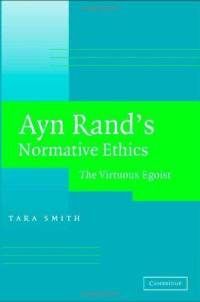
Ayn Rand is well known for advocating egoism, but the substance of that egoisms instruction is rarely understood. Far from representing the rejection of morality, selfishness, in Rands view, actually demands the practice of a systematic code of ethics. This book explains the fundamental virtues that Rand considers vital for a person to achieve his objective well-being: rationality, honesty, independence, justice, integrity, productiveness, and pride. Tara Smith examines what each of these virtues consists in, why it is a virtue, and what it demands of a person in practice.
This book explores questions regarding the justice of war and addresses the lack of comparative perspectives on the ethics of war, particularly with respect to Islam. Focusing on the role of Islamic symbols in the rhetoric of Saddam Hussein, Kelsay provides an overview of the Islamic tradition regarding war and peace, and investigates the notion of religion as a just cause for war.
ما از اخلاق چه انتظاری داریم؟ این سوال شاید تاحدودی برای عموم مردم و یا متخصصان این رشته قابل پاسخ باشد؛ اینکه خوب بودن را به ما بیاموزد و در تنظیم روابط فردی م...

جشن کتاب تهران به ایستگاه سی و یکم رسیده است. حال و احوال نشر کتاب خوب نیست و باید فرهنگدوستان را به خرید و هدیه دادن کتاب ترغیب نمود. خانه اخلاقپژوهان جوان ب...

بنیاد کتابهای اخلاق اسلامی عمدتا پالایش جان از آلودگیها و آراستن آن به زیباییها است. اندیشه محوری این قبیل کتابها آن است که انسان فعلی آنی نیست که باید باشد...

-
0 Comments