Notice: تابع WP_Block_Type_Registry::register به طورنادرست فراخوانی شد. نامهای نوع بلوک نباید حروف بزرگ داشته باشند. لطفاً برای اطلاعات بیشتر، اشکال زدایی در وردپرس را مشاهده کنید. (این پیام در نگارش 5.0.0 افزوده شده است.) in /home/ethicsho/public_html/wp-includes/functions.php on line 5313
Warning: Use of undefined constant TDC_PATH_LEGACY - assumed 'TDC_PATH_LEGACY' (this will throw an Error in a future version of PHP) in /home/ethicsho/public_html/wp-content/plugins/td-composer/td-composer.php on line 109
Warning: Use of undefined constant TDSP_THEME_PATH - assumed 'TDSP_THEME_PATH' (this will throw an Error in a future version of PHP) in /home/ethicsho/public_html/wp-content/plugins/td-composer/td-composer.php on line 113 بایگانیهای BJ1031 .K24 1993 - خانه اخلاق پژوهان جوان Notice: Trying to access array offset on value of type bool in /home/ethicsho/public_html/wp-content/plugins/wp-ulike/inc/general-functions.php on line 807
This revised edition of IEthics and StatecraftR has been reorganized to better situate chapters that play to one another thematically, on peacemaking, the ethics and statecraft of war, and the statecraft of major international reform, and two new chapters, on Theodore Roosevelt and the Vietnam War, respectively, have been added to this classic work. The contributions remain centrally concerned with moral reasoning about important decisions taken by key statesmen in times of war, peace, and transformation, arguing that national leaders-including realists-have always concerned themselves with normative constraints on power, both their own and that of others. This revised edition of IEthics and StatecraftR has been reorganized to better situate chapters that play to one another thematically, on peacemaking, the ethics and statecraft of war, and the statecraft of major international reform, and two new chapters, on Theodore Roosevelt and the Vietnam War, respectively, have been added to this classic work. The contributions remain centrally concerned with moral reasoning about important decisions taken by key statesmen in times of war, peace, and transformation, arguing that national leaders-including realists-have always concerned themselves with normative constraints on power, both their own and that of others. This book posits that the problems of ethics in international relations are always conditioned by uncertainty, actors’ inexact knowledge of real-world conditions, and morally ambiguous outcomes. Contrary to the course assumptions of much IR theory, individual leaders remain the major conduit by which ethical concerns are deployed or ignored in the foreign policy of states. To ignore moral norms, which already govern international relations, is to ignore a key dimension of the subject; such an oversight will necessarily lead to a shallow analysis and a basic misunderstanding of how and why states behave as they do.
Lisa Tessman’s Burdened Virtues is a deeply original and provocative work that engages questions central to feminist theory and practice, from the perspective of Aristotelian ethics. Focused primarily on selves who endure and resist oppression, she addresses the ways in which devastating conditions confronted by these selves both limit and burden their moral goodness, and affect their possibilities of flourishing. She describes two different forms of “moral trouble” prevalent under oppression. The first is that the oppressed self may be morally damaged, prevented from developing or exercising some of the virtues; the second is that the very conditions of oppression require the oppressed to develop a set of virtues that carry a moral cost to those who practice them–traits that Tessman refers to as “burdened virtues.” These virtues have the unusual feature of being disjoined from their bearer’s own well being. Tessman’s work focuses on issues that have been missed by many feminist moral theories, and her use of the virtue ethics framework brings feminist concerns more closely into contact with mainstream ethical theory. This book will appeal to feminist theorists in philosophy and women’s studies, but also more broadly, ethicists and social theorists.
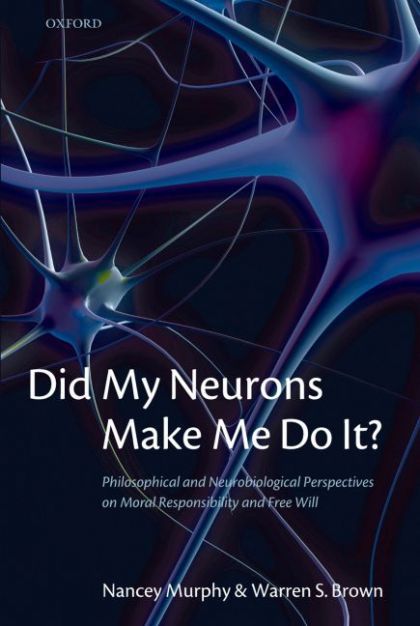
If humans are purely physical, and if it is the brain that does the work formerly assigned to the mind or soul, then how can it fail to be the case that all of our thoughts and actions are determined by the laws of neurobiology? If this is the case, then free will, moral responsibility, and, indeed, reason itself would appear to be in jeopardy. Nancey Murphy and Warren S. Brown here defend a non-reductive version of physicalism whereby humans are (sometimes) the authors of their own thoughts and actions. Did My Neurons Make Me Do It? brings together insights from both philosophy and the cognitive neurosciences to defeat neurobiological reductionism. One resource is a “post-Cartesian” account of mind as essentially embodied and constituted by action-feedback-evaluation-action loops in the environment, and “scaffolded” by cultural resources. Another is a non-mysterious account of downward (mental) causation explained in terms of a complex, higher-order system exercising constraints on lower-level causal processes. These resources are intrinsically related: the embeddedness of brain events in action-feedback loops is the key to their mentality, and those broader systems have causal effects on the brain itself. With these resources Murphy and Brown take on two problems in philosophy of mind: a response to the charges that physicalists cannot account for the meaningfulness of language nor the causal efficacy of the mental qua mental. Solutions to these problems are a prerequisite to addressing the central problem of the book: how can biological organisms be free and morally responsible? The authors argue that the free-will problem is badly framed if it is put in terms of neurobiological determinism; the real issue is neurobiological reductionism. If it is indeed possible to make sense of the notion of downward causation, then the relevant question is whether humans exert downward causation over some of their own parts and processes. If all organisms do this to some extent, what needs to be added to this animalian flexibility to constitute free and responsible action? The keys are sophisticated language and hierarchically ordered cognitive processes allowing (mature) humans to evaluate their own actions, motives, goals, and rational and moral principles.
Oxford Studies in Ancient Philosophy is a volume of original articles on all aspects of ancient philosophy. The articles may be of substantial length, and include critical notices of major books. OSAP is now published twice yearly, in both hardback and paperback. “The serial Oxford Studies in Ancient Philosophy (OSAP) is fairly regarded as the leading venue for publication in ancient philosophy. It is where one looks to find the state-of-the-art. That the serial, which presents itself more as an anthology than as a journal, has traditionally allowed space for lengthier studies, has tended only to add to its prestige; it is as if OSAP thus declares that, since it allows as much space as the merits of the subject require, it can be more entirely devoted to the best and most serious scholarship.”–Michael Pakaluk, Bryn Mawr Classical Review
ما از اخلاق چه انتظاری داریم؟ این سوال شاید تاحدودی برای عموم مردم و یا متخصصان این رشته قابل پاسخ باشد؛ اینکه خوب بودن را به ما بیاموزد و در تنظیم روابط فردی م...

جشن کتاب تهران به ایستگاه سی و یکم رسیده است. حال و احوال نشر کتاب خوب نیست و باید فرهنگدوستان را به خرید و هدیه دادن کتاب ترغیب نمود. خانه اخلاقپژوهان جوان ب...

بنیاد کتابهای اخلاق اسلامی عمدتا پالایش جان از آلودگیها و آراستن آن به زیباییها است. اندیشه محوری این قبیل کتابها آن است که انسان فعلی آنی نیست که باید باشد...

-
0 Comments