Notice: تابع WP_Block_Type_Registry::register به طورنادرست فراخوانی شد. نامهای نوع بلوک نباید حروف بزرگ داشته باشند. لطفاً برای اطلاعات بیشتر، اشکال زدایی در وردپرس را مشاهده کنید. (این پیام در نگارش 5.0.0 افزوده شده است.) in /home/ethicsho/public_html/wp-includes/functions.php on line 5313
Warning: Use of undefined constant TDC_PATH_LEGACY - assumed 'TDC_PATH_LEGACY' (this will throw an Error in a future version of PHP) in /home/ethicsho/public_html/wp-content/plugins/td-composer/td-composer.php on line 109
Warning: Use of undefined constant TDSP_THEME_PATH - assumed 'TDSP_THEME_PATH' (this will throw an Error in a future version of PHP) in /home/ethicsho/public_html/wp-content/plugins/td-composer/td-composer.php on line 113 بایگانیهای B2430.L484 .D83 2001 - خانه اخلاق پژوهان جوان Notice: Trying to access array offset on value of type bool in /home/ethicsho/public_html/wp-content/plugins/wp-ulike/inc/general-functions.php on line 807
This book shows how Darwinian biology supports an Aristotelian view of ethics as rooted in human nature. Defending a conception of “Darwinian natural right” based on the claim that the good is the desirable, the author argues that there are at least twenty natural desires that are universal to all human societies because they are based in human biology. The satisfaction of these natural desires constitutes a universal standard for judging social practice as either fulfilling or frustrating human nature, although prudence is required in judging what is best for particular circumstances.The author studies the familial bonding of parents and children and the conjugal bonding of men and women as illustrating social behavior that conforms to Darwinian natural right. He also studies slavery and psychopathy as illustrating social behavior that contradicts Darwinian natural right. He argues as well that the natural moral sense does not require religious belief, although such belief can sometimes reinforce the dictates of nature.
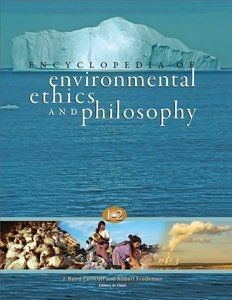
The field of environmental ethics is a new but now well-established sub-discipline of philosophy. Emerging in the mid-1970s, the field coalesced with the inaugural volume of the journal Environmental Ethics in 1979 and developed rapidly. By the turn of the century, most colleges and universities offered courses, if not major programs of study, in this important discipline. The Encyclopedia of Environmental Ethics and Philosophy addresses the needs of upper high school students, undergraduate researchers, teachers and professors, as well as general readers by examining the philosophical and ethical issues underlying contemporary and historical environmental issues, policies, and debates. More than 300 peer-reviewed articles cover concepts, institutions, topics, events and people, including global warming, animal rights, environmental movements, alternative energy, green chemistry, industrial ecology, and eco-sabotage. Encyclopedia of Environmental Ethics and Philosophy joins the suite of other MacMillan applied ethics titles: Encyclopedia of Bioethics and the Encyclopedia of Science, Technology, and Ethics. Additional features include 200 photographs and illustrations, thematic outline, annotated bibliography, and a comprehensive index.
These essays in political philosophy by T. M. Scanlon, written between 1969 and 1999, examine the standards by which social and political institutions should be justified and appraised. Scanlon explains how the powers of just institutions are limited by rights such as freedom of expression, and considers why these limits should be respected even when it seems that better results could be achieved by violating them. Other topics which are explored include voluntariness and consent, freedom of expression, tolerance, punishment, and human rights. The collection includes the classic essays ‘Preference and Urgency’, ‘A Theory of Freedom of Expression’, and ‘Contractualism and Utilitarianism’, as well as a number of other essays that have hitherto not been easily accessible. It will be essential reading for all those studying these topics from the perspective of political philosophy, politics, and law.
ما از اخلاق چه انتظاری داریم؟ این سوال شاید تاحدودی برای عموم مردم و یا متخصصان این رشته قابل پاسخ باشد؛ اینکه خوب بودن را به ما بیاموزد و در تنظیم روابط فردی م...

جشن کتاب تهران به ایستگاه سی و یکم رسیده است. حال و احوال نشر کتاب خوب نیست و باید فرهنگدوستان را به خرید و هدیه دادن کتاب ترغیب نمود. خانه اخلاقپژوهان جوان ب...

بنیاد کتابهای اخلاق اسلامی عمدتا پالایش جان از آلودگیها و آراستن آن به زیباییها است. اندیشه محوری این قبیل کتابها آن است که انسان فعلی آنی نیست که باید باشد...

-
0 Comments