Notice: تابع WP_Block_Type_Registry::register به طورنادرست فراخوانی شد. نامهای نوع بلوک نباید حروف بزرگ داشته باشند. لطفاً برای اطلاعات بیشتر، اشکال زدایی در وردپرس را مشاهده کنید. (این پیام در نگارش 5.0.0 افزوده شده است.) in /home/ethicsho/public_html/wp-includes/functions.php on line 5313
Warning: Use of undefined constant TDC_PATH_LEGACY - assumed 'TDC_PATH_LEGACY' (this will throw an Error in a future version of PHP) in /home/ethicsho/public_html/wp-content/plugins/td-composer/td-composer.php on line 109
Warning: Use of undefined constant TDSP_THEME_PATH - assumed 'TDSP_THEME_PATH' (this will throw an Error in a future version of PHP) in /home/ethicsho/public_html/wp-content/plugins/td-composer/td-composer.php on line 113 بایگانیهای B1532.A5 .H33 2007 - خانه اخلاق پژوهان جوان Notice: Trying to access array offset on value of type bool in /home/ethicsho/public_html/wp-content/plugins/wp-ulike/inc/general-functions.php on line 807
In 1784, the German newspaper Berlinische Monatsschrift asked its audience to reply to the question “What is Enlightenment?” Immanuel Kant took the opportunity to investigate the purported truths and assumptions of his age. Two hundred years later, Michel Foucault wrote a response to Kant’s initial essay, positioning Kant as the initiator of the discourse and critique of modernity. The Politics of Truth takes this initial encounter between Foucault and Kant, as a framework for its selection of unpublished essays and transcripts of lectures Foucault gave in America and France between 1978 and 1984, the year of his death. Ranging from reflections on the Enlightenment and revolution to a consideration of the Frankfurt School, this collection offers insight into the topics preoccupying Foucault as he worked on what would be his last body of published work, the three-volume History of Sexuality. It also offers what is in a sense the most “American” moment of Foucault’s thinking, for it was in America that he realized the necessity of tying his own thought to that of the Frankfurt School.
Moseley considers war from all angles: Christian, Marxist, Platonic, behavioralist, economic, psychological, and biological; he concludes that market-based societies tend to foster cooperation more than combat.?
Moral philosophy has long been dominated by the aim of understanding morality and the virtues in terms of principles. However, the underlying assumption that this is the best approach has received almost no defence, and has been attacked by particularists, who argue that the traditional link between morality and principles is little more than an unwarranted prejudice. In Principled Ethics, Michael Ridge and Sean McKeever meet the particularist challenge head-on, and defend a distinctive view they call “generalism as a regulative ideal.”
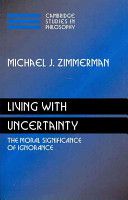
Every choice we make is set against a background of massive ignorance about our past, our future, our circumstances, and ourselves. Philosophers are divided on the moral significance of such ignorance. Some say that it has a direct impact on how we ought to behave – the question of what our moral obligations are; others deny this, claiming that it only affects how we ought to be judged in light of the behaviour in which we choose to engage – the question of what responsibility we bear for our choices. Michael Zimmerman claims that our ignorance has an important bearing on both questions, and offers an account of moral obligation and moral responsibility that is sharply at odds with the prevailing wisdom. His book will be of interest to a wide range of readers in ethics.
In many areas of modern life rapid developments in science are overwhelming established norms. Brain biology, through DNA testing and advanced brain imaging techniques, has given medical scientists new insights into the functioning of the human mind. This erosion of long-standing beliefs has many implications for understanding and treating what society considers to be aberrant or immoral behavior. What medical science is indicating is that the focus of our emphasis on mental processes–particularly free will and intentionality–is shifting to recognition of the important role the physical brain plays on human thought and behavior. In Hardwired Behavior the author argues that social morality begins in the brain, for without the brain there would be no concept of morality. Individual responsibility, therefore, must be reconsidered in the light of biological brain processes. The question of whether new scientific findings destroy the relevance of free will, placing it in the context of biological forces that may operate outside the conscious control of the actor, is one of intense debate. Hardwired Behavior takes this question and moves it into the open by clearly detailing neuroscience discoveries and explaining how the ancient precepts of “morality” that have guided mankind throughout its history must now be seen through the new lens of brain biology.
ما از اخلاق چه انتظاری داریم؟ این سوال شاید تاحدودی برای عموم مردم و یا متخصصان این رشته قابل پاسخ باشد؛ اینکه خوب بودن را به ما بیاموزد و در تنظیم روابط فردی م...

جشن کتاب تهران به ایستگاه سی و یکم رسیده است. حال و احوال نشر کتاب خوب نیست و باید فرهنگدوستان را به خرید و هدیه دادن کتاب ترغیب نمود. خانه اخلاقپژوهان جوان ب...

بنیاد کتابهای اخلاق اسلامی عمدتا پالایش جان از آلودگیها و آراستن آن به زیباییها است. اندیشه محوری این قبیل کتابها آن است که انسان فعلی آنی نیست که باید باشد...

-
0 Comments