Notice: تابع WP_Block_Type_Registry::register به طورنادرست فراخوانی شد. نامهای نوع بلوک نباید حروف بزرگ داشته باشند. لطفاً برای اطلاعات بیشتر، اشکال زدایی در وردپرس را مشاهده کنید. (این پیام در نگارش 5.0.0 افزوده شده است.) in /home/ethicsho/public_html/wp-includes/functions.php on line 5313
Warning: Use of undefined constant TDC_PATH_LEGACY - assumed 'TDC_PATH_LEGACY' (this will throw an Error in a future version of PHP) in /home/ethicsho/public_html/wp-content/plugins/td-composer/td-composer.php on line 109
Warning: Use of undefined constant TDSP_THEME_PATH - assumed 'TDSP_THEME_PATH' (this will throw an Error in a future version of PHP) in /home/ethicsho/public_html/wp-content/plugins/td-composer/td-composer.php on line 113 بایگانیهای 9789401151863 - خانه اخلاق پژوهان جوان Notice: Trying to access array offset on value of type bool in /home/ethicsho/public_html/wp-content/plugins/wp-ulike/inc/general-functions.php on line 807
The 1991 US Supreme Court decision in Feist Publications Inc. v. Rural Telephone Service Co. held that factual matter is not subject to copyright protection because it is not original to the author, thus dramatically rejecting a two-century-old tradition of protecting factual compilations under copyright. The contributors to this book reassess this decision and its implications, particularly for the protection of electronic databases. The debate over fact-based works has grown still more complicated since Feist with the enactment of worldwide initiatives that extend the protection of databases, such as the European Union’s Database Directive. A number of legal scholars have voiced their opinions on how Congress should react to the Court’s decision and the Database Directive, but none have put forth a viable solution or questioned the debate’s underlying assumptions. The contributors to this insightful book turn their attention to these overlooked aspects, approaching the protection of factual matter from a range of perspectives: policy, historical, comparative, empirical and philosophical. The range of viewpoints and disciplines represented in this compelling book will be of great interest to students, scholars and lawyers working in the area of intellectual property law.
This new edition of The Cambridge Medical Ethics Workbook builds on the success of the first edition by working from the ‘bottom up’, with a widely praised case-based approach. A variety of guided exercises are supplemented by short papers and commentaries on legal and ethical issues, challenging readers to develop their own analyses and recommendations. Chapters cover death, genetics, new reproductive technologies, research, long-term care, mental health, children and young people, allocation of scarce resources, and general issues about autonomy and patient choice. An appendix discusses the use of this book in teaching, along with a full bibliography, list of Kennedy Institute keywords, and suggestions for further reading. An interactive CD-ROM packaged with the book provides extra cases, a glossary, legal references and the chance to record a personal learning diary. Its simple, clear style makes this book ideal for individual reference and as a set text for group teaching.
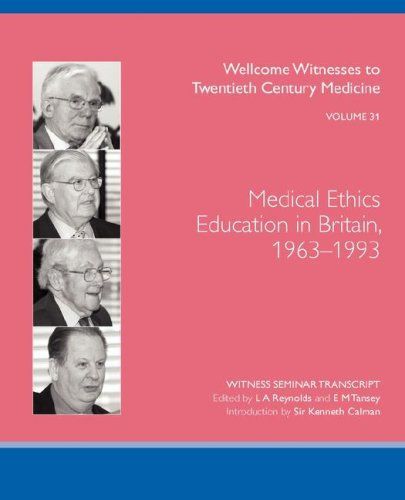
Changing attitudes toward human experimentation along with other controversial moral issues emerged after the Second World War and, in 1963, led to the establishment of the London Medical Group, organized by Ted Shotter, with similar Medical Groups elsewhere from 1967. These became forums for discussion and debate arising from dilemmas encountered in medical settings. Medical ethics did not become a recognized subject in the syllabus of Britain’s medical schools until 1993. This Witness Seminar transcript records the development of international ethical codes, the response to them over the period 1963-93 by students and doctors and the extent of resistance encountered from deans, hospital administrators and others; the Groups’ influence on medical practice; the impact on both Medical Group organizers and participants in their subsequent careers; the local and regional variations and their significant lasting contributions. The meeting was chaired by Dr Stephen Lock and included former Medical Group members, scientists, physicians and policy makers, such as Professors Kenneth Boyd, Bill Fulford, Roger Higgs, Sir Ian Kennedy, David Morton and Sir Malcolm Macnaughton. An introduction by Professor Sir Kenneth Calman and appendices of the Very Revd Edward Shotter’s reflections on the influence of the Medical Groups as a report for the Institute of Medical Ethics complete the transcript.
ما از اخلاق چه انتظاری داریم؟ این سوال شاید تاحدودی برای عموم مردم و یا متخصصان این رشته قابل پاسخ باشد؛ اینکه خوب بودن را به ما بیاموزد و در تنظیم روابط فردی م...

جشن کتاب تهران به ایستگاه سی و یکم رسیده است. حال و احوال نشر کتاب خوب نیست و باید فرهنگدوستان را به خرید و هدیه دادن کتاب ترغیب نمود. خانه اخلاقپژوهان جوان ب...

بنیاد کتابهای اخلاق اسلامی عمدتا پالایش جان از آلودگیها و آراستن آن به زیباییها است. اندیشه محوری این قبیل کتابها آن است که انسان فعلی آنی نیست که باید باشد...

-
0 Comments