Notice: تابع WP_Block_Type_Registry::register به طورنادرست فراخوانی شد. نامهای نوع بلوک نباید حروف بزرگ داشته باشند. لطفاً برای اطلاعات بیشتر، اشکال زدایی در وردپرس را مشاهده کنید. (این پیام در نگارش 5.0.0 افزوده شده است.) in /home/ethicsho/public_html/wp-includes/functions.php on line 5313
Warning: Use of undefined constant TDC_PATH_LEGACY - assumed 'TDC_PATH_LEGACY' (this will throw an Error in a future version of PHP) in /home/ethicsho/public_html/wp-content/plugins/td-composer/td-composer.php on line 109
Warning: Use of undefined constant TDSP_THEME_PATH - assumed 'TDSP_THEME_PATH' (this will throw an Error in a future version of PHP) in /home/ethicsho/public_html/wp-content/plugins/td-composer/td-composer.php on line 113 بایگانیهای 9781843761754 - خانه اخلاق پژوهان جوان Notice: Trying to access array offset on value of type bool in /home/ethicsho/public_html/wp-content/plugins/wp-ulike/inc/general-functions.php on line 807
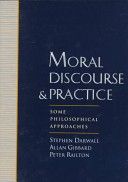
What are ethical judgments about? And what is their relation to practice? How can ethical judgment aspire to objectivity? The past two decades have witnessed a resurgence of interest in metaethics, placing questions such as these about the nature and status of ethical judgment at the very center of contemporary moral philosophy. Moral Discourse and Practice: Some Philosophical Approaches is a unique anthology which collects important recent work, much of which is not easily available elsewhere, on core metaethical issues. Naturalist moral realism, once devastated by the charge of “naturalistic fallacy,” has been reinvigorated, as have versions of moral realism that insist on the discontinuity between ethics and science. Irrealist, expressivist programs have also developed with great subtlety, encouraging the thought that a noncognivist account may actually be able to explain ethical judgments’ aspirations to objectivity. Neo-Kantian constructivist theories have flourished as well, offering hope that morality can be grounded in a plausible conception of reasonable conduct. Together, the positions advanced in the essays collected here address these recent developments, constituting a rich array of approaches to contemporary moral philosophy’s most fundamental debates. An extensive introduction by Darwall, Gibbard, and Railton is also included, making this volume the most comprehensive and up-to-date work of its kind. Moral Discourse is ideally suited for use in courses in contemporary ethics, ethical theory, and metaethics.
Robert B. Brandom is one of the most original philosophers of our day, whose book Making It Explicit covered and extended a vast range of topics in metaphysics, epistemology, and philosophy of language–the very core of analytic philosophy. This new work provides an approachable introduction to the complex system that Making It Explicit mapped out. A tour of the earlier book’s large ideas and relevant details, Articulating Reasons offers an easy entry into two of the main themes of Brandom’s work: the idea that the semantic content of a sentence is determined by the norms governing inferences to and from it, and the idea that the distinctive function of logical vocabulary is to let us make our tacit inferential commitments explicit.Brandom’s work, making the move from representationalism to inferentialism, constitutes a near-Copernican shift in the philosophy of language–and the most important single development in the field in recent decades. Articulating Reasons puts this accomplishment within reach of nonphilosophers who want to understand the state of the foundations of semantics.
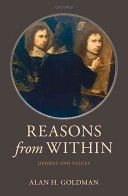
Do the reasons we have for acting as we do derive from our concerns and desires, or are there objective values in the world that we are rationally required to pursue and protect? Alan Goldman argues for the internalist or subjectivist view of practical reasons on the grounds that it is simpler, more unified, and more comprehensible than the rival objectivist position. He provides a naturalistic account of practical rationality in terms of coherence within sets of desires or motivational states, and between motivations, intentions, and actions. Coherence is defined as the avoidance of self-defeat, the defeat of one’s own deepest concerns. The demand for coherence underlies both practical and theoretical reason and derives from the natural aims of belief and action. In clarifying which desires create reasons, drawing on the literature of cognitive psychology, Goldman offers conceptual analyses of desires, emotions, and attitudes. Reasons are seen to derive ultimately from our deepest occurrent concerns. These concerns require no reasons themselves but provide reasons for many more superficial desires. In defense of this theory, Goldman argues that rational agents need not be morally motivated or concerned for their narrow self-interest. Objective values would demand such concern. They would be independent of our desires but would provide reasons for us to pursue and protect them. They would require rational agents to be motivated by them. But, Goldman argues, we are not motivated in that way, and it makes no sense to demand that our informed and coherent desires be generally other than they are. We need not appeal to such objective values in order to explain how our lives can be good and meaningful. Reasons from Within will appeal to anyone interested in the nature of values and reasons, particularly students of philosophy, psychology, and decision theory.
ما از اخلاق چه انتظاری داریم؟ این سوال شاید تاحدودی برای عموم مردم و یا متخصصان این رشته قابل پاسخ باشد؛ اینکه خوب بودن را به ما بیاموزد و در تنظیم روابط فردی م...

جشن کتاب تهران به ایستگاه سی و یکم رسیده است. حال و احوال نشر کتاب خوب نیست و باید فرهنگدوستان را به خرید و هدیه دادن کتاب ترغیب نمود. خانه اخلاقپژوهان جوان ب...

بنیاد کتابهای اخلاق اسلامی عمدتا پالایش جان از آلودگیها و آراستن آن به زیباییها است. اندیشه محوری این قبیل کتابها آن است که انسان فعلی آنی نیست که باید باشد...

-
0 Comments