Notice: تابع WP_Block_Type_Registry::register به طورنادرست فراخوانی شد. نامهای نوع بلوک نباید حروف بزرگ داشته باشند. لطفاً برای اطلاعات بیشتر، اشکال زدایی در وردپرس را مشاهده کنید. (این پیام در نگارش 5.0.0 افزوده شده است.) in /home/ethicsho/public_html/wp-includes/functions.php on line 5313
Warning: Use of undefined constant TDC_PATH_LEGACY - assumed 'TDC_PATH_LEGACY' (this will throw an Error in a future version of PHP) in /home/ethicsho/public_html/wp-content/plugins/td-composer/td-composer.php on line 109
Warning: Use of undefined constant TDSP_THEME_PATH - assumed 'TDSP_THEME_PATH' (this will throw an Error in a future version of PHP) in /home/ethicsho/public_html/wp-content/plugins/td-composer/td-composer.php on line 113 بایگانیهای 9781589011847 - خانه اخلاق پژوهان جوان Notice: Trying to access array offset on value of type bool in /home/ethicsho/public_html/wp-content/plugins/wp-ulike/inc/general-functions.php on line 807
Once regarded as a conservative critic of culture, then enlisted by the court theoreticians of Nazism, Nietzsche has come to be revered by postmodern thinkers as one of their founding fathers, a prophet of human liberation who revealed the perspectival character of all knowledge and broke radically with traditional forms of morality and philosophy. In Nietzsche: The Ethics of an Immoralist, Peter Berkowitz challenges this new orthodoxy, asserting that it produces a one-dimensional picture of Nietzsche’s philosophical explorations and passes by much of what is provocative and problematic in his thought. Berkowitz argues that Nietzsche’s thought is rooted in extreme and conflicting opinions about metaphysics and human nature. Discovering a deep unity in Nietzsche’s work by exploring the structure and argumentative movement of a wide range of his books, Berkowitz shows that Nietzsche is a moral and political philosopher in the Socratic sense whose governing question is, “What is the best life?” Nietzsche, Berkowitz argues, puts forward a severe and aristocratic ethics, an ethics of creativity, that demands that the few human beings who are capable acquire a fundamental understanding of and attain total mastery over the world. Following the path of Nietzsche’s thought, Berkowitz shows that this mastery, which represents a suprapolitical form of rule and entails a radical denigration of political life, is, from Nietzsche’s own perspective, neither desirable nor attainable. Out of the colorful and richly textured fabric of Nietzsche’s books, Peter Berkowitz weaves an interpretation of Nietzsche’s achievement that is at once respectful and skeptical, an interpretation that brings out the love of truth, the courage, and the yearning for the good that mark Nietzsche’s magisterial effort to live an examined life by giving an account of the best life.
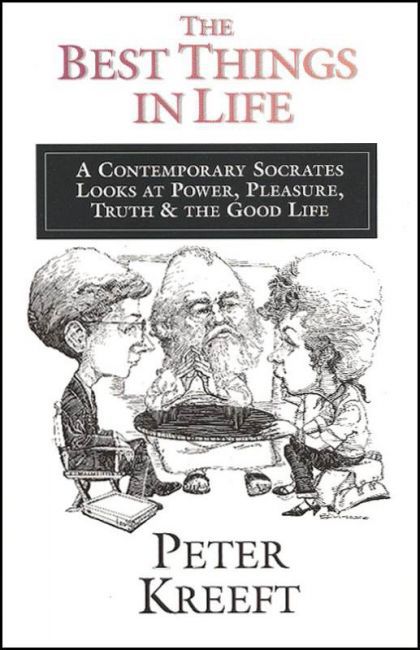
What are the best things in life? Questions like that may boggle your mind. But they don’t boggle Socrates. The indomitable old Greek brings his unending questions to Desperate State University. With him come the same mind-opening and spirit-stretching challenge that disrupted ancient Athens. What is the purpose of education? Why do we make love?What good is money? Can computers think like people? Is there a difference between Capitalism and Communism? What is the greatest good? Is belief in God like belief in Santa Claus?
In twelve short, Socratic dialogues Peter Kreeft explodes contemporary values like success, power and pleasure. And he bursts the modern bubbles of agnosticism and subjectivism. He leaves you richer, wiser and more able to discern what the best things in life actually are.
Choice Outstanding Academic Title, 2000.A Choice Outstanding Academic Title for 1999Academic debates about pluralism and truth have become increasingly polarized in recent years. One side embraces extreme relativism, deeming any talk of objective truth as philosophically naive. The opposition, frequently arguing that any sort of relativism leads to nihilism, insists on an objective notion of truth according to which there is only one true story of the world. Both sides agree that there is no middle path.In Truth in Context, Michael Lynch argues that there is a middle path, one where metaphysical pluralism is consistent with a robust realism about truth. Drawing on the work of Hilary Putnam, W. V. O. Quine, and Ludwig Wittgenstein, among others, Lynch develops an original version of metaphysical pluralism, which he calls relativistic Kantianism. He argues that one can take facts and propositions as relative without implying that our ordinary concept of truth is a relative, epistemic, or “soft” concept. The truths may be relative, but our concept of truth need not be.
Providing a groundbreaking collective commentary, by an international group of leading philosophical scholars, Blackwell’s Guide to Hegel’s Phenomenology of Spirit transforms and expands our understanding and appreciation of one of the most challenging works in Western philosophy. Collective philosophical commentary on the whole of Hegel’s Phenomenology in sequence with the original text.Original essays by leading international philosophers and Hegel experts.Provides a comprehensive Bibliography of further sources.
ما از اخلاق چه انتظاری داریم؟ این سوال شاید تاحدودی برای عموم مردم و یا متخصصان این رشته قابل پاسخ باشد؛ اینکه خوب بودن را به ما بیاموزد و در تنظیم روابط فردی م...

جشن کتاب تهران به ایستگاه سی و یکم رسیده است. حال و احوال نشر کتاب خوب نیست و باید فرهنگدوستان را به خرید و هدیه دادن کتاب ترغیب نمود. خانه اخلاقپژوهان جوان ب...

بنیاد کتابهای اخلاق اسلامی عمدتا پالایش جان از آلودگیها و آراستن آن به زیباییها است. اندیشه محوری این قبیل کتابها آن است که انسان فعلی آنی نیست که باید باشد...

-
0 Comments