Notice: تابع WP_Block_Type_Registry::register به طورنادرست فراخوانی شد. نامهای نوع بلوک نباید حروف بزرگ داشته باشند. لطفاً برای اطلاعات بیشتر، اشکال زدایی در وردپرس را مشاهده کنید. (این پیام در نگارش 5.0.0 افزوده شده است.) in /home/ethicsho/public_html/wp-includes/functions.php on line 5313
Warning: Use of undefined constant TDC_PATH_LEGACY - assumed 'TDC_PATH_LEGACY' (this will throw an Error in a future version of PHP) in /home/ethicsho/public_html/wp-content/plugins/td-composer/td-composer.php on line 109
Warning: Use of undefined constant TDSP_THEME_PATH - assumed 'TDSP_THEME_PATH' (this will throw an Error in a future version of PHP) in /home/ethicsho/public_html/wp-content/plugins/td-composer/td-composer.php on line 113 بایگانیهای 9781403965080 - خانه اخلاق پژوهان جوان Notice: Trying to access array offset on value of type bool in /home/ethicsho/public_html/wp-content/plugins/wp-ulike/inc/general-functions.php on line 807
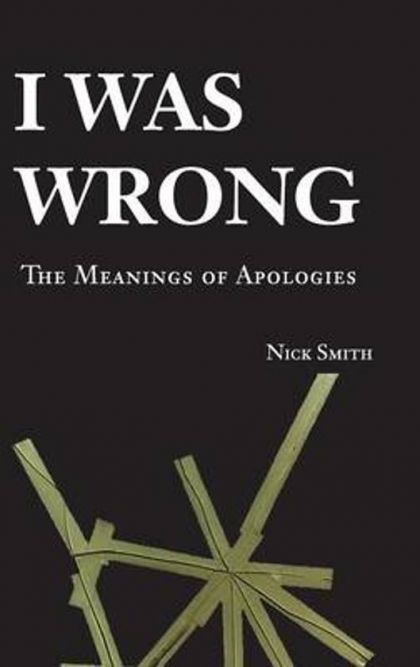
Apologies pervade our news headlines and our private affairs, but how should we evaluate these often vague and deceptive rituals? Discussing numerous examples from ancient and recent history, I Was Wrong: On The Meanings of Apologies argues that we suffer from considerable confusion about the moral meanings and social functions of these complex interactions. Rather than asking whether a speech act “is or is not” an apology, Smith offers a nuanced theory of apologetic meaning. Smith leads us with a clear voice though a series of rich philosophical and interdisciplinary questions, arguing that apologies have evolved from a confluence of diverse cultural and religious practices that do not translate easily into pluralistic secular discourse. After describing several varieties of apologies between individuals, Smith turns to collectives. Although apologies from corporations, governments, and other groups can be profoundly significant, Smith guides readers to appreciate the kinds of meaning that collective apologies often do not convey and warns of the dangers of collective acts of contrition that allow individual wrongdoers to obscure their personal blame. Dr. Smith is an assistant professor of philosophy at the University of New Hampshire. A graduate of Vassar College, he earned a law degree from SUNY at Buffalo and a Ph.D. in philosophy from Vanderbilt University. Before coming to UNH, he worked as a litigator for LeBoeuf, Lamb, Greene, and MacRae and as a judicial clerk for the Honorable R.L. Nygaard of the United States Court of Appeals for the Third Circuit. He specializes in the philosophy of Law, Politics, and Society and he writes on and teaches aesthetics. He is working with Cambridge University Press on the sequel to I Was Wrong, applying his framework for apologetic meanings to examples in criminal and civil law. His writings have appeared in journals such as Continental Philosophy Review, Social Theory and Practice, The Journal of Social Philosophy, Culture, Theory & Critique, The Rutgers Law Journal, and The Buffalo Law Review.
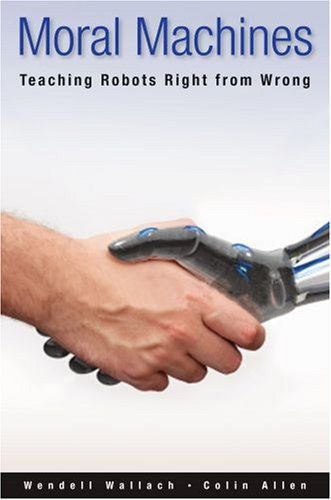
Computers are already approving financial transactions, controlling electrical supplies, and driving trains. Soon, service robots will be taking care of the elderly in their homes, and military robots will have their own targeting and firing protocols. Colin Allen and Wendell Wallach argue that as robots take on more and more responsibility, they must be programmed with moral decision-making abilities, for our own safety. Taking a fast paced tour through the latest thinking about philosophical ethics and artificial intelligence, the authors argue that even if full moral agency for machines is a long way off, it is already necessary to start building a kind of functional morality, in which artificial moral agents have some basic ethical sensitivity. But the standard ethical theories don’t seem adequate, and more socially engaged and engaging robots will be needed. As the authors show, the quest to build machines that are capable of telling right from wrong has begun. Moral Machines is the first book to examine the challenge of building artificial moral agents, probing deeply into the nature of human decision making and ethics.
This book is an accessible introduction that will enable students, through practical exercises, to develop their own skills in reasoning about ethical issues, including analyzing and evaluating arguments used in discussions of ethical issues; analyzing and evaluating ethical concepts, such as utilitarianism; making decisions on ethical issues; and learning how to approach ethical issues in a fair minded way. The issues discussed in the book include abortion, euthanasia, capital punishment, animal rights, the environment and war. The book will be essential reading for students studying all aspects of ethics.
ما از اخلاق چه انتظاری داریم؟ این سوال شاید تاحدودی برای عموم مردم و یا متخصصان این رشته قابل پاسخ باشد؛ اینکه خوب بودن را به ما بیاموزد و در تنظیم روابط فردی م...

جشن کتاب تهران به ایستگاه سی و یکم رسیده است. حال و احوال نشر کتاب خوب نیست و باید فرهنگدوستان را به خرید و هدیه دادن کتاب ترغیب نمود. خانه اخلاقپژوهان جوان ب...

بنیاد کتابهای اخلاق اسلامی عمدتا پالایش جان از آلودگیها و آراستن آن به زیباییها است. اندیشه محوری این قبیل کتابها آن است که انسان فعلی آنی نیست که باید باشد...

-
0 Comments