Notice: تابع WP_Block_Type_Registry::register به طورنادرست فراخوانی شد. نامهای نوع بلوک نباید حروف بزرگ داشته باشند. لطفاً برای اطلاعات بیشتر، اشکال زدایی در وردپرس را مشاهده کنید. (این پیام در نگارش 5.0.0 افزوده شده است.) in /home/ethicsho/public_html/wp-includes/functions.php on line 5313
Warning: Use of undefined constant TDC_PATH_LEGACY - assumed 'TDC_PATH_LEGACY' (this will throw an Error in a future version of PHP) in /home/ethicsho/public_html/wp-content/plugins/td-composer/td-composer.php on line 109
Warning: Use of undefined constant TDSP_THEME_PATH - assumed 'TDSP_THEME_PATH' (this will throw an Error in a future version of PHP) in /home/ethicsho/public_html/wp-content/plugins/td-composer/td-composer.php on line 113 بایگانیهای 9781134532803 - خانه اخلاق پژوهان جوان Notice: Trying to access array offset on value of type bool in /home/ethicsho/public_html/wp-content/plugins/wp-ulike/inc/general-functions.php on line 807
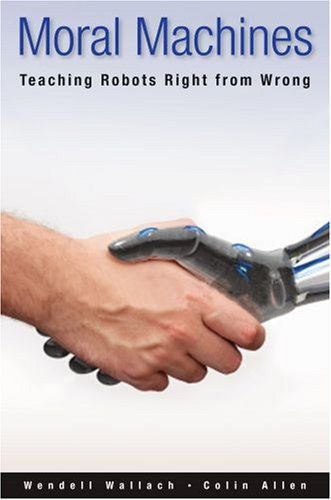
Computers are already approving financial transactions, controlling electrical supplies, and driving trains. Soon, service robots will be taking care of the elderly in their homes, and military robots will have their own targeting and firing protocols. Colin Allen and Wendell Wallach argue that as robots take on more and more responsibility, they must be programmed with moral decision-making abilities, for our own safety. Taking a fast paced tour through the latest thinking about philosophical ethics and artificial intelligence, the authors argue that even if full moral agency for machines is a long way off, it is already necessary to start building a kind of functional morality, in which artificial moral agents have some basic ethical sensitivity. But the standard ethical theories don’t seem adequate, and more socially engaged and engaging robots will be needed. As the authors show, the quest to build machines that are capable of telling right from wrong has begun. Moral Machines is the first book to examine the challenge of building artificial moral agents, probing deeply into the nature of human decision making and ethics.
Although Alasdair MacIntyre is best known today as the author of “After Virtue” (1981), he was, in the 1950s and 1960s, one of the most erudite members of Britain’s Marxist Left: being a militant within, first, the Communist Party, then the New Left, and finally the heterodox Trotskyist International Socialism group. This selection of his essays on Marxism from that period aims to show that his youthful thought profoundly informed his mature ethics, and that, in the wake of the collapse of the state-capitalist regimes in Russia and Eastern Europe, the powerful and optimistic revolutionary Marxist ethics of liberation he articulated in that period is arguably as salient to anti-capitalist activists today as it was half a century ago.
“By explicitly addressing moral knowledge from a particularists perspective, this book can engage with an established and vibrant area of moral philosophy whilst making a distinctive and productive contribution to a relatively neglected dimension of it”–
Nearly a century before the advent of “multiculturalism,” Jane Addams put forward her conception of the moral significance of diversity. Each member of a democracy, Addams believed, is under a moral obligation to seek out diverse experiences, making a daily effort to confront others’ perspectives. Morality must be seen as a social rather than an individual endeavour, and democracy as a way of life rather than merely a basis for laws. Failing this, both democracy and ethics remain sterile, empty concepts.In this, Addams’ earliest book on ethics – presented here with a substantial introduction by Charlene Haddock Seigfried – she reflects on the factors that hinder the ability of all members of society to determine their own well-being. Observing relationships between charitable workers and their clients, between factory owners and their employers, and between household employers and their servants, she identifies sources of friction and shows how conceiving of democracy as a social obligation can lead to new, mutually beneficial lines of conduct.She also considers the proper education of workers, struggles between parents and their adult daughters over conflicting family and social claims, and the merging of politics with the daily lives of constituents. “The sphere of morals is the sphere of action”, Addams proclaims. It is not enough to believe passively in the innate dignity of all human beings. Rather, one must work daily to root out racial, gender, class, and other prejudices from personal relationships.
ما از اخلاق چه انتظاری داریم؟ این سوال شاید تاحدودی برای عموم مردم و یا متخصصان این رشته قابل پاسخ باشد؛ اینکه خوب بودن را به ما بیاموزد و در تنظیم روابط فردی م...

جشن کتاب تهران به ایستگاه سی و یکم رسیده است. حال و احوال نشر کتاب خوب نیست و باید فرهنگدوستان را به خرید و هدیه دادن کتاب ترغیب نمود. خانه اخلاقپژوهان جوان ب...

بنیاد کتابهای اخلاق اسلامی عمدتا پالایش جان از آلودگیها و آراستن آن به زیباییها است. اندیشه محوری این قبیل کتابها آن است که انسان فعلی آنی نیست که باید باشد...

-
0 Comments