Notice: تابع WP_Block_Type_Registry::register به طورنادرست فراخوانی شد. نامهای نوع بلوک نباید حروف بزرگ داشته باشند. لطفاً برای اطلاعات بیشتر، اشکال زدایی در وردپرس را مشاهده کنید. (این پیام در نگارش 5.0.0 افزوده شده است.) in /home/ethicsho/public_html/wp-includes/functions.php on line 5313
Warning: Use of undefined constant TDC_PATH_LEGACY - assumed 'TDC_PATH_LEGACY' (this will throw an Error in a future version of PHP) in /home/ethicsho/public_html/wp-content/plugins/td-composer/td-composer.php on line 109
Warning: Use of undefined constant TDSP_THEME_PATH - assumed 'TDSP_THEME_PATH' (this will throw an Error in a future version of PHP) in /home/ethicsho/public_html/wp-content/plugins/td-composer/td-composer.php on line 113 بایگانیهای 9780814472002 - خانه اخلاق پژوهان جوان Notice: Trying to access array offset on value of type bool in /home/ethicsho/public_html/wp-content/plugins/wp-ulike/inc/general-functions.php on line 807
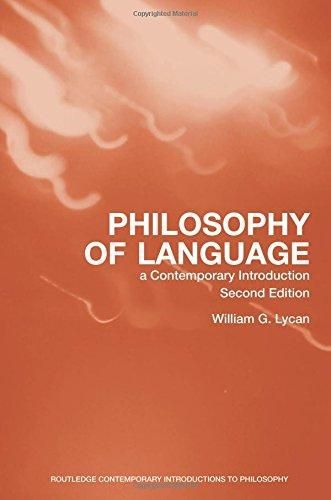
Philosophy of Language: a Contemporary Introduction introduces the student to the main issues and theories in twentieth-century philosophy of language, focusing specifically on linguistic phenomena. Topics are structured in three parts in the book. Part I, Reference and Referring Expressions, includes topics such as Russell’s Theory of Desciptions, Donnellan’s distinction, problems of anaphora, the description theory of proper names, Searle’s cluster theory, and the causal-historical theory. Part II, Theories of Meaning, surveys the competing theories of linguistic meaning and compares their various advantages and liabilities. Part III, Pragmatics and Speech Acts, introduces the basic concepts of linguistic pragmatics, includes a detailed discussion of the problem of indirect force and surveys approaches to metaphor. Part IV, new to this edition, examines the four theories of metaphor. Features of Philosophy of Language include: New chapters on Frege and puzzles, inferentialism, illocutionary theories ofmeaning and relevance theory chapter overviews and summaries clear supportive examples study questions annotated further reading glossary
This book deals with foundational issues in the history of the nature of action, the intentionality of action, the compatibility of freedom of action with determinism, and the explanation of action. Ginet’s is a volitional view: that every action has as its core a “simple” mental action. He develops a sophisticated account of the individuation of actions and also propounds a challenging version of the view that freedom of action is incompatible with determinism.
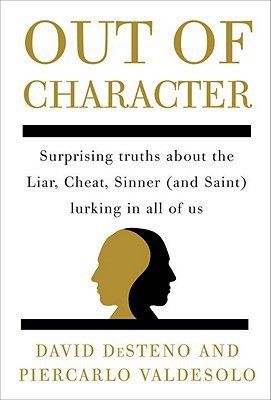
Have you ever wondered why a trumpeter of family values would suddenly turn around and cheat on his wife? Why jealousy would send an otherwise level-headed person into a violent rage? What could drive a person to blow a family fortune at the blackjack tables? Or have you ever pondered what might make Mr. Right leave his beloved at the altar, why hypocrisy seems to be rampant, or even why, every once in awhile, even you are secretly tempted, to lie, cheat, or steal (or, conversely, help someone you never even met)? This book answers these questions and more, and in doing so, turns the prevailing wisdom about who we are upside down. Our character, argue psychologists DeSteno and Valdesolo, isn’t a stable set of traits, but rather a shifting state that is subject to the constant push and pull of hidden mechanisms in our mind. And it’s the battle between these dueling psychological forces that determine how we act at any given point in time. Drawing on the surprising results of the clever experiments concocted in their own laboratory, DeSteno and Valdesolo shed new scientific light on so many of the puzzling behaviors that regularly grace the headlines. For example, you’ll learn: • Why Tiger Woods just couldn’t resist the allure of his mistresses even though he had a picture-perfect family at home. And why no one, including those who knew him best, ever saw it coming. • Why even the shrewdest of investors can be tempted to gamble their fortunes away (and why risky financial behavior is driven by the same mechanisms that compel us to root for the underdog in sports). • Why Eliot Spitzer, who made a career of crusading against prostitution, turned out to be one of the most famous johns of all time. • Why Mel Gibson, a noted philanthropist and devout Catholic, has been repeatedly caught spewing racist rants, even though close friends say he doesn’t have a racist bone in his body. • And why any of us is capable of doing the same, whether we believe it or not!A surprising look at the hidden forces driving the saint and sinner lurking in us all, Out of Character reveals why human behavior is so much more unpredictable than we ever realized.
Experience and Value: Essays on John Dewey and Pragmatic Naturalism brings together twelve philosophical essays spanning the career of noted Dewey scholar, S. Morris Eames. The volume includes both critiques and interpretations of important issues in John Dewey’s value theory as well as the application of Eames’s pragmatic naturalism in addressing contemporary problems in social theory, education, and religion. The collection begins with a discussion of the underlying principles of Dewey’s pragmatic naturalism, including the concepts of nature, experience, and philosophic method. Essays “Experience and Philosophical Method in John Dewey” and “Primary Experience in the Philosophy of John Dewey” develop what Eames believed to be a central theme in Dewey’s thought and provide a theoretical framework for subsequent discussion. The volume continues with specific applications of this framework in the areas of value theory, moral theory, social philosophy, and the philosophy of religion. Eames’s analysis of value exposes the connection between the immediately felt values of experience and the more sophisticated judgments of value that are the product of reflection. From this basis in moral theory, Eames considers the derivation of judgments of obligation from judgments of fact. This discussion provides a grounding for a consideration of contemporary social issues directed by naturalistic and scientific principles. In the third section, with regard to educational theory, Eames considers possible resolutions of the current dichotomy between the factual worldview of science and the humanistic worldview of the liberal arts. The comprehensive article, “Dewey’s Views of Truth, Beauty, and Goodness,” connects the essays of the first and second sections and explores the placement of Dewey’s value theory with respect to morals and aesthetics. With “Creativity and Democracy,” in the fourth section, Eames also considers the concept of democracy from the standpoint of current and historical issues faced by society. This article hints at a major project of Eames’s intellectual life—the theory of democracy. The volume concludes with a discussion of the difficulty of maintaining the values of religious experience in a scientifically and technologically sophisticated world, the very topic that first brought Eames to philosophy—the meaning of religion and the religious life. Suggested solutions are offered in “The Lost Individual and Religious Unity.” Experience and Value: Essays on John Dewey and Pragmatic Naturalism illuminates Eames’ life of inquiry, a life that included moral, social, aesthetic, and religious dimensions of value—all suffused with the influence of John Dewey.
ما از اخلاق چه انتظاری داریم؟ این سوال شاید تاحدودی برای عموم مردم و یا متخصصان این رشته قابل پاسخ باشد؛ اینکه خوب بودن را به ما بیاموزد و در تنظیم روابط فردی م...

جشن کتاب تهران به ایستگاه سی و یکم رسیده است. حال و احوال نشر کتاب خوب نیست و باید فرهنگدوستان را به خرید و هدیه دادن کتاب ترغیب نمود. خانه اخلاقپژوهان جوان ب...

بنیاد کتابهای اخلاق اسلامی عمدتا پالایش جان از آلودگیها و آراستن آن به زیباییها است. اندیشه محوری این قبیل کتابها آن است که انسان فعلی آنی نیست که باید باشد...

-
0 Comments