Notice: تابع WP_Block_Type_Registry::register به طورنادرست فراخوانی شد. نامهای نوع بلوک نباید حروف بزرگ داشته باشند. لطفاً برای اطلاعات بیشتر، اشکال زدایی در وردپرس را مشاهده کنید. (این پیام در نگارش 5.0.0 افزوده شده است.) in /home/ethicsho/public_html/wp-includes/functions.php on line 5313
Warning: Use of undefined constant TDC_PATH_LEGACY - assumed 'TDC_PATH_LEGACY' (this will throw an Error in a future version of PHP) in /home/ethicsho/public_html/wp-content/plugins/td-composer/td-composer.php on line 109
Warning: Use of undefined constant TDSP_THEME_PATH - assumed 'TDSP_THEME_PATH' (this will throw an Error in a future version of PHP) in /home/ethicsho/public_html/wp-content/plugins/td-composer/td-composer.php on line 113 بایگانیهای 9780754671145 - خانه اخلاق پژوهان جوان Notice: Trying to access array offset on value of type bool in /home/ethicsho/public_html/wp-content/plugins/wp-ulike/inc/general-functions.php on line 807
Book Summary of Moral RealityWe typically assume that the standard for what is beautiful lies in the eye of the beholder. Yet this is not the case when we consider morality; what we deem morally good is not usually a matter of opinion. Such thoughts push us toward being realists about moral properties, but a cogent theory of moral realism has long been an elusive philosophical goal. Paul Bloomfield here offers a rigorous defense of moral realism, developing an ontology for morality that models the property of being morally good on the property of being physically healthy. The model is assembled systematically; it first presents the metaphysics of healthiness and goodness, then explains our epistemic access to properties such as these, adds a complementary analysis of the semantics and syntax of moral discourse, and finishes with a discussion of how we become motivated to act morally. Bloomfield closely attends to the traditional challenges facing moral realism, and the discussion nimbly ranges from modern medical theory to ancient theories of virtue, and from animal navigation to the nature of normativity. Maintaining a highly readable style throughout, Moral Reality yields one of the most compelling theories of moral realism to date and will appeal to philosophers working on issues in metaphysics or moral philosophy.
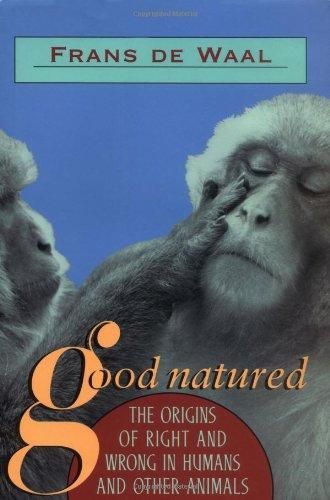
To observe a dog’s guilty look.to witness a gorilla’s self-sacrifice for a wounded mate, to watch an elephant herd’s communal effort on behalf of a stranded calf–to catch animals in certain acts is to wonder what moves them. Might there he a code of ethics in the animal kingdom? Must an animal be human to he humane? In this provocative book, a renowned scientist takes on those who have declared ethics uniquely human Making a compelling case for a morality grounded in biology, he shows how ethical behavior is as much a matter of evolution as any other trait, in humans and animals alike.World famous for his brilliant descriptions of Machiavellian power plays among chimpanzees-the nastier side of animal life–Frans de Waal here contends that animals have a nice side as well. Making his case through vivid anecdotes drawn from his work with apes and monkeys and holstered by the intriguing, voluminous data from his and others’ ongoing research, de Waal shows us that many of the building blocks of morality are natural: they can he observed in other animals. Through his eyes, we see how not just primates but all kinds of animals, from marine mammals to dogs, respond to social rules, help each other, share food, resolve conflict to mutual satisfaction, even develop a crude sense of justice and fairness.Natural selection may be harsh, but it has produced highly successful species that survive through cooperation and mutual assistance. De Waal identifies this paradox as the key to an evolutionary account of morality, and demonstrates that human morality could never have developed without the foundation of fellow feeling our species shares with other animals. As his work makes clear, a morality grounded in biology leads to an entirely different conception of what it means to he human–and humane.
In Taking Morality Seriously: A Defense of Robust Realism David Enoch develops, argues for, and defends a strongly realist and objectivist view of ethics and normativity more broadly. This view–according to which there are perfectly objective, universal, moral and other normative truths that are not in any way reducible to other, natural truths–is familiar, but this book is the first in-detail development of the positive motivations for the view into reasonably precise arguments. And when the book turns defensive–defending Robust Realism against traditional objections–it mobilizes the original positive arguments for the view to help with fending off the objections.The main underlying motivation for Robust Realism developed in the book is that no other metaethical view can vindicate our taking morality seriously. The positive arguments developed here–the argument from the deliberative indispensability of normative truths, and the argument from the moral implications of metaethical objectivity (or its absence)–are thus arguments for Robust Realism that are sensitive to the underlying, pre-theoretical motivations for the view.
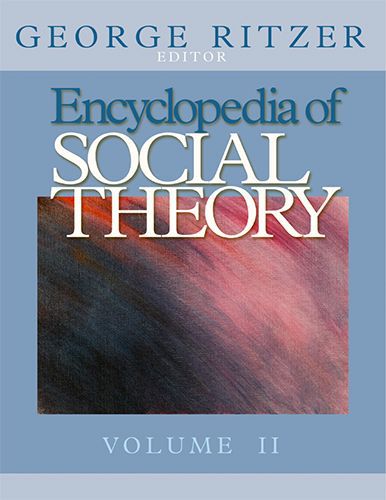
The Encyclopedia of Social Theory is an indispensable reference source for anyone interested in the roots of contemporary social theory. It examines the global landscape of all the key theories and the theorists behind them, presenting them in the context needed to understand their strengths and weaknesses. Led by internationally renowned scholar George Ritzer, the Encyclopedia of Social Theory draws together a team of more than 200 international scholars covering the developments, achievements, and prospects of social theory from its inception in the 18th century to the present. Understanding that social theory can both explain and alter the social world, this two-volume set serves as not only a foundation for learning, but also an inspiration for creative and reflexive engagement with the rich range of ideas it contains.
The Ethics of Nationalism blends a philosophical discussion of the ethical merits and limits of nationalism with a detailed understanding of nationalist aspirations and a variety of national conflict zones. The author discusses the controversial and contemporary issues of rights of secession,the policies of the state in privileging a particular national group, the kinds of accommodations of minority national, and multi cultural identity groups that are justifiable and appropriate. These insights are then applied to two central nationalist aspirations: nation-building and nationalself-determination projects. The discussion of nation-building projects invloves a theory of the appropriate policies and principles that the state should follow in giving preferences to a particular national group. The discussion of national self-determination projets analyses the kind of prodedualright to secession that should be institutionalized in domestic constitutions or international law, and the psooibilities for accomodation rival caims to national recognition in the changing international order.
ما از اخلاق چه انتظاری داریم؟ این سوال شاید تاحدودی برای عموم مردم و یا متخصصان این رشته قابل پاسخ باشد؛ اینکه خوب بودن را به ما بیاموزد و در تنظیم روابط فردی م...

جشن کتاب تهران به ایستگاه سی و یکم رسیده است. حال و احوال نشر کتاب خوب نیست و باید فرهنگدوستان را به خرید و هدیه دادن کتاب ترغیب نمود. خانه اخلاقپژوهان جوان ب...

بنیاد کتابهای اخلاق اسلامی عمدتا پالایش جان از آلودگیها و آراستن آن به زیباییها است. اندیشه محوری این قبیل کتابها آن است که انسان فعلی آنی نیست که باید باشد...

-
0 Comments