Notice: تابع WP_Block_Type_Registry::register به طورنادرست فراخوانی شد. نامهای نوع بلوک نباید حروف بزرگ داشته باشند. لطفاً برای اطلاعات بیشتر، اشکال زدایی در وردپرس را مشاهده کنید. (این پیام در نگارش 5.0.0 افزوده شده است.) in /home/ethicsho/public_html/wp-includes/functions.php on line 5313
Warning: Use of undefined constant TDC_PATH_LEGACY - assumed 'TDC_PATH_LEGACY' (this will throw an Error in a future version of PHP) in /home/ethicsho/public_html/wp-content/plugins/td-composer/td-composer.php on line 109
Warning: Use of undefined constant TDSP_THEME_PATH - assumed 'TDSP_THEME_PATH' (this will throw an Error in a future version of PHP) in /home/ethicsho/public_html/wp-content/plugins/td-composer/td-composer.php on line 113 بایگانیهای 9780521895071 - خانه اخلاق پژوهان جوان Notice: Trying to access array offset on value of type bool in /home/ethicsho/public_html/wp-content/plugins/wp-ulike/inc/general-functions.php on line 807
This work explains how human beings can live more peacefully with one another by understanding the conditions of possibility for dialogue. Philosophically, this challenge is articulated as the problem of: how dialogue as dia-logos is possible when the shared logos is precisely that which is in question. Emmanuel Levinas, in demonstrating that the shared logos is a function of interhuman relationship, helps us to make some progress in understanding the possibilities for dialogue in this situation. If the terms of the argument to his point are taken largely from Levina’s 1961 Totality & Infinity, Dudiak further proposes that Levina’s 1974 Otherwise than Being can be read as a deepening of these earlier analyses, delineating, both the conditions of possibility & impossibility for discourse itself. Throughout these analyses Dudiak discovers that in Levina’s view dialogue is ultimately possible, only for a gracious subjectivity already graced by God by way of the other, but where the word God is inseparable from my subjectivity as a graciousness to the other. Finally, for Levinas, the facilitation of dialogue, the facilitation of peace, comes down to the subject’s capacity & willingness to be who he or she is, to take the beautiful risk of a peaceful gesture offered to the other & that peace, in this gesture itself. As Levinas himself puts it: “Peace then is under my responsibility. I am a hostage, for I am alone to wage it, running a fine risk, dangerously.” Levinas’s philosophical discourse is precisely itself to be read as such a gesture.
If there is such a thing as reason, it has to be universal. Reason must reflect objective principles whose validity is independent of our point of view–principles that anyone with enough intelligence ought to be able to recognize as correct. But this generality of reason is what relativists and subjectivists deny in ever-increasing numbers. And such subjectivism is not just an inconsequential intellectual flourish or badge of theoretical chic. It is exploited to deflect argument and to belittle the pretensions of the arguments of others. The continuing spread of this relativistic way of thinking threatens to make public discourse increasingly difficult and to exacerbate the deep divisions of our society. In The Last Word, Thomas Nagel, one of the most influential philosophers writing in English, presents a sustained defense of reason against the attacks of subjectivism, delivering systematic rebuttals of relativistic claims with respect to language, logic, science, and ethics. He shows that the last word in disputes about the objective validity of any form of thought must lie in some unqualified thoughts about how things are–thoughts that we cannot regard from outside as mere psychological dispositions.
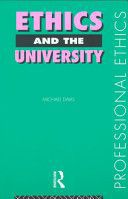
Ethics and the University brings together two closely related topics, the practice of ethics in the university (“academic ethics”) and the teaching of practical or applied ethics in the university. This volume is divided into four parts: * A survey of practical ethics, offering an explanation of its recent emergence as a university subject, situating that subject into a wider social and historical context and identifying some problems that the subject generates for universities * An examination of research ethics, including the problem of plagiarism * A discussion of the teaching of practical ethics. Michael Davis explores how ethics can be integrated into the university curriculum and what part particular cases should play in the teaching of ethics * An exploration of sexual ethics Ethics and the University provides a stimulating and provocative analysis of academic ethics which will be useful to students, academics and practitioners.
Copyright laws, along with other Intellectual Property Rights (IPRs), constitute the legal foundation for the “global knowledge-based economy” and copyright law now plays an increasingly important role in the creation of business fortunes, the access to and dissemination of knowledge, and human development in general. This book examines major problems in the current IPR regime, particularly the copyright regime, in the context of digitization, knowledge economy, and globalization. The book contends that the final goals of IP law and policy-making are to enhance the progress of science and economic development, and the use and even-distribution of intellectual resource at the global level. By referring to major international IP consensus, recent developments in regional IP forums and the successful experiences of various countries, YiJun Tian is able to provide specific theoretical, policy and legislative suggestions for addressing current copyright challenges. The book contends that each nation should strengthen the coordination of its IP protection and development strategies, adopt a more systematic and heterogeneous approach, and make IP theory, policy, specific legal mechanisms, marketing forces and all other available measures work collectively to deal with digital challenges and in a way that contributes to the establishment of a knowledge equilibrium international society.
ما از اخلاق چه انتظاری داریم؟ این سوال شاید تاحدودی برای عموم مردم و یا متخصصان این رشته قابل پاسخ باشد؛ اینکه خوب بودن را به ما بیاموزد و در تنظیم روابط فردی م...

جشن کتاب تهران به ایستگاه سی و یکم رسیده است. حال و احوال نشر کتاب خوب نیست و باید فرهنگدوستان را به خرید و هدیه دادن کتاب ترغیب نمود. خانه اخلاقپژوهان جوان ب...

بنیاد کتابهای اخلاق اسلامی عمدتا پالایش جان از آلودگیها و آراستن آن به زیباییها است. اندیشه محوری این قبیل کتابها آن است که انسان فعلی آنی نیست که باید باشد...

-
0 Comments