Notice: تابع WP_Block_Type_Registry::register به طورنادرست فراخوانی شد. نامهای نوع بلوک نباید حروف بزرگ داشته باشند. لطفاً برای اطلاعات بیشتر، اشکال زدایی در وردپرس را مشاهده کنید. (این پیام در نگارش 5.0.0 افزوده شده است.) in /home/ethicsho/public_html/wp-includes/functions.php on line 5313
Warning: Use of undefined constant TDC_PATH_LEGACY - assumed 'TDC_PATH_LEGACY' (this will throw an Error in a future version of PHP) in /home/ethicsho/public_html/wp-content/plugins/td-composer/td-composer.php on line 109
Warning: Use of undefined constant TDSP_THEME_PATH - assumed 'TDSP_THEME_PATH' (this will throw an Error in a future version of PHP) in /home/ethicsho/public_html/wp-content/plugins/td-composer/td-composer.php on line 113 بایگانیهای 9780521416979 - خانه اخلاق پژوهان جوان Notice: Trying to access array offset on value of type bool in /home/ethicsho/public_html/wp-content/plugins/wp-ulike/inc/general-functions.php on line 807
Like nature itself, modern economic life is driven by relentless competition and unbridled selfishness. Or is it? Drawing on converging evidence from neuroscience, social science, biology, law, and philosophy,Moral Marketsmakes the case that modern market exchange works only because most people, most of the time, act virtuously. Competition and greed are certainly part of economics, butMoral Marketsshows how the rules of market exchange have evolved to promote moral behavior and how exchange itself may make us more virtuous. Examining the biological basis of economic morality, tracing the connections between morality and markets, and exploring the profound implications of both,Moral Marketsprovides a surprising and fundamentally new view of economics–one that also reconnects the field to Adam Smith’s position that morality has a biological basis.Moral Markets, the result of an extensive collaboration between leading social and natural scientists, includes contributions by neuroeconomist Paul Zak; economists Robert H. Frank, Herbert Gintis, Vernon Smith (winner of the 2002 Nobel Prize in economics), and Bart Wilson; law professors Oliver Goodenough, Erin O’Hara, and Lynn Stout; philosophers William Casebeer and Robert Solomon; primatologists Sarah Brosnan and Frans de Waal; biologists Carl Bergstrom, Ben Kerr, and Peter Richerson; anthropologists Robert Boyd and Michael Lachmann; political scientists Elinor Ostrom and David Schwab; management professor Rakesh Khurana; computational science and informatics doctoral candidate Erik Kimbrough; and business writer Charles Handy.
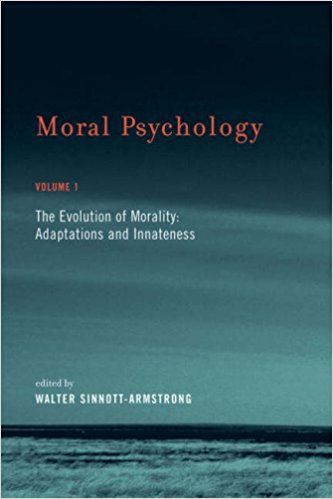
For much of the twentieth century, philosophy and science went their separate ways. In moral philosophy, fear of the so-called naturalistic fallacy kept moral philosophers from incorporating developments in biology and psychology. Since the 1990s, however, many philosophers have drawn on recent advances in cognitive psychology, brain science, and evolutionary psychology to inform their work. This collaborative trend is especially strong in moral philosophy, and these three volumes bring together some of the most innovative work by both philosophers and psychologists in this emerging interdisciplinary field.Contributors to Volume 1:William Casebeer (Air Force Academy), Leda Cosmides (University of California, Santa Barbara), Oliver Curry (London School of Economics), Michael Dietrich (Dartmouth College), Catherine Driscoll (North Carolina State University), Susan Dwyer (University of Maryland, Baltimore County), Owen Flanagan (Duke University), Gilbert Harman (Princeton University), Richard Joyce (Australian National University Research School of Social Science), Debra Lieberman (University of Hawaii), Ron Mallon (University of Utah), John Mikhail (Georgetown Law School), Geoffrey Miller (University of New Mexico), Jesse Prinz (University of North Carolina at Chapel Hill), Peter Railton (University of Michigan), Michael Ruse (Florida State University) Hagop Sarkissian (Duke University), Walter Sinnott-Armstrong (Dartmouth College), Chandra Sekhar Sripada (University of Michigan) Valerie Tiberius (University of Minnesota), John Tooby (University of California, Santa Barbara), Peter Tse (Dartmouth College) Kathleen Wallace (Hofstra University), Arthur Wolf (Stanford University), David Wong (Duke University).
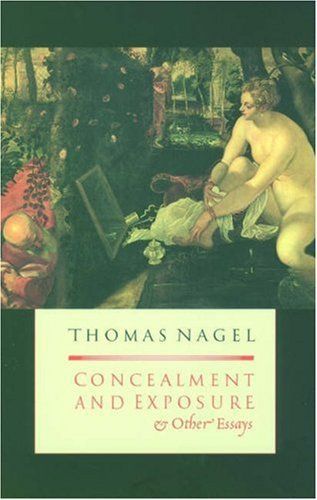
Thomas Nagel is widely recognized as one of the top American philosophers working today. Reflecting the diversity of his many philosophical preoccupations, this volume is a collection of his most recent critical essays and reviews. The first section, Public and Private, focuses on the notion of privacy in the context of social and political issues, such as the impeachment of President Clinton. The second section, Right and Wrong, discusses moral, political and legal theory, and includes pieces on John Rawls, G.A. Cohen, and T.M. Scanlon, among others. The final section, Mind and Reality, features discussions of Richard Rorty, Donald Davidson, and the Sokal hoax, and closes with a substantial new essay on the mind-body problem. Written with characteristic rigor, these pieces reveal the intellectual passion underlying the incisive analysis for which Nagel is known.
ما از اخلاق چه انتظاری داریم؟ این سوال شاید تاحدودی برای عموم مردم و یا متخصصان این رشته قابل پاسخ باشد؛ اینکه خوب بودن را به ما بیاموزد و در تنظیم روابط فردی م...

جشن کتاب تهران به ایستگاه سی و یکم رسیده است. حال و احوال نشر کتاب خوب نیست و باید فرهنگدوستان را به خرید و هدیه دادن کتاب ترغیب نمود. خانه اخلاقپژوهان جوان ب...

بنیاد کتابهای اخلاق اسلامی عمدتا پالایش جان از آلودگیها و آراستن آن به زیباییها است. اندیشه محوری این قبیل کتابها آن است که انسان فعلی آنی نیست که باید باشد...

-
0 Comments