Notice: تابع WP_Block_Type_Registry::register به طورنادرست فراخوانی شد. نامهای نوع بلوک نباید حروف بزرگ داشته باشند. لطفاً برای اطلاعات بیشتر، اشکال زدایی در وردپرس را مشاهده کنید. (این پیام در نگارش 5.0.0 افزوده شده است.) in /home/ethicsho/public_html/wp-includes/functions.php on line 5313
Warning: Use of undefined constant TDC_PATH_LEGACY - assumed 'TDC_PATH_LEGACY' (this will throw an Error in a future version of PHP) in /home/ethicsho/public_html/wp-content/plugins/td-composer/td-composer.php on line 109
Warning: Use of undefined constant TDSP_THEME_PATH - assumed 'TDSP_THEME_PATH' (this will throw an Error in a future version of PHP) in /home/ethicsho/public_html/wp-content/plugins/td-composer/td-composer.php on line 113 بایگانیهای 9780300128697 - خانه اخلاق پژوهان جوان Notice: Trying to access array offset on value of type bool in /home/ethicsho/public_html/wp-content/plugins/wp-ulike/inc/general-functions.php on line 807
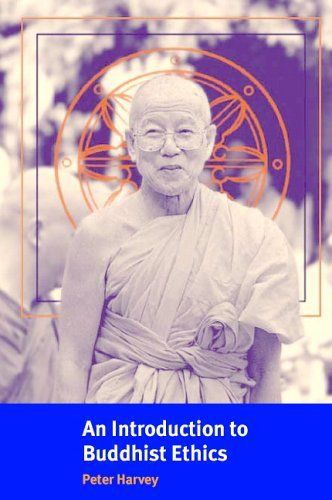
This systematic introduction to Buddhist ethics is aimed at anyone interested in Buddhism, including students, scholars and general readers. Peter Harvey is the author of the acclaimed Introduction to Buddhism (Cambridge, 1990), and his new book is written in a clear style, assuming no prior knowledge. At the same time it develops a careful, probing analysis of the nature and practical dynamics of Buddhist ethics in both its unifying themes and in the particularities of different Buddhist traditions. The book applies Buddhist ethics to a range of issues of contemporary concern: humanity’s relationship with the rest of nature; economics; war and peace; euthanasia; abortion; the status of women; and homosexuality. Professor Harvey draws on texts of the main Buddhist traditions, and on historical and contemporary accounts of the behaviour of Buddhists, to describe existing Buddhist ethics, to assess different views within it, and to extend its application into new areas.
Canadian Intellectual Property Law and Strategy provides a comprehensive overview of the Canadian law relating to trademarks, copyright and industrial designs, along with strategic, practice-oriented commentary regarding how such laws can best be used for business advantage. The first part of the book is devoted to trademarks. The material in this section, in addition to providing an overview of Canadian trademark law, will deal with how a foreign trademark owner can use the system most advantageously. The initial focus will be on acquisition of rights-for example, an application can be filed in Canada based on foreign registration and use and a registration can be obtained without having to show any use of the trade mark in Canada-while latter sections will emphasize the best strategies to maintain and protect trademark rights in Canada. The second part of the book is devoted to copyright, with less emphasis on the specific industries-e.g., movie production-that typically rely on the copyright system than a broad, business-oriented treatment that reflects the potentially far-reaching impact of the law. (For example, copyright can subsist in a design trade mark if sufficiently original.) The approach will thus be of a general commercial nature, emphasizing how legislation can be used to protect rights in Canada, with specific attention paid to understanding which rights are available and the steps that should be taken to protect those rights, whether by means of the appropriate assignments and registrations, or on enforcement actions in the Canadian courts. The third part of the book focuses on industrial designs, and will explain what needs to be done and when by manufacturers to protect their products. The emphasis will initially be on understanding the system and the potential benefits available by obtaining registrations, with the rest of the section focusing on the steps required to protect and assert those rights against infringers.
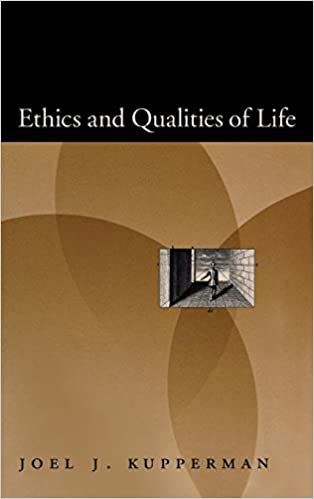
Ethics and Qualities of Life looks at what enters into ethical judgment and choice. Interpretation of a case and of what the options are is always a factor, as is a sense of the possible values at stake. Intuitions also enter in, but often are unreliable. For a long time it seemed only fair that oldest sons inherited, and struck few people as unfair that women were not allowed to attend universities. A moral judgment is putatively part of a moral order in a society that any reasonable person would accept. But what counts as “reasonable” is generally contestable. The unreliability of intuitions leads naturally to ethical theory. Kantian, contractualist, and consequentialist theories all have some important truth in them, but not the whole truth. Contractualism lacks the resources required for a fully determinate account of what counts as “reasonable”. Broad general rules are important to Kant and are at the center of everyday morality. But can Kantian ethics explain why they have to have this central role? Our evolving social contract now contains elements (e.g. the rejection of racism and sexism) that once would have seemed counter-intuitive to most people. But could consequentialists have predicted with entire confidence the consequences of social changes that we now think were desirable? The last part of this book contains a double argument. One is that ethical theory is employed by humans in a state of semi-ignorance of relevant factors, grasping at likely truths and evolved intuitions. The other is that consequentialist considerations have a major role at the fundamental level, but much more in justification or criticism than in ethical discovery.
ما از اخلاق چه انتظاری داریم؟ این سوال شاید تاحدودی برای عموم مردم و یا متخصصان این رشته قابل پاسخ باشد؛ اینکه خوب بودن را به ما بیاموزد و در تنظیم روابط فردی م...

جشن کتاب تهران به ایستگاه سی و یکم رسیده است. حال و احوال نشر کتاب خوب نیست و باید فرهنگدوستان را به خرید و هدیه دادن کتاب ترغیب نمود. خانه اخلاقپژوهان جوان ب...

بنیاد کتابهای اخلاق اسلامی عمدتا پالایش جان از آلودگیها و آراستن آن به زیباییها است. اندیشه محوری این قبیل کتابها آن است که انسان فعلی آنی نیست که باید باشد...

-
0 Comments