Notice: تابع WP_Block_Type_Registry::register به طورنادرست فراخوانی شد. نامهای نوع بلوک نباید حروف بزرگ داشته باشند. لطفاً برای اطلاعات بیشتر، اشکال زدایی در وردپرس را مشاهده کنید. (این پیام در نگارش 5.0.0 افزوده شده است.) in /home/ethicsho/public_html/wp-includes/functions.php on line 5313
Warning: Use of undefined constant TDC_PATH_LEGACY - assumed 'TDC_PATH_LEGACY' (this will throw an Error in a future version of PHP) in /home/ethicsho/public_html/wp-content/plugins/td-composer/td-composer.php on line 109
Warning: Use of undefined constant TDSP_THEME_PATH - assumed 'TDSP_THEME_PATH' (this will throw an Error in a future version of PHP) in /home/ethicsho/public_html/wp-content/plugins/td-composer/td-composer.php on line 113 بایگانیهای 9780231138185 - خانه اخلاق پژوهان جوان Notice: Trying to access array offset on value of type bool in /home/ethicsho/public_html/wp-content/plugins/wp-ulike/inc/general-functions.php on line 807
This important new study offers a powerful exposition of the ethical theory underlying Hegel’s philosophy of society, politics, and history. Professor Wood shows how Hegel applies his theory to such topics as human rights, the justification of legal punishment, criteria of moral responsibility, and the authority of individual conscience. The book includes a critical discussion of Hegel’s treatment of other moral philosophers (especially Kant, Fichte and Fries), provides an account of the controversial concept of “ethical life,” and shows the relation between the theory and Hegel’s critical assessment of modern social institutions. The book is nontechnical and should interest anyone concerned with Hegel’s ethical and political thought, including philosophers, political scientists, intellectual historians and students of German culture.
East Asian medicine, biomedical research, and health care policy are framed by their own set of moral and cultural commitments. Chief among these is the influence of Confucian ideas. A rich portrayal is offered of the implications of Confucian moral and ontological understandings for medical decision-making, human embryonic stem cell research, and health care financing. What is offered is a multifaceted insight into what distinguishes East Asian bioethical reflections. This volume opens with an exploration of the Confucian recognition of the family as an entity existing in its own right and which is not reducible to its members or their interests. As the essays in this volume show, this recognition of the family supports a notion of family autonomy that contrasts with Western individualistic accounts of proper medical decision-making. There are analyses of basic concepts as well as explorations of their implications for actual medical practice. The conflicts in East Asian countries between traditional Confucian and Western bioethics are explored as well as the tension between the new reproductive technologies and traditional understandings of the family. The studies of East Asian reflections concerning the moral status of human embryos and the morality of human embryo stem cell research disclose a set of concerns quite different from those anchored in Christian and Muslim cultural perspectives. The volume closes with an exploration of how Confucian cultural resources can be drawn upon to meet the contemporary challenges of health care financing.
Russell Hardin presents a new explication of David Hume’s moral and political theory. With Hume, he holds that our normative views can be scientifically explained but they cannot be justified as true. Hume argued for the psychological basis of such views. In particular, he argued for sympathy as the mirroring of the psychological sensations and emotions of others. By placing Hume in the developing tradition of social science, as a strong forerunner of his younger friend Adam Smith, Hardin demonstrates Hume’s strong strategic sense, his nascent utilitarianism, his powerful theory of convention as a main source of social and political order, and his recognition of moral and political theory as a single enterprise.
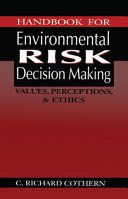
This handbook describes the broad aspects of risk management involving scientific policy judgment, uncertainty analysis, perception considerations, statistical insights, and strategic thinking. This book presents all the important concepts to enable the reader to “see the big picture.” This ability is extremely important – it allows the decision maker or strategic environmental planner to understand and cope with a wide variety of complex and interlinked pieces of information and data. The text presents environmental problems and, whenever applicable, the methodology required to reach a successful solution. Decisions and policies are examined. The book covers numerous objective and subjective components of environmental risk decision making. It details quantitative and comparative risk, and investigates the cost and feasibility of different decisions. Social pressures, safety, and political, religious, ethical, and psychological issues are addressed. How to evaluate the potential impact on the quality of life also is discussed. Any company doing risk assessment, risk management, or risk communication, as well as those doing environmental decision making will find this reference to be invaluable. It is also suitable as a text for courses in environmental management, environmental science, and risk assessment in the areas of risk management and strategic environmental planning.
ما از اخلاق چه انتظاری داریم؟ این سوال شاید تاحدودی برای عموم مردم و یا متخصصان این رشته قابل پاسخ باشد؛ اینکه خوب بودن را به ما بیاموزد و در تنظیم روابط فردی م...

جشن کتاب تهران به ایستگاه سی و یکم رسیده است. حال و احوال نشر کتاب خوب نیست و باید فرهنگدوستان را به خرید و هدیه دادن کتاب ترغیب نمود. خانه اخلاقپژوهان جوان ب...

بنیاد کتابهای اخلاق اسلامی عمدتا پالایش جان از آلودگیها و آراستن آن به زیباییها است. اندیشه محوری این قبیل کتابها آن است که انسان فعلی آنی نیست که باید باشد...

-
0 Comments