Notice: تابع WP_Block_Type_Registry::register به طورنادرست فراخوانی شد. نامهای نوع بلوک نباید حروف بزرگ داشته باشند. لطفاً برای اطلاعات بیشتر، اشکال زدایی در وردپرس را مشاهده کنید. (این پیام در نگارش 5.0.0 افزوده شده است.) in /home/ethicsho/public_html/wp-includes/functions.php on line 5313
Warning: Use of undefined constant TDC_PATH_LEGACY - assumed 'TDC_PATH_LEGACY' (this will throw an Error in a future version of PHP) in /home/ethicsho/public_html/wp-content/plugins/td-composer/td-composer.php on line 109
Warning: Use of undefined constant TDSP_THEME_PATH - assumed 'TDSP_THEME_PATH' (this will throw an Error in a future version of PHP) in /home/ethicsho/public_html/wp-content/plugins/td-composer/td-composer.php on line 113 بایگانیهای 9780199897261 - خانه اخلاق پژوهان جوان Notice: Trying to access array offset on value of type bool in /home/ethicsho/public_html/wp-content/plugins/wp-ulike/inc/general-functions.php on line 807
How should we decide which inequalities between people are justified, and which are unjustified? One answer is that such inequalities are only justified where there is a corresponding variation in responsible action or choice on the part of the persons concerned. This view, which has become known as ‘luck egalitarianism’, has come to occupy a central place in recent debates about distributive justice. This book is the first full length treatment of this significant development in contemporary political philosophy. Each of its three parts addresses a key question concerning the theory. Which version of luck egalitarian comes closest to realizing luck egalitarian objectives? Does luck egalitarianism succeed as a view of egalitarian justice? And is it sound as an account of distributive justice in general? The book provides a distinctive answer to each of these questions, along the way engaging with the leading theorists identified in the literature as luck egalitarians, such as Richard Arneson, G. A. Cohen, and Ronald Dworkin, as well as the most influential critics, including Elizabeth Anderson, Marc Fleurbaey, Susan Hurley, Samuel Scheffler, and Jonathan Wolff. Key Features *Presents a critical survey of already classic debates about responsibility, equality and justice *Provides a sustained engagement with luck egalitarianism’s critics *Stakes a distinctive position on the key questions regarding luck egalitarianism
Biotechnology and the Challenge of Property addresses the question of how the advancement of property law is capable of controlling the interests generated by the engineering of human tissues. Through a comparative consideration of non-Western societies and industrialized cultures, this book addresses the impact of modern biotechnology, and its legal accommodation on the customary conduct and traditional beliefs which shape the lives of different communities. As such, it provides an introduction to the legal regulation of the evolving uses of human tissues, and its implications for traditional knowledge, beliefs and cultures.
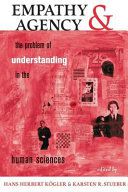
How do we, as interpreters and theorists in the human and social sciences, understand agency? What are the methods, models, and mediating theoretical frameworks that allow us to give a reliable and adequate account of beliefs, actions, and cultural practices? More specifically, how can we as interpretive analysts employ our own cognitive capacities so as to render the beliefs, intentions, and actions of other human beings intelligible? These are the leading questions that a group of well-established social philosophers explore in this volume in light of the most recent (and hotly debated) findings in cognitive science, developmental psychology, and philosophy of mind. In particular, the debate concerning simulation — whether agents interpret others by means of implicit theoretical assumptions, or whether they rather simulate their behavior by putting themselves in their shoes — has produced a wide set of important empirical and philosophical insights. This book takes up those insights and discusses their impact in the context of their most important paradigms in social methodology today.A systematic introduction pertaining to the understanding-explanation debate sets the stage, followed by eleven chapters representing the different approaches tot he field. The paradigms include Wittgensteinian, Davidsonian and Diltheyan approaches, hermeneutics and critical theory, game theory, naturalized epistemology, philosophy of history and twentieth-century social theory, as well as simulation approach proper. As stake are the relation between everyday and social-scientific interpretation, the role of empathy (or role-taking) in understanding human agency, the implications of attributing rationality in the course of interpretation, as well as the relation between rational and causal models in social explanation. The discussions cut across well-established disciplinary boundaries so that the book appeals to both analytic and hermeneutic traditions within philosophy. In addition, the book speaks to all who are engaged in interpreting or explaining human agency in the cultural and social sciences.
ما از اخلاق چه انتظاری داریم؟ این سوال شاید تاحدودی برای عموم مردم و یا متخصصان این رشته قابل پاسخ باشد؛ اینکه خوب بودن را به ما بیاموزد و در تنظیم روابط فردی م...

جشن کتاب تهران به ایستگاه سی و یکم رسیده است. حال و احوال نشر کتاب خوب نیست و باید فرهنگدوستان را به خرید و هدیه دادن کتاب ترغیب نمود. خانه اخلاقپژوهان جوان ب...

بنیاد کتابهای اخلاق اسلامی عمدتا پالایش جان از آلودگیها و آراستن آن به زیباییها است. اندیشه محوری این قبیل کتابها آن است که انسان فعلی آنی نیست که باید باشد...

-
0 Comments