Notice: تابع WP_Block_Type_Registry::register به طورنادرست فراخوانی شد. نامهای نوع بلوک نباید حروف بزرگ داشته باشند. لطفاً برای اطلاعات بیشتر، اشکال زدایی در وردپرس را مشاهده کنید. (این پیام در نگارش 5.0.0 افزوده شده است.) in /home/ethicsho/public_html/wp-includes/functions.php on line 5313
Warning: Use of undefined constant TDC_PATH_LEGACY - assumed 'TDC_PATH_LEGACY' (this will throw an Error in a future version of PHP) in /home/ethicsho/public_html/wp-content/plugins/td-composer/td-composer.php on line 109
Warning: Use of undefined constant TDSP_THEME_PATH - assumed 'TDSP_THEME_PATH' (this will throw an Error in a future version of PHP) in /home/ethicsho/public_html/wp-content/plugins/td-composer/td-composer.php on line 113 بایگانیهای 9780195335996 - خانه اخلاق پژوهان جوان Notice: Trying to access array offset on value of type bool in /home/ethicsho/public_html/wp-content/plugins/wp-ulike/inc/general-functions.php on line 807
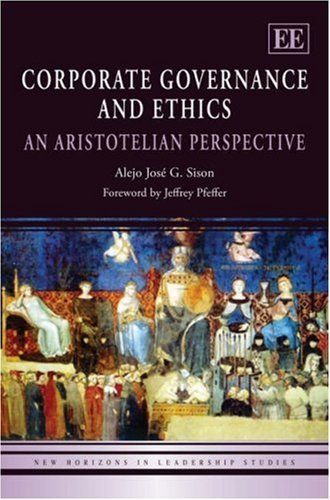
Corporate Governance and Ethics is an illuminating and practical reading of Aristotle’s Politics for today’s corporate directors. With a deft synthesis of ethics, economics and politics, Alejo Sison elevates the discussion of corporate governance out of the realm of abstract rules and structures into a more effective form of Aristotelian politics. He argues that corporate governance is a human practice where subjective, ethical conditions outweigh the mastery of techniques, since the firm is not a mere production function but, above all, a community of workers. Corporate governance issues are discussed in a holistic fashion, using international case studies to embed the discussion in environments defined by their economic, legal and cultural systems. One of the author’s key messages is that reform starts with the ethical and political education of directors.Alejo Sison uses an integrative approach to corporate governance that incorporates ethical-political considerations with the economic and legal dimensions of issues. He backs his theoretical claims with a series of case histories including Fiat from Italy, Cheung Kong Holdings and Whampoa Limited from China, Banco Popular from Spain and United Airlines from the US. He provides a special focus on the education of corporate directors in accordance with the principles of Aristotle’s Politics. This accessible book will appeal to corporate directors, executives and managers; academics and students with an interest in corporate governance, leadership and ethics, corporate citizenship and corporate social responsibility; and modern readers of Aristotle’s virtue theory and politics in relation to business ethics.
Truth — Meaning — Reality presents a fresh approach to philosophy: a broad and unified deflationism that encompasses language, thought, knowledge, reality, and the relations between them. Horwich’s story begins with a minimalist view of truth according to which this extraordinary concept is far less profound and substantial than has usually been assumed, since it stems entirely from our regarding “It is true that dogs bark” as equivalent to “Dogs bark,” and similarly in the case of all other statements. There’s nothing more to truth than that! This view turns out to be of fundamental importance throughout the subject. In the first instance it paves the way to an account of meaning as use, whereby the sense of each word-type is given by its basic patterns of deployment rather than by its association with a feature of the non-linguistic world. And the combination of deflated truth and ‘meaning as use’ then yields a perspective from which the long-standing debates between forms of “realism” and “anti-realism” must be preconceived. We are able to see that the positions typically adopted in these debates are all defective — contrived products of the mistaken assumption that reality, together with our representation of it, must exhibit a rigid uniformity and that deviations from the norm would be intolerably “weird.” The fourteen essays collected here constitute a coherent and complete expression of this three-pronged philosophy. Each of them is self-standing. But they have been revised and arranged so as to reveal the power and plausibility of Horwich’s overall approach. is three-pronged philosophy.
Recent scientific advances have placed many traditional philosophical concepts under great stress. In this pathbreaking book, the eminent philosopher Robert Nozick rethinks and transforms the concepts of truth, objectivity, necessity, contingency, consciousness, and ethics. Using an original method, he presents bold new philosophical theories that take account of scientific advances in physics, evolutionary biology, economics, and cognitive neuroscience, and casts current cultural controversies (such as whether all truth is relative and whether ethics is objective) in a wholly new light. Throughout, the book is open to, and engages in, the bold exploration of new philosophical possibilities.Philosophy will never look the same. Truth is embedded in space-time and is relative to it. However, truth is not socially relative among human beings (extraterrestrials are another matter). Objective facts are invariant under specified transformations; objective beliefs are arrived at by a process in which biasing factors do not play a significant role. Necessity’s domain is contracted (there are no important metaphysical necessities; water is not necessarily H2O) while the important and useful notion of degrees of contingency is elaborated. Gradations of consciousness (based upon “common registering”) yield increasing capacity to fit actions to the world. The originating function of ethics is cooperation to mutual benefit, and evolution has instilled within humans a “normative module”: the capacities to learn, internalize, follow norms, and make evaluations. Ethics has normative force because of the connection between ethics and conscious self-awareness. Nozick brings together the book’s novel theories to show the extent to which there are objective ethical truths.
Willliam O. Stephens explores the moral philosophy of Epictetus and shows how, for Epictetus, happiness results from focusing our concern on what is up to us while not worrying about what is beyond our control. He concludes that the strength of Epictetus’ philosophy lies in his conception of happiness as freedom from fear, worry, grief, and dependence upon luck.
ما از اخلاق چه انتظاری داریم؟ این سوال شاید تاحدودی برای عموم مردم و یا متخصصان این رشته قابل پاسخ باشد؛ اینکه خوب بودن را به ما بیاموزد و در تنظیم روابط فردی م...

جشن کتاب تهران به ایستگاه سی و یکم رسیده است. حال و احوال نشر کتاب خوب نیست و باید فرهنگدوستان را به خرید و هدیه دادن کتاب ترغیب نمود. خانه اخلاقپژوهان جوان ب...

بنیاد کتابهای اخلاق اسلامی عمدتا پالایش جان از آلودگیها و آراستن آن به زیباییها است. اندیشه محوری این قبیل کتابها آن است که انسان فعلی آنی نیست که باید باشد...

-
0 Comments