Notice: تابع WP_Block_Type_Registry::register به طورنادرست فراخوانی شد. نامهای نوع بلوک نباید حروف بزرگ داشته باشند. لطفاً برای اطلاعات بیشتر، اشکال زدایی در وردپرس را مشاهده کنید. (این پیام در نگارش 5.0.0 افزوده شده است.) in /home/ethicsho/public_html/wp-includes/functions.php on line 5313
Warning: Use of undefined constant TDC_PATH_LEGACY - assumed 'TDC_PATH_LEGACY' (this will throw an Error in a future version of PHP) in /home/ethicsho/public_html/wp-content/plugins/td-composer/td-composer.php on line 109
Warning: Use of undefined constant TDSP_THEME_PATH - assumed 'TDSP_THEME_PATH' (this will throw an Error in a future version of PHP) in /home/ethicsho/public_html/wp-content/plugins/td-composer/td-composer.php on line 113 بایگانیهای 9780195180985 - خانه اخلاق پژوهان جوان Notice: Trying to access array offset on value of type bool in /home/ethicsho/public_html/wp-content/plugins/wp-ulike/inc/general-functions.php on line 807
Is there a “right to die”? Should the elderly or the terminally ill be allowed to take their own lives? Should the families of comatose patients be permitted to decide when to “pull the plug”? Do “living wills” have full legal standing? Questions like these have been brought to the forefront of national attention by cases such as the battle in Terri Schiavo’s family. Offering excerpts from court decisions, plenty of full-color photographs, and other essential resources, “The Right to Die” examines this incendiary issue by illuminating the arguments from both sides.
In this cutting-edge volume leading scholars examine a diverse range of environmental inequalities from around the world and introduce a pluralistic agenda for critical environmental justice research Spaces of Environmental Justice explores novel theoretical approaches and neglected spaces of inequality and shows how far the field has moved beyond its original focus on uneven distributions of pollution in the USAThe book also considers the influence of critical geographical and social theory on environmental justice studies Arrange of possibilities for future research directions are identified as are the challenges involved in investigating and pursuing environmental justice at a time of rapid economic and environmental change
Book Summary of Classical Moralists: Selections Illustrating EthicsThis book is a history of ethics based upon selections from the original sources and upon translations of the authors themselves. The evolution of ethical thought is thereby revealed from Socrates to Martineau. Contents: Socrates; Plato; Aristotle; Zeno; Epicurus; Titus Lucretius Carus; Epictetus; Marcus Aurelius Antoninus; Plotinus; Saint Augustine; Peter Abelard; Thomas Abelard; Thomas Aquinas; Hugo Grotius; Thomas Hobbes; Ralph Cudworth; Henry More; Richard Cumberland; Baruch De Spinoza; Nicolas Malebranche; John Locke; Samuel Clarke; Third Earl of Shaftesbury; Benard De Mandeville; William Wollaston; Joseph Butler; Francis Hutcheson; David Hartley; David Hume; Adam Smith; Claude Adrien Helvetius; William Paley; Jeremy Bentham; Richard Price; Thomas Reid; Immanuel Kant; Johann Gottlieb; Georg Wilhelm Friedrich; Arthur Schopnehauer; Friedrich Eduard Beneke; John Stuart Mill; Herbert Spencer; Henry Sidgwick..
The last few years have seen a remarkable revival of interest in the virtues, which have regained their central role in moral philosophy. This thought-provoking new collection is a much-needed survey of virtue ethics and virtue theory. The specially commissioned articles by an international team of philosophers represent the state of the art in this subject and will set the agenda for future work in the area. The contributors–including Lawrence Blum, John Cottingham, Julia Driver, Rosalind Hursthouse, Terence Irwin, Susan Moller Okin, Onora O’Neill, Michael Slote, Michael Stocker, and David Wiggins–cover practical virtue ethics, ancient views of the virtues, impartiality and partiality, Kant, utilitarianism, human nature, natural and artificial virtues, virtue and the good life, the vices, emotions, politics, feminism, moral education, and community.
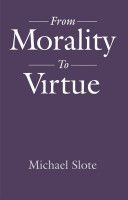
In this book, Slote offers the first full-scale foundational account of virtue ethics to have appeared since the recent revival of interest in the ethics of virtue. Slote advocates a particular form of such ethics for its intuitive and structural advantages over Kantianism, utilitarianism, and common-sense morality, and he argues that the problems of other views can be avoided and a contemporary plausible version of virtue ethics achieved only by abandoning specifically moral concepts for general aretaic notions like admirability and virtue. Although this study is not bound by particular Aristotelian doctrines, it places an Aristotelian emphasis on both self-benefiting and other-benefiting virtues. Slote criticizes Kantian and common-sense morality for internal incoherencies and for downgrading the moral individual and her well-being in some previously unnoticed ways. By contrast, this book defends a distinctive, intuitive, and symmetric ethical principle according to which we should balance self-concern with concern for others, but it also concludes that there is, contrary to utilitarianism, no single basis for status as a virtue nor any simple relation between the virtues and human well-being.
ما از اخلاق چه انتظاری داریم؟ این سوال شاید تاحدودی برای عموم مردم و یا متخصصان این رشته قابل پاسخ باشد؛ اینکه خوب بودن را به ما بیاموزد و در تنظیم روابط فردی م...

جشن کتاب تهران به ایستگاه سی و یکم رسیده است. حال و احوال نشر کتاب خوب نیست و باید فرهنگدوستان را به خرید و هدیه دادن کتاب ترغیب نمود. خانه اخلاقپژوهان جوان ب...

بنیاد کتابهای اخلاق اسلامی عمدتا پالایش جان از آلودگیها و آراستن آن به زیباییها است. اندیشه محوری این قبیل کتابها آن است که انسان فعلی آنی نیست که باید باشد...

-
0 Comments