Notice: تابع WP_Block_Type_Registry::register به طورنادرست فراخوانی شد. نامهای نوع بلوک نباید حروف بزرگ داشته باشند. لطفاً برای اطلاعات بیشتر، اشکال زدایی در وردپرس را مشاهده کنید. (این پیام در نگارش 5.0.0 افزوده شده است.) in /home/ethicsho/public_html/wp-includes/functions.php on line 5313
Warning: Use of undefined constant TDC_PATH_LEGACY - assumed 'TDC_PATH_LEGACY' (this will throw an Error in a future version of PHP) in /home/ethicsho/public_html/wp-content/plugins/td-composer/td-composer.php on line 109
Warning: Use of undefined constant TDSP_THEME_PATH - assumed 'TDSP_THEME_PATH' (this will throw an Error in a future version of PHP) in /home/ethicsho/public_html/wp-content/plugins/td-composer/td-composer.php on line 113 بایگانیهای 978-1-118-28172-7 - خانه اخلاق پژوهان جوان Notice: Trying to access array offset on value of type bool in /home/ethicsho/public_html/wp-content/plugins/wp-ulike/inc/general-functions.php on line 807
Everywhere people share certain moral principles–it is bad to steal, to kill, to lie–and yet we often subvert these rules. As Robert Hinde points out in this provocative book, the politician will vote with his party instead of his conscience, a lawyer will argue a point that he or she personally abhors. And this constant bending the rules ultimately endangers our world. Hinde, an eminent Cambridge biologist and psychologist, here presents a new approach to morality–combining insights from evolutionary science with observations on how people actually behave. Featuring contributions by Nobel Peace Laureate Sir Joseph Rotblat, the book illuminates how rule-bending–hardening in-group boundaries, putting duty over other moral obligations, and much more–occurs within personal relationships, law, science, medicine, politics, business, and war. Hinde argues that many of the world’s problems are related to the disregard of moral rules–for instance, racism, religious intolerance, excessive consumerism, and global warming. With growing reliance on nuclear weapons, we are heading for a world ruled by threat and fear, instead of one ruled by law and mutual understanding. We need a new understanding of morality, its nature, sources, and importance for communal living. This book helps to provide that understanding.
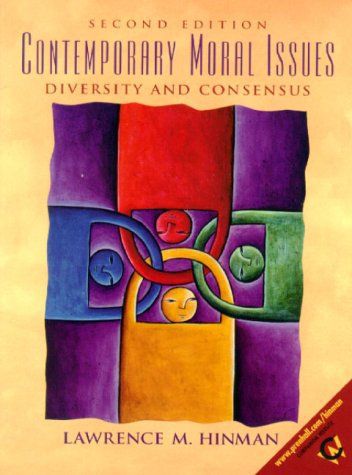
This anthology provides a comprehensive selection of readings on eleven contemporary social issues revolving around three general themes: Matters of Life and Death, Matters of Equality and Diversity, and Expanding the Circle (duties beyond borders, living together with animals, and environmental ethics). Each group of readings is accompanied by narrative selections that present the moral issues from a first person point of view; an extensive introduction surveys the problems and issues; and a bibliographical essay to relevant additional literature. Each selection is accompanied by pre- and post-reading questions. An ethical self-inventory–with pre-test and post-test–helps readers track changes in their own beliefs as they work through the readings, and a special section shows readers step-by-step how develop a personal position on ethical issues. A Pluralistic Approach to Moral Problems. How to Develop a Position on Ethical Issues. MATTERS OF LIFE AND DEATH: Abortion; Genetic Manipulation and Cloning; Euthanasia; Punishment and the Death Penalty. MATTERS OF EQUALITY AND DIVERSITY: Race and Ethnicity; Gender; Sexual Orientation; Poverty and Welfare; EXPANDING THE CIRCLE: Duties Beyond Borders; Living Together with Animals; Environmental Ethics. For anyone interested in Ethics, Social Ethics, and Contemporary Moral Problems.
In The Morality of Everyday Life, Thomas Fleming offers an alternative to the enlightened liberalism espoused by thinkers as different as Kant, Mill, Rand, and Rawls. These thinkers maintain that a problem should be looked at from an objective point of view and a decision made from a distant perspective that is both rational and universally applied to all comparable cases. Fleming instead places importance on the particular, the local, and moral complexity. For Fleming, postmodernism, which began with Nietzsche, is not the answer to moral dilemmas either. Fleming advocates a return to premodern traditions, such as those exemplified in the texts of Aristotle, the Talmud, and the folk wisdom in ancient Greek literature, for a solution to ethical predicaments. In his view, liberalism and postmodernism ignore the fact that human beings by their very nature refuse to live in a world of universal abstractions wherein the attachments of friends, neighbors, family, and country make no difference. Premodern thinkers, unlike those since the seventeenth century, recognized that particular obligations arise from specific circumstances and experiences. While such modern philosophers as Kant and Kohlberg have regarded a mother’s self-sacrificing love for her children as beneath their level of morality, folk wisdom tells us it is nearly the highest morality, taking precedence over the duties of citizenship or the claims of humanity. Fleming believes that a modern type of “casuistry” should be applied to these hard cases–moral conflicts in which thee is no clear right or wrong. Casuistry, as it was practiced in the Middle Ages, was a case-by-case analysis of each dilemma. Genuine casuistry is based ontwo principles: that there are general and universally applicable moral laws governing human conduct, and that these laws may not be applied simplistically and uniformly to the great variety of human circumstances and situa
ما از اخلاق چه انتظاری داریم؟ این سوال شاید تاحدودی برای عموم مردم و یا متخصصان این رشته قابل پاسخ باشد؛ اینکه خوب بودن را به ما بیاموزد و در تنظیم روابط فردی م...

جشن کتاب تهران به ایستگاه سی و یکم رسیده است. حال و احوال نشر کتاب خوب نیست و باید فرهنگدوستان را به خرید و هدیه دادن کتاب ترغیب نمود. خانه اخلاقپژوهان جوان ب...

بنیاد کتابهای اخلاق اسلامی عمدتا پالایش جان از آلودگیها و آراستن آن به زیباییها است. اندیشه محوری این قبیل کتابها آن است که انسان فعلی آنی نیست که باید باشد...

-
0 Comments