Notice: تابع WP_Block_Type_Registry::register به طورنادرست فراخوانی شد. نامهای نوع بلوک نباید حروف بزرگ داشته باشند. لطفاً برای اطلاعات بیشتر، اشکال زدایی در وردپرس را مشاهده کنید. (این پیام در نگارش 5.0.0 افزوده شده است.) in /home/ethicsho/public_html/wp-includes/functions.php on line 5313
Warning: Use of undefined constant TDC_PATH_LEGACY - assumed 'TDC_PATH_LEGACY' (this will throw an Error in a future version of PHP) in /home/ethicsho/public_html/wp-content/plugins/td-composer/td-composer.php on line 109
Warning: Use of undefined constant TDSP_THEME_PATH - assumed 'TDSP_THEME_PATH' (this will throw an Error in a future version of PHP) in /home/ethicsho/public_html/wp-content/plugins/td-composer/td-composer.php on line 113 بایگانیهای 0966405927 - خانه اخلاق پژوهان جوان Notice: Trying to access array offset on value of type bool in /home/ethicsho/public_html/wp-content/plugins/wp-ulike/inc/general-functions.php on line 807
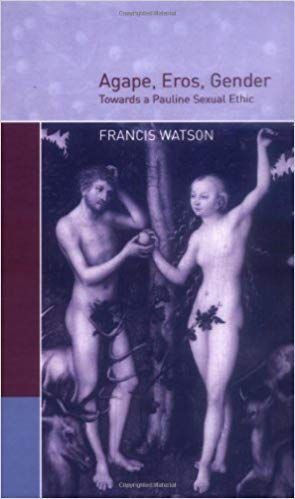
Issues of gender and sexuality have recently come to the fore in all humanities disciplines, and this book reflects this broad interdisciplinary situation. It focuses on issues of gender and sexuality (eros) in the light of the comprehensive divine-human love (agape) which, for the New Testament, lies at the heart of Christian faith and practice. The intention is to outline a distinctively Christian understanding of the male/female relationship reflecting the priority of agape over eros. Key Pauline texts are read alongside modern texts by Virginia Woolf, Freud and Irigaray.
In The Bodies of Women, Rosalyn Diprose argues that traditional approaches to ethics both perpetuate and remain blind to the mechanisms of the subordination of women. She claims that injustice against women is found within the social discourses and practices which evaluate and constitute the ways they are represented in relation to men.Diprose draws on insights from continental philosophy and feminist theory of the English-speaking world, and supports her arguments with critical readings of Irigaray, Cornell, Fraser, Hegel, Nietzsche, Merleau-Ponty, Derrida and Foucault. What emerges is a new ethics of sexual difference that better locates the mechanisms of discrimination and also provides the means to subvert them.
This book analyzes the moral confusion of contemporary society, relating rival conceptions of morality with a wide variety of views about the nature and predicament of man. Mitchell argues that many secular thinkers possess a traditional “Christian” conscience which they find hard to defend in terms of an entirely secular world-view, but which is more in line with a Christian understanding of man.
Christine M. Korsgaard is one of today’s leading moral philosophers: this volume collects ten influential papers by her on practical reason and moral psychology. Korsgaard draws on the work of important figures in the history of philosophy such as Plato, Aristotle, Kant, and Hume, showing how their ideas can inform the solution of contemporary and traditional philosophical problems, such as the foundations of morality and practical reason, the nature of agency, and the role of the emotions in action. In Part 1, The Principles of Practical Reason, Korsgaard defends the view that the principles of practical reason are constitutive principles of action. By governing our actions in accordance with Kant’s categorical imperative and the principle of instrumental reason, she argues, we take control of our own movements and so render ourselves active, self-determining beings. She criticizes rival attempts to give a normative foundation to the principles of practical reason, challenges the claims of the principle of maximizing one’s own interests to be a rational principle, and argues for some deep continuities between Plato’s account of the connection between justice and agency and Kant’s account of the connection between autonomy and agency. In Part II, Moral Virtue and Moral Psychology , Korsgaard takes up the question of the role of our more passive or receptive faculties–our emotions and responses –in constituting our agency. She sketches a reading of the Nicomachean Ethics , based on the idea that our emotions can serve as perceptions of good and evil, and argues that this view of the emotions is at the root of the apparent differences between Aristotle and Kant’s accounts of morality. She argues that in fact, Aristotle and Kant share a distinctive view about the locus of moral value and the nature of human choice that, among other things, gives them account of what it means to act rationally that is superior to other accounts. In Part III, Other Reflections, Korsgaard takes up question how we come to view one another as moral agents in Hume’s philosophy. She examines the possible clash between the agency of the state and that of the individual that led to Kant’s paradoxical views about revolution. And finally, she discusses her methodology in an account of what it means to be a constructivist moral philosopher. The essays are united by an introduction in which Korsgaard explains their connections to each other and to her current work.
ما از اخلاق چه انتظاری داریم؟ این سوال شاید تاحدودی برای عموم مردم و یا متخصصان این رشته قابل پاسخ باشد؛ اینکه خوب بودن را به ما بیاموزد و در تنظیم روابط فردی م...

جشن کتاب تهران به ایستگاه سی و یکم رسیده است. حال و احوال نشر کتاب خوب نیست و باید فرهنگدوستان را به خرید و هدیه دادن کتاب ترغیب نمود. خانه اخلاقپژوهان جوان ب...

بنیاد کتابهای اخلاق اسلامی عمدتا پالایش جان از آلودگیها و آراستن آن به زیباییها است. اندیشه محوری این قبیل کتابها آن است که انسان فعلی آنی نیست که باید باشد...

-
0 Comments