Notice: تابع WP_Block_Type_Registry::register به طورنادرست فراخوانی شد. نامهای نوع بلوک نباید حروف بزرگ داشته باشند. لطفاً برای اطلاعات بیشتر، اشکال زدایی در وردپرس را مشاهده کنید. (این پیام در نگارش 5.0.0 افزوده شده است.) in /home/ethicsho/public_html/wp-includes/functions.php on line 5313
Warning: Use of undefined constant TDC_PATH_LEGACY - assumed 'TDC_PATH_LEGACY' (this will throw an Error in a future version of PHP) in /home/ethicsho/public_html/wp-content/plugins/td-composer/td-composer.php on line 109
Warning: Use of undefined constant TDSP_THEME_PATH - assumed 'TDSP_THEME_PATH' (this will throw an Error in a future version of PHP) in /home/ethicsho/public_html/wp-content/plugins/td-composer/td-composer.php on line 113 بایگانیهای 97 - خانه اخلاق پژوهان جوان Notice: Trying to access array offset on value of type bool in /home/ethicsho/public_html/wp-content/plugins/wp-ulike/inc/general-functions.php on line 807
“By integrating the fields of psychology and special education . . . [t]his book provides a valuable reference for graduate faculty members and students as well as practitioners.”Linda K. Knauss, PhD, Assistant Professor and Director of Internship TrainingP>”A must-read for any comprehensive school psychology law and ethics course. I could not imagine teaching the course without the support of this book.”Kara E. McGoey, PhD, Assistant ProfessorP>This completely updated edition of the leading ethics and law guide for students, as well as practicing school psychologists, provides authoritative, timely information on professional standards and legal requirements pertinent to the delivery of school psychological services. Ethics and Law for School Psychologists, Fourth Edition covers a host of ethical and legal issues that are unique to the field, including LI>Students’ and parents’ rights to privacy and informed consentLI>Confidentiality and the duty to protectLI>Psychoeducational assessment and interventionLI>Schooling for students with special needsLI>School discipline and violence preventionLI>Provision of culturally sensitive services to diverse clienteleLI>Protection of the rights of sexual minority studentsLI>Supervision of school psychologists in trainingP>Offering a wealth of new information, this book includes recent changes in professional standards such as the 2002 revision of the American Psychological Association’s “Ethical Principles and Code of Conduct” and the 2000 revision of the National Association of School Psychologists’ “Principles for Professional Ethics.” The discussion of the Individuals with Disabilities Education Act (IDEA) incorporates the 1999 regulations as well as recent developments in case law. The ethical and legal mandate to respect cultural, linguistic, and role differences is given greater emphasis throughout this edition
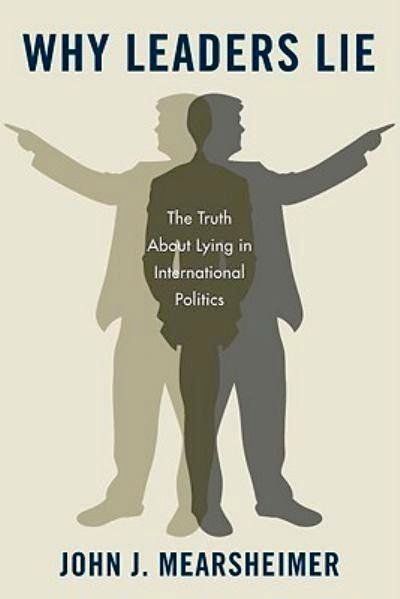
For more than two decades, John J. Mearsheimer has been regarded as one of the foremost realist thinkers on foreign policy. Clear and incisive, a fearlessly honest analyst, his coauthored 2007 New York Times bestseller, The Israel Lobby and U.S. Foreign Policy, aroused a firestorm with its unflinching look at the making of America’s Middle East policy. Now he takes a look at another controversial but understudied aspect of international relations: lying.In Why Leaders Lie, Mearsheimer provides the first systematic analysis of lying as a tool of statecraft, identifying the varieties, the reasons, and the potential costs and benefits. Drawing on a trove of examples, he argues that leaders often lie for good strategic reasons, so a blanket condemnation is unrealistic and unwise. Yet there are other kinds of deception besides lying, including concealment and spinning. Perhaps no distinction is more important than that between lying to another state and lying to one’s own people. Mearsheimer was amazed to discover how unusual interstate lying has been; given the atmosphere of distrust among the great powers, he found that outright deceit is difficult to pull off and thus rarely worth the effort. Plus it sometimes backfires when it does occur. Khrushchev lied about the size of the Soviet missile force, sparking an American build-up. Eisenhower got caught lying about U-2 spy flights in 1960, which scuttled an upcoming summit with Krushchev. Leaders more often mislead their own publics, sometimes with damaging consequences. Though the reasons may be noble–Franklin Roosevelt, for example, lied to the American people about German U-boats attacking the destroyer Greer in 1940, to build a case for war against Hitler–they can easily lead to disaster, as with the Bush administration’s falsehoods about Iraq’s weapons of mass destruction. There has never been a full discussion of international lying. Now a leading expert fills the gap with a richly informed and powerfully argued book.
“In this book, Jean Kazez asks the perennial philosophical questions about what we should place at the center of our lives. Incorporating the views of both past and present philosophers, as well as examples from history, literature, media, and the news, this concise introduction to ethics and philosophy offers an opportunity for personal reflection. Contemplating the importance of happiness, morality, self expression, desire, religion, and family, The Weight of Things invites the reader to explore the difficult questions in our daily lives.”–BOOK JACKET.
ما از اخلاق چه انتظاری داریم؟ این سوال شاید تاحدودی برای عموم مردم و یا متخصصان این رشته قابل پاسخ باشد؛ اینکه خوب بودن را به ما بیاموزد و در تنظیم روابط فردی م...

جشن کتاب تهران به ایستگاه سی و یکم رسیده است. حال و احوال نشر کتاب خوب نیست و باید فرهنگدوستان را به خرید و هدیه دادن کتاب ترغیب نمود. خانه اخلاقپژوهان جوان ب...

بنیاد کتابهای اخلاق اسلامی عمدتا پالایش جان از آلودگیها و آراستن آن به زیباییها است. اندیشه محوری این قبیل کتابها آن است که انسان فعلی آنی نیست که باید باشد...

-
0 Comments