Notice: تابع WP_Block_Type_Registry::register به طورنادرست فراخوانی شد. نامهای نوع بلوک نباید حروف بزرگ داشته باشند. لطفاً برای اطلاعات بیشتر، اشکال زدایی در وردپرس را مشاهده کنید. (این پیام در نگارش 5.0.0 افزوده شده است.) in /home/ethicsho/public_html/wp-includes/functions.php on line 5313
Warning: Use of undefined constant TDC_PATH_LEGACY - assumed 'TDC_PATH_LEGACY' (this will throw an Error in a future version of PHP) in /home/ethicsho/public_html/wp-content/plugins/td-composer/td-composer.php on line 109
Warning: Use of undefined constant TDSP_THEME_PATH - assumed 'TDSP_THEME_PATH' (this will throw an Error in a future version of PHP) in /home/ethicsho/public_html/wp-content/plugins/td-composer/td-composer.php on line 113 بایگانیهای 618 - خانه اخلاق پژوهان جوان Notice: Trying to access array offset on value of type bool in /home/ethicsho/public_html/wp-content/plugins/wp-ulike/inc/general-functions.php on line 807
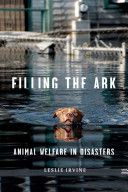
When disasters strike, people are not the only victims. Hurricane Katrina raised public attention about how disasters affect dogs, cats, and other animals considered members of the human family. In this short but powerful book, noted sociologist Leslie Irvine goes beyond Katrina to examine how disasters like oil spills, fires, and other calamities affect various animal populations-on factory farms, in research facilities, and in the wild.Filling the Arkargues that humans cause most of the risks faced by animals and urges for better decisions about the treatment of animals in disasters. Furthermore, it makes a broad appeal for the ethical necessity of better planning to keep animals out of jeopardy. Irvine not only offers policy recommendations and practical advice for evacuating animals, she also makes a strong case for rethinking our use of animals, suggesting ways to create more secure conditions.
Philosophers have long suspected that thought and discourse about what we ought to do differ in some fundamental way from statements about what is. But the difference has proved elusive, in part because the two kinds of statement look alike. Focusing on judgments that express decisions–judgments about what is to be done, all things considered–Allan Gibbard offers a compelling argument for reconsidering, and reconfiguring, the distinctions between normative and descriptive discourse–between questions of “ought” and “is.” Gibbard considers how our actions, and our realities, emerge from the thousands of questions and decisions we form for ourselves. The result is a book that investigates the very nature of the questions we ask ourselves when we ask how we should live, and that clarifies the concept of “ought” by understanding the patterns of normative concepts involved in beliefs and decisions. An original and elegant work of metaethics, this book brings a new clarity and rigor to the discussion of these tangled issues, and will significantly alter the long-standing debate over “objectivity” and “factuality” in ethics. Table of Contents: I. Preliminaries 1. Introduction: A Possibility Proof 2. Intuitionism as Template: Emending Moore II. The Thing to Do 3. Planning and Ruling Out: The “Frege-Geach” Problem 4. Judgment, Disagreement, Negation 5. Supervenience and Constitution 6. Character and Import III. Normative Concepts 7. Ordinary Oughts: Meaning and Motivation 8. Normative Kinds: Patterns of Engagement 9. What to Say about the Thing to Do: The Expressivistic Turn and What it Gains Us IV. Knowing What to Do 10. Explaining with Plans 11. Knowing What to Do 12. Ideal Response Concepts 13. Deep Vindication and Practical Confidence 14. Impasse and Dissent References Index This is a remarkable book. It takes up a central and much-discussed problem – the difference between normative thought (and discourse) and “descriptive” thought (and discourse). It develops a compelling response to that problem with ramifications for much else in philosophy. But perhaps most importantly, it brings new clarity and rigor to the discussion of these tangled issues. It will take some time to come to terms with the details of Gibbard’s discussion. It is absolutely clear, however, that the book will reconfigure the debate over objectivity and “factuality” in ethics.–Gideon Rosen, Professor of Philosophy, Princeton UniversityGibbard,/author> writes elegantly, and the theory he develops is innovative, philosophically sophisticated, and challenging. Gibbard defends his theory vigorously and with admirable intellectual honesty.–David Copp, Professor of Philosophy, Bowling Green State University
Wide-ranging and ambitious, Justice combines moral philosophy and Christian ethics to develop an important theory of rights and of justice as grounded in rights. Nicholas Wolterstorff discusses what it is to have a right, and he locates rights in the respect due the worth of the rights-holder. After contending that socially-conferred rights require the existence of natural rights, he argues that no secular account of natural human rights is successful; he offers instead a theistic account. Wolterstorff prefaces his systematic account of justice as grounded in rights with an exploration of the common claim that rights-talk is inherently individualistic and possessive. He demonstrates that the idea of natural rights originated neither in the Enlightenment nor in the individualistic philosophy of the late Middle Ages, but was already employed by the canon lawyers of the twelfth century. He traces our intuitions about rights and justice back even further, to Hebrew and Christian scriptures. After extensively discussing justice in the Old Testament and the New, he goes on to show why ancient Greek and Roman philosophy could not serve as a framework for a theory of rights. Connecting rights and wrongs to God’s relationship with humankind, Justice not only offers a rich and compelling philosophical account of justice, but also makes an important contribution to overcoming the present-day divide between religious discourse and human rights.
Much of the intense current interest in collective memory concerns the politics of memory. In a book that asks, “Is there an ethics of memory?” Avishai Margalit addresses a separate, perhaps more pressing, set of concerns. The idea he pursues is that the past, connecting people to each other, makes possible the kinds of “thick” relations we can call truly ethical. Thick relations, he argues, are those that we have with family and friends, lovers and neighbors, our tribe and our nation–and they are all dependent on shared memories. But we also have “thin” relations with total strangers, people with whom we have nothing in common except our common humanity. A central idea of the ethics of memory is that when radical evil attacks our shared humanity, we ought as human beings to remember the victims. Margalit’s work offers a philosophy for our time, when, in the wake of overwhelming atrocities, memory can seem more crippling than liberating, a force more for revenge than for reconciliation. Morally powerful, deeply learned, and elegantly written, The Ethics of Memory draws on the resources of millennia of Western philosophy and religion to provide us with healing ideas that will engage all of us who care about the nature of our relations to others.
“While providing background theory on harm reduction and pragmatic public health approaches to disease prevention, is focused on HIV/AIDS epidemic in the countries of Central and Eastern Europe and the Newly Independent States (CEE/NIS). This region now se”
ما از اخلاق چه انتظاری داریم؟ این سوال شاید تاحدودی برای عموم مردم و یا متخصصان این رشته قابل پاسخ باشد؛ اینکه خوب بودن را به ما بیاموزد و در تنظیم روابط فردی م...

جشن کتاب تهران به ایستگاه سی و یکم رسیده است. حال و احوال نشر کتاب خوب نیست و باید فرهنگدوستان را به خرید و هدیه دادن کتاب ترغیب نمود. خانه اخلاقپژوهان جوان ب...

بنیاد کتابهای اخلاق اسلامی عمدتا پالایش جان از آلودگیها و آراستن آن به زیباییها است. اندیشه محوری این قبیل کتابها آن است که انسان فعلی آنی نیست که باید باشد...

-
0 Comments