Notice: تابع WP_Block_Type_Registry::register به طورنادرست فراخوانی شد. نامهای نوع بلوک نباید حروف بزرگ داشته باشند. لطفاً برای اطلاعات بیشتر، اشکال زدایی در وردپرس را مشاهده کنید. (این پیام در نگارش 5.0.0 افزوده شده است.) in /home/ethicsho/public_html/wp-includes/functions.php on line 5313
Warning: Use of undefined constant TDC_PATH_LEGACY - assumed 'TDC_PATH_LEGACY' (this will throw an Error in a future version of PHP) in /home/ethicsho/public_html/wp-content/plugins/td-composer/td-composer.php on line 109
Warning: Use of undefined constant TDSP_THEME_PATH - assumed 'TDSP_THEME_PATH' (this will throw an Error in a future version of PHP) in /home/ethicsho/public_html/wp-content/plugins/td-composer/td-composer.php on line 113 بایگانیهای 565 - خانه اخلاق پژوهان جوان Notice: Trying to access array offset on value of type bool in /home/ethicsho/public_html/wp-content/plugins/wp-ulike/inc/general-functions.php on line 807
Thomas Aquinas is one of the foremost thinkers in Western philosophy and Christian scholarship, recognized as a significant voice in both theological discussions and secular philosophical debates. Alongside a revival of interest in Thomism in philosophy, scholars have realized its relevance when addressing certain contemporary issues in bioethics. This book offers a rigorous interpretation of Aquinas’s metaphysics and ethical thought, and highlights its significance to questions in bioethics. Jason T. Eberl applies Aquinas’s views on the seminal topics of human nature and morality to key questions in bioethics at the margins of human life – questions which are currently contested in the academia, politics and the media such as: * When does a human person’s life begin? How should we define and clinically determine a person’s death? * Is abortion ever morally permissible? How should we resolve the conflict between the potential benefits of embryonic stem cell research and the lives ofhuman embryos? * Does cloning involve a misuse of human ingenuity and technology? * What forms of treatment are appropriate for irreversibly comatose patients? How should we care for patients who experience unbearable suffering as they approach the end of life? * What ethical mandates and concerns underlie the practice of organ donation? Thomistic Principles and Bioethicspresents a significant philosophical viewpoint which should motivate further dialogue amongst religious and secular arenas of inquiry concerning such complex issues of both individual and public concern. It will be illuminating reading for scholars, postgraduate and research students of philosophy, metaphysics, ethics, bioethics and moral theology.
Religion is a dominant force in the lives of many Americans. It animates, challenges, directs and shapes, as well, the legal, political, and scientific agendas of the new Age of Biotechnology. In a very real way, religion, biomedical technology and law are – epistemologically – different. Yet, they are equal vectors of force in defining reality and approaching an understanding of it. Indeed, all three share a synergetic relationship, for they seek to understand and improve the human condition. This book strikes a rich balance between thorough analysis (in the body), anchored in sound references to religion, law and medical scientific analysis, and a strong scholarly direction in the end notes. It presents new insights into the decision-making processes of the new Age of Biotechnology and shows how religion, law and medical science interact in shaping, directing and informing the political processes. This volume will be of interest to both scholars and practitioners in the fields of religion and theology, philosophy, ethics, (family) law, science, medicine, political science and public policy, and gender studies. It will serve as a reference source and can be used in graduate and undergraduate courses in law, medicine and religion.
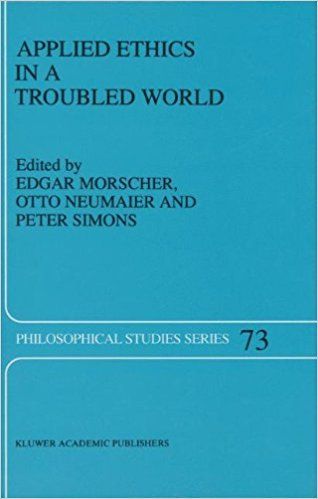
During the last two decades, applied ethics has not only developed into one of the most important philosophical disciplines but has also differentiated into so many subdisciplines that it is becoming increasingly difficult to survey it. A much-needed overview is provided by the eighteen contributions to this volume, in which internationally renowned experts deal with central questions of environmental ethics, bioethics and medical ethics, professional and business ethics, social, political, and legal ethics as well as with the aims and foundations of applied ethics in general. Thanks to a philosophical introduction and selected bibliographical references added to each chapter, the book is very well suited as a basis for courses in applied ethics. It is directed not only to philosophers and to ethicists from other disciplines but to scientists in general and to all people who are interested in the rational discussion of moral principles and their application to concrete problems in the sciences and in everyday life.
ما از اخلاق چه انتظاری داریم؟ این سوال شاید تاحدودی برای عموم مردم و یا متخصصان این رشته قابل پاسخ باشد؛ اینکه خوب بودن را به ما بیاموزد و در تنظیم روابط فردی م...

جشن کتاب تهران به ایستگاه سی و یکم رسیده است. حال و احوال نشر کتاب خوب نیست و باید فرهنگدوستان را به خرید و هدیه دادن کتاب ترغیب نمود. خانه اخلاقپژوهان جوان ب...

بنیاد کتابهای اخلاق اسلامی عمدتا پالایش جان از آلودگیها و آراستن آن به زیباییها است. اندیشه محوری این قبیل کتابها آن است که انسان فعلی آنی نیست که باید باشد...

-
0 Comments