Notice: تابع WP_Block_Type_Registry::register به طورنادرست فراخوانی شد. نامهای نوع بلوک نباید حروف بزرگ داشته باشند. لطفاً برای اطلاعات بیشتر، اشکال زدایی در وردپرس را مشاهده کنید. (این پیام در نگارش 5.0.0 افزوده شده است.) in /home/ethicsho/public_html/wp-includes/functions.php on line 5313
Warning: Use of undefined constant TDC_PATH_LEGACY - assumed 'TDC_PATH_LEGACY' (this will throw an Error in a future version of PHP) in /home/ethicsho/public_html/wp-content/plugins/td-composer/td-composer.php on line 109
Warning: Use of undefined constant TDSP_THEME_PATH - assumed 'TDSP_THEME_PATH' (this will throw an Error in a future version of PHP) in /home/ethicsho/public_html/wp-content/plugins/td-composer/td-composer.php on line 113 بایگانیهای 532 - خانه اخلاق پژوهان جوان Notice: Trying to access array offset on value of type bool in /home/ethicsho/public_html/wp-content/plugins/wp-ulike/inc/general-functions.php on line 807
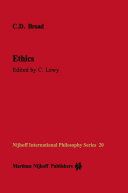
This volume contains C. D. Broad’s Cambridge lectures on Ethics. Broad gave a course of lectures on the subject, intended primarily for Part I of the Moral Sciences Tripos, every academic year from 1933 – 34 up to and in cluding 1952 – 53 (except that he did not lecture on Ethics in 1935 – 36). The course however was frequently revised, and the present version is es sentially that which he gave in 1952 – 53. Broad always wrote out his lectures fully beforehand, and the manuscript on Ethics, although full of revisions, is in a reasonably good state. But his handwriting is small and close and in places difficult to decipher. I therefore fear that some words may have been misread. There was an additional complication. In the summer of 1953 Broad revised and enlarged two sections of the course, namely the section on “Moore’s theory” and that on “Naturalistic theories” (both sections occur in Chapter 4). The revised version of the section on Moore is undoubtedly superior to the earlier version, and I have therefore included it. But in my opinion this is not true of the new version of the section on naturalistic theories: although more comprehensive than the earlier version, it is not only repetitive in itself, but also repeats, sometimes almost verbatim, passages which occur elsewhere in the lectures. In brief, the new version is not fully integrated with the rest of the course.
This second edition of Ethics in Practice is a comprehensive collection of more than 60 new, newly-revised, and classic essays on fourteen contemporary moral questions. Through the selection of essays, organization of sections, and incisive general and section introductions, this book integrates ethical theory and the discussion of practical moral problems. In addition to the more familiar issues, such as abortion, euthanasia, animal rights, preferential treatment, and the environment, the volume includes coverage of less familiar, but equally important issues such as immigration, political correctness, free speech, the use of drugs, world hunger, and economic justice. The second edition includes 21 essays not in the first edition, with expanded sections discussing three more topics: reproductive technologies, gun control, and capital punishment. This volume features accessible and engaging, yet philosophically rigorous essays that encourage the student to think critically about a wide range of practical moral issues. The supporting website at http://www.stpt.usf.edu/hhl/papers/ethics.in.practice.2nd.htm contains extensive links to sources on the topics, ethical theories, and guides on writing papers. These features make Ethics in Practice the ideal text for introductory and applied ethics courses.
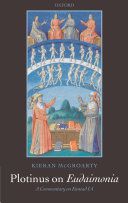
In this volume, Kieran McGroarty provides a philosophical commentary on a section of the Enneads written by the last great Neoplatonist thinker, Plotinus. The treatise is entitled “Concerning Well-Being” and was written at a late stage in Plotinus’ life when he was suffering from an illness that was shortly to kill him. Its main concern is with the good man and how he should pursue the good life. The treatise is therefore central to our understanding of Plotinus’ ethical theory, and the commentary seeks to explicate and elucidate that theory. Plotinus’ views on how one should live in order to fulfill oneself as a human being are as relevant now as they were in the third century AD. All Greek and Latin is translated, while short summaries introducing the content of each chapter help to make Plotinus’ argument clear even to the non-specialist.
Whether firms can be said to be moral agents and to have the capacity for moral responsibility has significant practical consequences. In most legal systems in the world, business firms are recognized as persons with the ability to own property, to maintain and defend lawsuits, and to self-organize governance structures. To recognize that these business persons can also act morally or immorally as organizations, however, would justify the imposition of other legal constraints and normative expectations on organizations. In the criminal law, for example, the idea that an organized firm may itself have criminal culpability is accepted in many countries (such as the United States) but rejected in others (such as Germany). This book collects new contributions by leading business scholars in business ethics, philosophy, and related disciplines to extend our understanding of the moral responsibility of firms.
ما از اخلاق چه انتظاری داریم؟ این سوال شاید تاحدودی برای عموم مردم و یا متخصصان این رشته قابل پاسخ باشد؛ اینکه خوب بودن را به ما بیاموزد و در تنظیم روابط فردی م...

جشن کتاب تهران به ایستگاه سی و یکم رسیده است. حال و احوال نشر کتاب خوب نیست و باید فرهنگدوستان را به خرید و هدیه دادن کتاب ترغیب نمود. خانه اخلاقپژوهان جوان ب...

بنیاد کتابهای اخلاق اسلامی عمدتا پالایش جان از آلودگیها و آراستن آن به زیباییها است. اندیشه محوری این قبیل کتابها آن است که انسان فعلی آنی نیست که باید باشد...

-
0 Comments