Notice: تابع WP_Block_Type_Registry::register به طورنادرست فراخوانی شد. نامهای نوع بلوک نباید حروف بزرگ داشته باشند. لطفاً برای اطلاعات بیشتر، اشکال زدایی در وردپرس را مشاهده کنید. (این پیام در نگارش 5.0.0 افزوده شده است.) in /home/ethicsho/public_html/wp-includes/functions.php on line 5313
Warning: Use of undefined constant TDC_PATH_LEGACY - assumed 'TDC_PATH_LEGACY' (this will throw an Error in a future version of PHP) in /home/ethicsho/public_html/wp-content/plugins/td-composer/td-composer.php on line 109
Warning: Use of undefined constant TDSP_THEME_PATH - assumed 'TDSP_THEME_PATH' (this will throw an Error in a future version of PHP) in /home/ethicsho/public_html/wp-content/plugins/td-composer/td-composer.php on line 113 بایگانیهای 3588 - خانه اخلاق پژوهان جوان Notice: Trying to access array offset on value of type bool in /home/ethicsho/public_html/wp-content/plugins/wp-ulike/inc/general-functions.php on line 807
How should we decide which inequalities between people are justified, and which are unjustified? One answer is that such inequalities are only justified where there is a corresponding variation in responsible action or choice on the part of the persons concerned. This view, which has become known as ‘luck egalitarianism’, has come to occupy a central place in recent debates about distributive justice. This book is the first full length treatment of this significant development in contemporary political philosophy. Each of its three parts addresses a key question concerning the theory. Which version of luck egalitarian comes closest to realizing luck egalitarian objectives? Does luck egalitarianism succeed as a view of egalitarian justice? And is it sound as an account of distributive justice in general? The book provides a distinctive answer to each of these questions, along the way engaging with the leading theorists identified in the literature as luck egalitarians, such as Richard Arneson, G. A. Cohen, and Ronald Dworkin, as well as the most influential critics, including Elizabeth Anderson, Marc Fleurbaey, Susan Hurley, Samuel Scheffler, and Jonathan Wolff. Key Features *Presents a critical survey of already classic debates about responsibility, equality and justice *Provides a sustained engagement with luck egalitarianism’s critics *Stakes a distinctive position on the key questions regarding luck egalitarianism
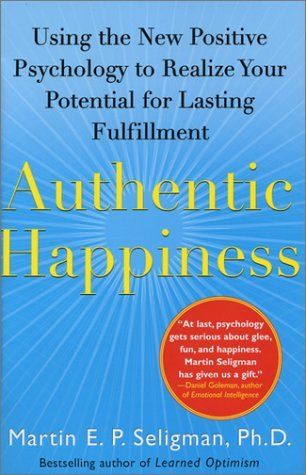
In this national bestseller — Martin Seligman’s most stimulating, persuasive book to date — the acclaimed author of Learned Optimism introduces yet another revolutionary idea. Drawing on groundbreaking scientific research, Seligman shows how Positive Psychology is shifting the profession’s paradigm away from its narrow-minded focus on pathology, victimology, and mental illness to positive emotion and mental health. Happiness, studies show, is not the result of good genes or luck. It can be cultivated by identifying and nurturing traits that we already possess — including kindness, originality, humor, optimism, and generosity.Seligman provides the tools you need in order to ascertain your most positive traits or strengths. Then he explains how, by frequently calling upon these “signature strengths” in all the crucial realms of life — health, relationships, career — you will not only develop natural buffers against misfortune and negative emotion, but also achieve new and sustainable levels of authentic contentment, gratification, and meaning.
Is there a public good? A prevalent view in political science is that democracy is unavoidably chaotic, arbitrary, meaningless, and impossible. Such scepticism began with Condorcet in the eighteenth century, and continued most notably with Arrow and Riker in the twentieth century. In this powerful book, Gerry Mackie confronts and subdues these long-standing doubts about democratic governance. Problems of cycling, agenda control, strategic voting, and dimensional manipulation are not sufficiently harmful, frequent, or irremediable, he argues, to be of normative concern. Mackie also examines every serious empirical illustration of cycling and instability, including Rikers famous argument that the US Civil War was due to arbitrary dimensional manipulation. Almost every empirical claim is erroneous, and none is normatively troubling, Mackie says. This spirited defence of democratic institutions should prove both provocative and influential.
ما از اخلاق چه انتظاری داریم؟ این سوال شاید تاحدودی برای عموم مردم و یا متخصصان این رشته قابل پاسخ باشد؛ اینکه خوب بودن را به ما بیاموزد و در تنظیم روابط فردی م...

جشن کتاب تهران به ایستگاه سی و یکم رسیده است. حال و احوال نشر کتاب خوب نیست و باید فرهنگدوستان را به خرید و هدیه دادن کتاب ترغیب نمود. خانه اخلاقپژوهان جوان ب...

بنیاد کتابهای اخلاق اسلامی عمدتا پالایش جان از آلودگیها و آراستن آن به زیباییها است. اندیشه محوری این قبیل کتابها آن است که انسان فعلی آنی نیست که باید باشد...

-
0 Comments