Notice: تابع WP_Block_Type_Registry::register به طورنادرست فراخوانی شد. نامهای نوع بلوک نباید حروف بزرگ داشته باشند. لطفاً برای اطلاعات بیشتر، اشکال زدایی در وردپرس را مشاهده کنید. (این پیام در نگارش 5.0.0 افزوده شده است.) in /home/ethicsho/public_html/wp-includes/functions.php on line 5313
Warning: Use of undefined constant TDC_PATH_LEGACY - assumed 'TDC_PATH_LEGACY' (this will throw an Error in a future version of PHP) in /home/ethicsho/public_html/wp-content/plugins/td-composer/td-composer.php on line 109
Warning: Use of undefined constant TDSP_THEME_PATH - assumed 'TDSP_THEME_PATH' (this will throw an Error in a future version of PHP) in /home/ethicsho/public_html/wp-content/plugins/td-composer/td-composer.php on line 113 بایگانیهای 3216 - خانه اخلاق پژوهان جوان Notice: Trying to access array offset on value of type bool in /home/ethicsho/public_html/wp-content/plugins/wp-ulike/inc/general-functions.php on line 807
Bernard Williams is remembered as one of the most brilliant and original philosophers of the past fifty years. Widely respected as a moral philosopher, Williams began to write about politics in a sustained way in the early 1980s. There followed a stream of articles, lectures, and other major contributions to issues of public concern–all complemented by his many works on ethics, which have important implications for political theory.This new collection of essays, most of them previously unpublished, addresses many of the core subjects of political philosophy: justice, liberty, and equality; the nature and meaning of liberalism; toleration; power and the fear of power; democracy; and the nature of political philosophy itself. A central theme throughout is that political philosophers need to engage more directly with the realities of political life, not simply with the theories of other philosophers. Williams makes this argument in part through a searching examination of where political thinking should originate, to whom it might be addressed, and what it should deliver.Williams had intended to weave these essays into a connected narrative on political philosophy with reflections on his own experience of postwar politics. Sadly he did not live to complete it, but this book brings together many of its components. Geoffrey Hawthorn has arranged the material to resemble as closely as possible Williams’s original design and vision. He has provided both an introduction to Williams’s political philosophy and a bibliography of his formal and informal writings on politics.Those who know the work of Bernard Williams will find here the familiar hallmarks of his writing–originality, clarity, erudition, and wit. Those who are unfamiliar with, or unconvinced by, a philosophical approach to politics, will find this an engaging introduction. Both will encounter a thoroughly original voice in modern political theory and a searching approach to the shape and direction of liberal political thought in the past thirty-five years.
Although the environmental movement and the environmental justice movement would seem to be natural allies, their relationship over the years has often been characterized by conflict and division. The environmental justice movement has charged the mainstream environmental movement with racism and elitism and has criticized its activist agenda on the grounds that it values wilderness over people. Environmental justice advocates have called upon environmental organizations to act on environmental injustice and address racism and classism in their own hiring and organizational practices, lobbying agenda, and political platforms. This book examines the current relationship between the two movements in both conceptual and practical terms and explores the possibilities for future collaboration. In ten original essays, contributors from a variety of disciplines consider such topics as the relationship between the two movements’ ethical commitments and activist goals, instances of successful cooperation in U.S. contexts, and the challenges posed to both movements by globalization and climate change. They examine the possibility and desirability of one unified movement as opposed to two complementary ones by means of analyses and case studies; these include a story of asbestos hazards that begins in a Montana mine and ends with the release of asbestos insulation into the air of Manhattan after the collapse of the World Trade Center. This book, part of a necessary rethinking of the relationship between the two movements, shows that effective, mutually beneficial alliances can advance the missions of both.Contributors:Kim Allen, J. Robert Cox, Vinci Daro, Kevin DeLuca, Giovanna Di Chiro, Daniel Faber, Dorothy Holland, Dale Jamieson, M. Nils Peterson, Markus John Peterson, Tarla Rai Peterson, Phaedra C. Pezzullo, J. Timmons Roberts, Ronald Sandler, Steve Schwarze, Peter Wenz
Edited by four leading members of the new generation of medical and healthcare ethicists working in the UK, respected worldwide for their work in medical ethics, Principles of Health Care Ethics, Second Edition is a standard resource for students, professionals, and academics wishing to understand current and future issues in healthcare ethics. With a distinguished international panel of contributors working at the leading edge of academia, this volume presents a comprehensive guide to the field, with state of the art introductions to the wide range of topics in modern healthcare ethics, from consent to human rights, from utilitarianism to feminism, from the doctor-patient relationship to xenotransplantation. This volume is the Second Edition of the highly successful work edited by Professor Raanan Gillon, Emeritus Professor of Medical Ethics at Imperial College London and former editor of the Journal of Medical Ethics, the leading journal in this field. Developments from the First Edition include: The focus on ‘Four Principles Method’ is relaxed to cover more different methods in health care ethics. More material on new medical technologies is included, the coverage of issues on the doctor/patient relationship is expanded, and material on ethics and public health is brought together into a new section.
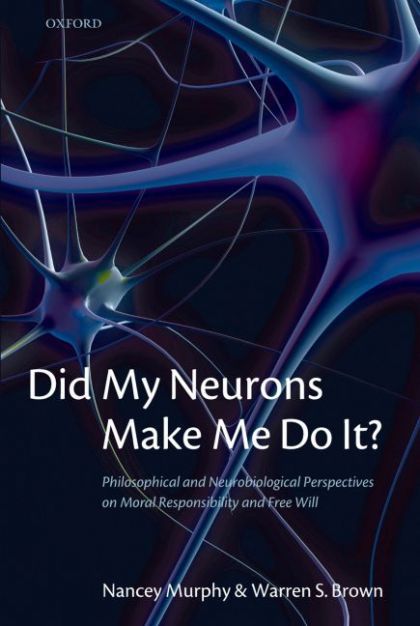
If humans are purely physical, and if it is the brain that does the work formerly assigned to the mind or soul, then how can it fail to be the case that all of our thoughts and actions are determined by the laws of neurobiology? If this is the case, then free will, moral responsibility, and, indeed, reason itself would appear to be in jeopardy. Nancey Murphy and Warren S. Brown here defend a non-reductive version of physicalism whereby humans are (sometimes) the authors of their own thoughts and actions. Did My Neurons Make Me Do It? brings together insights from both philosophy and the cognitive neurosciences to defeat neurobiological reductionism. One resource is a “post-Cartesian” account of mind as essentially embodied and constituted by action-feedback-evaluation-action loops in the environment, and “scaffolded” by cultural resources. Another is a non-mysterious account of downward (mental) causation explained in terms of a complex, higher-order system exercising constraints on lower-level causal processes. These resources are intrinsically related: the embeddedness of brain events in action-feedback loops is the key to their mentality, and those broader systems have causal effects on the brain itself. With these resources Murphy and Brown take on two problems in philosophy of mind: a response to the charges that physicalists cannot account for the meaningfulness of language nor the causal efficacy of the mental qua mental. Solutions to these problems are a prerequisite to addressing the central problem of the book: how can biological organisms be free and morally responsible? The authors argue that the free-will problem is badly framed if it is put in terms of neurobiological determinism; the real issue is neurobiological reductionism. If it is indeed possible to make sense of the notion of downward causation, then the relevant question is whether humans exert downward causation over some of their own parts and processes. If all organisms do this to some extent, what needs to be added to this animalian flexibility to constitute free and responsible action? The keys are sophisticated language and hierarchically ordered cognitive processes allowing (mature) humans to evaluate their own actions, motives, goals, and rational and moral principles.
ما از اخلاق چه انتظاری داریم؟ این سوال شاید تاحدودی برای عموم مردم و یا متخصصان این رشته قابل پاسخ باشد؛ اینکه خوب بودن را به ما بیاموزد و در تنظیم روابط فردی م...

جشن کتاب تهران به ایستگاه سی و یکم رسیده است. حال و احوال نشر کتاب خوب نیست و باید فرهنگدوستان را به خرید و هدیه دادن کتاب ترغیب نمود. خانه اخلاقپژوهان جوان ب...

بنیاد کتابهای اخلاق اسلامی عمدتا پالایش جان از آلودگیها و آراستن آن به زیباییها است. اندیشه محوری این قبیل کتابها آن است که انسان فعلی آنی نیست که باید باشد...

-
0 Comments