Notice: تابع WP_Block_Type_Registry::register به طورنادرست فراخوانی شد. نامهای نوع بلوک نباید حروف بزرگ داشته باشند. لطفاً برای اطلاعات بیشتر، اشکال زدایی در وردپرس را مشاهده کنید. (این پیام در نگارش 5.0.0 افزوده شده است.) in /home/ethicsho/public_html/wp-includes/functions.php on line 5313
Warning: Use of undefined constant TDC_PATH_LEGACY - assumed 'TDC_PATH_LEGACY' (this will throw an Error in a future version of PHP) in /home/ethicsho/public_html/wp-content/plugins/td-composer/td-composer.php on line 109
Warning: Use of undefined constant TDSP_THEME_PATH - assumed 'TDSP_THEME_PATH' (this will throw an Error in a future version of PHP) in /home/ethicsho/public_html/wp-content/plugins/td-composer/td-composer.php on line 113 بایگانیهای 3164 - خانه اخلاق پژوهان جوان Notice: Trying to access array offset on value of type bool in /home/ethicsho/public_html/wp-content/plugins/wp-ulike/inc/general-functions.php on line 807
Death is the one ineradicable fact of being human. How we think about it is central to our understanding of and engagement with the world. Our human and cultural construction of death and dying shapes the structure and purpose of our institutions and has underpinned the work of scholars and philosophers down the ages. In its organization and values, its form and content, its construction of the past and of the future, the relationship between law and mortality remains one of the most perplexing and under-theorized aspects of the legal system, whether dealing with AIDS, euthanasia, sadomasochism, “mercy killings,” murder, the judicial review of the right to die, or the criminal death sentence. This timely and important collection brings together scholars from Australia, Britain and the United States to reconsider the relationship between death and the law, in ways that will be of particular interest to post-structural philosophers and legal theorists and to cultural theorists and practitioners in a much wider field, for whom there is nothing more certain than the existence of “death and taxes.” Contributors, and their university or col
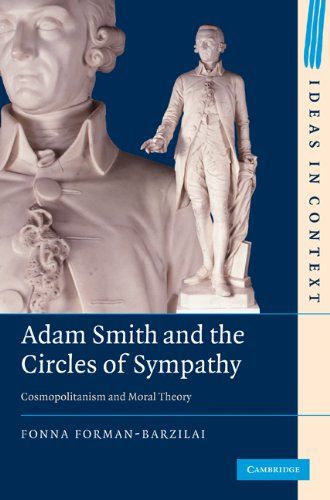
Adam Smith and the Circles of Sympathy pursues Adam Smith’s views on moral judgement, humanitarian care, commerce, justice and international law both in historical context and through a twenty-first century cosmopolitan lens, making this a major and timely contribution not only to Smith studies but also to the history of cosmopolitan thought and to contemporary cosmopolitan discourse itself. Forman-Barzilai breaks new ground, demonstrating the spatial texture of Smith’s moral psychology and the ways he believed that physical, affective and cultural distance constrain the identities, connections and ethical obligations of modern commercial people. Forman-Barzilai emphasises his resistance to the sort of relativism, moral insularity and cultural chauvinism that too often accompany localist critiques of cosmopolitan thought today. This is a timely, revisionist study that integrates the perspectives of intellectual history, moral philosophy, political theory, cultural theory, international relations theory and political economy, and will appeal across the humanities and social sciences.
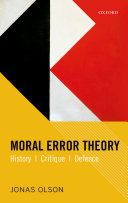
Jonas Olson presents a critical survey of moral error theory, the view that there are no moral facts and so all moral claims are false. In Part I (History), he explores the historical context of the debate, and discusses the moral error theories of David Hume and of some more or less influential twentieth century philosophers, including Axel Hägerström, Bertrand Russell, Ludwig Wittgenstein, and Richard Robinson. He argues that the early cases for moral error theory are suggestive but that they would have been stronger had they included something like J. L. Mackie’s arguments that moral properties and facts are metaphysically queer. Part II (Critique) focuses on these arguments. Olson identifies four queerness arguments, concerning supervenience, knowledge, motivation, and irreducible normativity, and goes on to establish that while the first three are not compelling, the fourth has considerable force, especially when combined with debunking explanations of why we tend to believe that there are moral properties and facts when in fact there are none. One conclusion of Part II is that a plausible error theory takes the form of an error theory about irreducible normativity. In Part III (Defence), Olson considers challenges according to which that kind of error theory has problematic ramifications regarding hypothetical reasons, epistemic reasons, and deliberation. He ends his discussion with a consideration of the implications of moral error theory for ordinary moral thought and talk, and for normative theorizing.
ما از اخلاق چه انتظاری داریم؟ این سوال شاید تاحدودی برای عموم مردم و یا متخصصان این رشته قابل پاسخ باشد؛ اینکه خوب بودن را به ما بیاموزد و در تنظیم روابط فردی م...

جشن کتاب تهران به ایستگاه سی و یکم رسیده است. حال و احوال نشر کتاب خوب نیست و باید فرهنگدوستان را به خرید و هدیه دادن کتاب ترغیب نمود. خانه اخلاقپژوهان جوان ب...

بنیاد کتابهای اخلاق اسلامی عمدتا پالایش جان از آلودگیها و آراستن آن به زیباییها است. اندیشه محوری این قبیل کتابها آن است که انسان فعلی آنی نیست که باید باشد...

-
0 Comments