Notice: تابع WP_Block_Type_Registry::register به طورنادرست فراخوانی شد. نامهای نوع بلوک نباید حروف بزرگ داشته باشند. لطفاً برای اطلاعات بیشتر، اشکال زدایی در وردپرس را مشاهده کنید. (این پیام در نگارش 5.0.0 افزوده شده است.) in /home/ethicsho/public_html/wp-includes/functions.php on line 5313
Warning: Use of undefined constant TDC_PATH_LEGACY - assumed 'TDC_PATH_LEGACY' (this will throw an Error in a future version of PHP) in /home/ethicsho/public_html/wp-content/plugins/td-composer/td-composer.php on line 109
Warning: Use of undefined constant TDSP_THEME_PATH - assumed 'TDSP_THEME_PATH' (this will throw an Error in a future version of PHP) in /home/ethicsho/public_html/wp-content/plugins/td-composer/td-composer.php on line 113 بایگانیهای 3157 - خانه اخلاق پژوهان جوان Notice: Trying to access array offset on value of type bool in /home/ethicsho/public_html/wp-content/plugins/wp-ulike/inc/general-functions.php on line 807
Written by internationally renowned scholars, this Companion maps the moral teachings of the world’s religions, and also charts new directions for work in the field of religious ethics. Now available in paperback, this is a rich resource for understanding the moral teachings and practices of the world’s religions Includes detailed discussions of issues in moral theory Offers extensive treatment of the world’s major religious traditions, including Judaism, Christianity, Islam, Buddhism, Hinduism, Chinese religions and African religions Compares the ways in which the religions provide resources for addressing current moral challenges in areas such as ecology, economics, global dynamics, religious war, human rights and other topics.
This volume is the first English-language book-length text to trace the development of bioethics in the Ibero-American context. Coverage is given to many particular countries within Latin America with an aim to present the historical development of bioethics therein. This history takes place against the backdrop of a tumultuous period of time in the history of Latin America. The volume also discusses the relationship of bioethics in Latin America to questions and issues in Roman Catholic moral theology and philosophy. Moreover, it specifically touches on how these issues affect women in the region.”Ibero-American Bioethics: History and Perspectives” is a landmark work, collecting the voices of those who participated in the founding and development of bioethics in Latin America, the Caribbean, and the Iberian Peninsula. The volume offers the reader a cluster of perspectives on the various births of bioethics in this region. The essays in part are irreplaceable first-person voices that give an account of how bioethics took shape within the Spanish and Portuguese cultures both in Europe and in the Americas. As such, the volume is a collection of primary sources, otherwise not available in English, that presents historical panoramas and explores the new perspectives born of the different phases of bioethics in Ibero-America – from its assimilation of bioethics to its creation of its own authentic voices. The volume also encompasses critical reflections from this region on the quite different ways in which its local bioethics have taken shape. As such, this volume also offers an introduction into the quite different concerns that frame and direct bioethics in the cultural context of Ibero-America.The book gives a rich, deep, broad, and pluralist presentation of Ibero-American bioethics and its contribution to the international phenomenon of bioethics. It is a volume for all readers interested in bioethics, Ibero-American studies, and international approaches to health care policy.
Anita Superson challenges the traditional picture of the skeptic who asks, “Why be moral?” While holding that the skeptic’s position is important, she builds an argument against it by understanding it more deeply, and then shows what it would take to successfully defeat it. Superson argues that we must defeat not only the action skeptic, but the disposition skeptic, who denies that being morally disposed is rationally required, and the motive skeptic, who believes that merely going through the motions in acting morally is rationally permissible. We also have to address the amoralist, who is not moved by moral reasons he recognizes. Superson argues for expanding the skeptic’s position from self-interest to privilege to include morally unjustified behavior targeting disenfranchised social groups, as well as revising the traditional expected utility model to exclude desires deformed by patriarchy as irrational. Lastly she argues that the challenge can be answered if it can be shown that it is, in an important way, inconsistent and therefore irrational to privilege oneself over others. The Moral Skeptic makes an important contribution to both metaethics/moral theory and feminist philosophy, and brings feminist thinking into the larger discussion of the skeptical challenge.
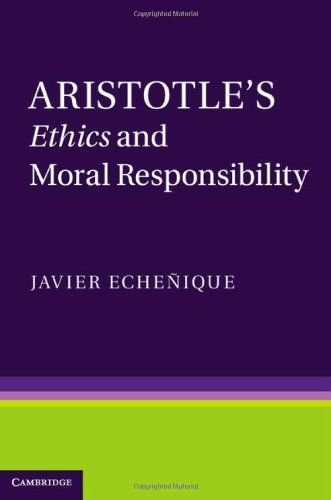
“Aristotle’s Ethics develops a complex theory of the qualities which make for a good human being and for several decades there has been intense discussion about whether Aristotle’s theory of voluntariness, outlined in the Ethics, actually delineates what modern thinkers would recognize as a theory of moral responsibility. Javier Echeñique presents a novel account of Aristotle’s discussion of voluntariness in the Ethics, arguing – against the interpretation by Arthur Adkins and that inspired by Peter Strawson – that he developed an original and compelling theory of moral responsibility and that this theory has contributed in important ways to our understanding of coercion, ignorance and violence. His study will be valuable for a wide range of readers interested in Aristotle and in ancient ethics more broadly”–
ما از اخلاق چه انتظاری داریم؟ این سوال شاید تاحدودی برای عموم مردم و یا متخصصان این رشته قابل پاسخ باشد؛ اینکه خوب بودن را به ما بیاموزد و در تنظیم روابط فردی م...

جشن کتاب تهران به ایستگاه سی و یکم رسیده است. حال و احوال نشر کتاب خوب نیست و باید فرهنگدوستان را به خرید و هدیه دادن کتاب ترغیب نمود. خانه اخلاقپژوهان جوان ب...

بنیاد کتابهای اخلاق اسلامی عمدتا پالایش جان از آلودگیها و آراستن آن به زیباییها است. اندیشه محوری این قبیل کتابها آن است که انسان فعلی آنی نیست که باید باشد...

-
0 Comments