Notice: تابع WP_Block_Type_Registry::register به طورنادرست فراخوانی شد. نامهای نوع بلوک نباید حروف بزرگ داشته باشند. لطفاً برای اطلاعات بیشتر، اشکال زدایی در وردپرس را مشاهده کنید. (این پیام در نگارش 5.0.0 افزوده شده است.) in /home/ethicsho/public_html/wp-includes/functions.php on line 5313
Warning: Use of undefined constant TDC_PATH_LEGACY - assumed 'TDC_PATH_LEGACY' (this will throw an Error in a future version of PHP) in /home/ethicsho/public_html/wp-content/plugins/td-composer/td-composer.php on line 109
Warning: Use of undefined constant TDSP_THEME_PATH - assumed 'TDSP_THEME_PATH' (this will throw an Error in a future version of PHP) in /home/ethicsho/public_html/wp-content/plugins/td-composer/td-composer.php on line 113 بایگانیهای 3133 - خانه اخلاق پژوهان جوان Notice: Trying to access array offset on value of type bool in /home/ethicsho/public_html/wp-content/plugins/wp-ulike/inc/general-functions.php on line 807
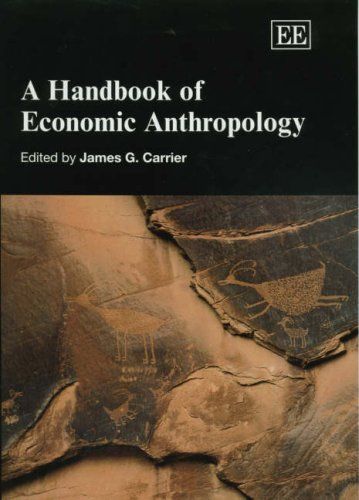
For more than a century, anthropologists have studied the economic lives and institutions of people around the world. The results of their research and reflection on economy have generally stayed within the discipline and have not been available in an accessible form to a broader readership. This major reference book is intended to correct this. This unique Handbook contains substantial and invaluable summary discussions of work on economic processes and issues, and on the relationship between economic and non-economic areas of life. Furthermore it describes conceptual orientations that are important among economic anthropologists, and presents summaries of key issues in the anthropological study of economic life in different regions of the world. Its scope and accessibility make it useful both to those who are interested in a particular topic and to those who want to see the breadth and fruitfulness of an anthropological study of economics. Economists from a wide range of fields and perspectives – from heterodox to classical, and from industrial economics to economic psychology and sociology – will find much to engage them within this exciting Handbook, as will anthropologists drawn to the significant statements by senior figures in the field. Those involved in development projects will find this an invaluable reference work with which to gain greater understanding of and insight into the reasons for people’s economic activities and decisions. The concise treatments of topics will provide invaluable teaching aids and reference for further reading by scholars at all levels of study.
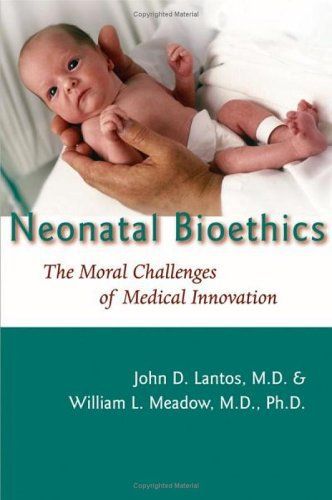
Neonatal intensive care has been one of the most morally controversial areas of medicine during the past thirty years. This study examines the interconnected development of four key aspects of neonatal intensive care: medical advances, ethical analysis, legal scrutiny, and econometric evaluation.The authors assert that a dramatic shift in societal attitudes toward newborns and their medical care was a stimulus for and then a result of developments in the medical care of newborns. They divide their analysis into three eras of neonatal intensive care. The first, characterized by the rapid advance of medical technology from the late 1960s to the Baby Doe case of 1982, established neonatal care as a legitimate specialty of medical care, separate from the rest of pediatrics and medicine. During this era, legal scholars and moral philosophers debated the relative importance of parental autonomy, clinical prognosis, and children’s rights. The second era, beginning with the Baby Doe case (a legal battle that spurred legislation mandating that infants with debilitating birth defects be treated unless the attending physician deems efforts to prolong life “futile”), stimulated efforts to establish a consistent federal standard on neonatal care decisions and raised important moral questions concerning the meaning of “futility” and of “inhumane” treatment. In the third era, a consistent set of decision-making criteria and policies was established. These policies were the result of the synergy and harmonization of newly agreed upon ethical principles and newly discovered epidemiological characteristics of neonatal care.Tracing the field’s recent history, notable advances, and considerable challenges yet to be faced, the authors present neonatal bioethics as a paradigm of complex conversation among physicians, philosophers, policy makers, judges, and legislators which has led to responsible societal oversight of a controversial medical innovation.
When Thomas Jefferson placed “the pursuit of happiness” along with life and liberty in The Declaration of Independence he was most likely referring to Aristotle’s concept of happiness, or eudaimonia. Eudaimonia is not about good feelings but rather the fulfillment of human potentials. Fulfillment is made possible by virtue; the moderation of desire and emotion by reason. The Psychology of Happiness is the first book to bring together psychological, philosophical, and physiological theory and research in support of Aristotle’s view. It examines the similarity between Aristotle’s concept of virtue and modern cognitive theories of emotion. It discusses the discovery of human potentials, the development of virtue and its neurological basis, the mistaken idea that fulfillment is selfish, and several other issues related to the pursuit of a good human life.
ما از اخلاق چه انتظاری داریم؟ این سوال شاید تاحدودی برای عموم مردم و یا متخصصان این رشته قابل پاسخ باشد؛ اینکه خوب بودن را به ما بیاموزد و در تنظیم روابط فردی م...

جشن کتاب تهران به ایستگاه سی و یکم رسیده است. حال و احوال نشر کتاب خوب نیست و باید فرهنگدوستان را به خرید و هدیه دادن کتاب ترغیب نمود. خانه اخلاقپژوهان جوان ب...

بنیاد کتابهای اخلاق اسلامی عمدتا پالایش جان از آلودگیها و آراستن آن به زیباییها است. اندیشه محوری این قبیل کتابها آن است که انسان فعلی آنی نیست که باید باشد...

-
0 Comments