Notice: تابع WP_Block_Type_Registry::register به طورنادرست فراخوانی شد. نامهای نوع بلوک نباید حروف بزرگ داشته باشند. لطفاً برای اطلاعات بیشتر، اشکال زدایی در وردپرس را مشاهده کنید. (این پیام در نگارش 5.0.0 افزوده شده است.) in /home/ethicsho/public_html/wp-includes/functions.php on line 5313
Warning: Use of undefined constant TDC_PATH_LEGACY - assumed 'TDC_PATH_LEGACY' (this will throw an Error in a future version of PHP) in /home/ethicsho/public_html/wp-content/plugins/td-composer/td-composer.php on line 109
Warning: Use of undefined constant TDSP_THEME_PATH - assumed 'TDSP_THEME_PATH' (this will throw an Error in a future version of PHP) in /home/ethicsho/public_html/wp-content/plugins/td-composer/td-composer.php on line 113 بایگانیهای 3020 - خانه اخلاق پژوهان جوان Notice: Trying to access array offset on value of type bool in /home/ethicsho/public_html/wp-content/plugins/wp-ulike/inc/general-functions.php on line 807
Is it possible to apply a theoretical approach to ethics? The French philosopher Catherine Chalier addresses this question with an unusual combination of traditional ethics and continental philosophy. In a powerful argument for the necessity of moral reflection, Chalier counters the notion that morality can be derived from theoretical knowledge.Chalier analyzes the positions of two great moral philosophers, Kant and Levinas. While both are critical of an ethics founded on knowledge, their criticisms spring from distinctly different points of view. Chalier reexamines their conclusions, pitting Levinas against (and with) Kant, to interrogate the very foundations of moral philosophy and moral imperatives. She provides a clear, systematic comparison of their positions on essential ideas such as free will, happiness, freedom, and evil. Although based on a close and elegant presentation of Kant and Levinas, Chalier’s book serves as a context for the development of the author’s own reflections on the question “What am I supposed to do?” and its continued importance for contemporary philosophy.
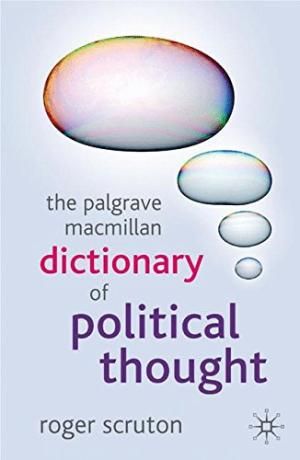
Roger Scruton’s Dictionary of Political Thought has been widely acclaimed as a profound and incisive guide to political ideas. This new edition takes stock of the revolutionary political changes that have taken place since the dictionary was first published in 1982, bringing the dictionary right up to date. Some 1790 entries cover every aspect of political thought, defining concepts and ideologies, surveying the arguments on issues, giving capsule histories of political institutions, and summarizing (with newly expanded treatment) the thought of major political theorists. The dictionary provides a readable and impartial survey of political thought, of immense value to students of political science, government, philosophy and jurisprudence as well as to the general reader with an interest in ideas.
This ground-breaking volume considers the ethical aspects of foreign policy change through five interrelated dimensions: conceptual, security, economic, normative and diplomatic. Defining ethics and what an ethical foreign policy should be is highly contested. The book includes many very different viewpoints to reflect the strong divergence of opinion on such issues as humanitarian intervention, free trade, the doctrine of preemption, political corruption and human rights. The thematic approach provides this volume with a clear organizational structure, giving readers a balanced overview of a number of important conceptual and practical issues central to the ethical analysis of states’ conduct and foreign policy making. An impressive group of international scholars and practitioners, including a New Zealand Foreign Minister, a US National Security Advisor, and an ICJ Justice, makes this volume ideally suited to courses on international relations, security studies, ethics and human rights, philosophy, media studies and international law.
Simon Blackburn puts forward a compelling and original philosophy of human motivation and morality. Why do we behave as we do? Can we improve? Is our ethics at war with our passions, or is it an upshot of those passions? Blackburn seeks the answers to such questions in an exploration of the nature of moral emotions and the structures of human motivation. He develops a naturalistic ethics, which integrates our understanding of ethics with the rest of our understanding of the world we live in. His theory does not debunk the ethical by reducing it to the non-ethical, and it banishes the spectres of scepticism and relativism that have haunted recent moral philosophy. Ruling Passions reveals how ethics can maintain its authority even though it is rooted in the very emotions and motivations that it exists to control.
ما از اخلاق چه انتظاری داریم؟ این سوال شاید تاحدودی برای عموم مردم و یا متخصصان این رشته قابل پاسخ باشد؛ اینکه خوب بودن را به ما بیاموزد و در تنظیم روابط فردی م...

جشن کتاب تهران به ایستگاه سی و یکم رسیده است. حال و احوال نشر کتاب خوب نیست و باید فرهنگدوستان را به خرید و هدیه دادن کتاب ترغیب نمود. خانه اخلاقپژوهان جوان ب...

بنیاد کتابهای اخلاق اسلامی عمدتا پالایش جان از آلودگیها و آراستن آن به زیباییها است. اندیشه محوری این قبیل کتابها آن است که انسان فعلی آنی نیست که باید باشد...

-
0 Comments