Notice: تابع WP_Block_Type_Registry::register به طورنادرست فراخوانی شد. نامهای نوع بلوک نباید حروف بزرگ داشته باشند. لطفاً برای اطلاعات بیشتر، اشکال زدایی در وردپرس را مشاهده کنید. (این پیام در نگارش 5.0.0 افزوده شده است.) in /home/ethicsho/public_html/wp-includes/functions.php on line 5313
Warning: Use of undefined constant TDC_PATH_LEGACY - assumed 'TDC_PATH_LEGACY' (this will throw an Error in a future version of PHP) in /home/ethicsho/public_html/wp-content/plugins/td-composer/td-composer.php on line 109
Warning: Use of undefined constant TDSP_THEME_PATH - assumed 'TDSP_THEME_PATH' (this will throw an Error in a future version of PHP) in /home/ethicsho/public_html/wp-content/plugins/td-composer/td-composer.php on line 113 بایگانیهای 2878 - خانه اخلاق پژوهان جوان Notice: Trying to access array offset on value of type bool in /home/ethicsho/public_html/wp-content/plugins/wp-ulike/inc/general-functions.php on line 807
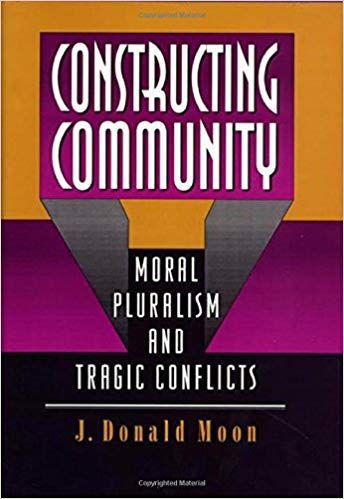
In developing a new theory of political and moral community, J. Donald Moon takes questions of cultural pluralism and difference more seriously than do many other liberal thinkers of our era: Moon is willing to confront the problem of how community can be created among those who have very different views about the proper ends of human life. Experiencing such profound disagreement, can we live together in a society under norms we all accept? In recent years, traditional ways of looking at this query have come under attack by post-modernists, feminists, and thinkers concerned with pluralism. Respectfully engaging their critiques, Moon proposes a reformulated liberalism that is intended to overcome the problems they have identified.In developing a new theory of political and moral community, J. Donald Moon takes questions of cultural pluralism and difference more seriously than do many other liberal thinkers of our era: Moon is willing to confront the problem of how community can be created among those who have very different views about the proper ends of human life. Experiencing such profound disagreement, can we live together in a society under norms we all accept? In recent years, traditional ways of looking at this query have come under attack by post-modernists, feminists, and thinkers concerned with pluralism. Respectfully engaging their critiques, Moon proposes a reformulated liberalism that is intended to overcome the problems they have identified.
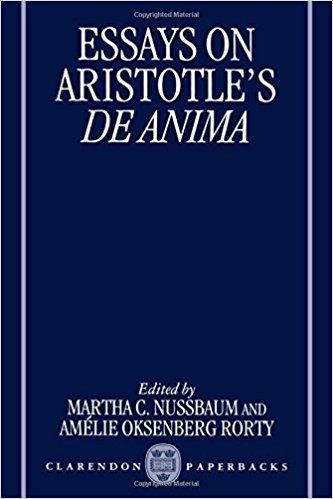
‘De Anima’ is one of the most influential and widely-studied of Aristotle’s works. This volume offers discussions of all aspects of this work by leading philosophers. Covering topics such as the relation between soul and body, memory, desire, and thought the essays present the philosophical substance of Aristotle’s views to the modern reader.
There is no escaping landscape: it’s everywhere and part of everyone’s life. Landscapes have received much less attention in aesthetics than those arts we can choose to ignore, such as painting or music – but they can tell us a lot about the ethical and aesthetic values of the societies that produce them. Drawing examples from a wide range of landscapes from around the world and throughout history, Susan Herrington considers the ways landscapes can affect our emotions, our imaginations, and our understanding of the passage of time. On Landscapes reveals the enormous design work involved in even the most naturalistic of landscapes, such as Prospect Park in Brooklyn, and the ways in which contemporary landscapes are turning the challenges of the industrial past into opportunities for the future. These contemporary landscapes, such as a park in Germany that uses industrial relics as ruins and a playground in Japan built on a former landfill, signal a change in the way we think about nature and art. By invitingus to thoughtfully see and experience the landscapes that we encounter in our daily lives, On Landscapes demonstrates that art is all around us.
In his seminal Philosophy of David Hume (1941), Norman Kemp Smith called for a study of Hume “in all his manifold activities: as philosopher, as political theorist, as economist, as historian, and as man of letters, ” indicating that “Hume’s philosophy, as the attitude of mind which found for itself these various forms of expression, will then have been presented, adequately and in due perspective, for the first time.” Claudia Schmidt seeks to address this long-standing need in Hume scholarship. Against the charges that Hume holds no consistent philosophical position, offers no constructive account of rationality, and sees no positive relation between philosophy and other areas of inquiry, Schmidt argues for the overall coherence of Hume’s thought as a study of “reason in history.” She develops this interpretation by tracing Hume’s constructive account of human cognition and its historical dimension as a unifying theme across the full range of his writings. Hume, she shows, provides a positive account of the ways in which our concepts, beliefs, emotions, and standards of judgment in different areas of inquiry are shaped by experience, both in the personal history of the individual and in the life of a community. This book is valuable at many levels: for students, as an introduction to Hume’s writings and issues in their interpretation; for Hume specialists, as a unified and intriguing interpretation of his thought; for philosophers generally, as a synthesis of recent developments in Hume scholarship; and for scholars in other disciplines, as a guide to Hume’s contributions to their own fields.
ما از اخلاق چه انتظاری داریم؟ این سوال شاید تاحدودی برای عموم مردم و یا متخصصان این رشته قابل پاسخ باشد؛ اینکه خوب بودن را به ما بیاموزد و در تنظیم روابط فردی م...

جشن کتاب تهران به ایستگاه سی و یکم رسیده است. حال و احوال نشر کتاب خوب نیست و باید فرهنگدوستان را به خرید و هدیه دادن کتاب ترغیب نمود. خانه اخلاقپژوهان جوان ب...

بنیاد کتابهای اخلاق اسلامی عمدتا پالایش جان از آلودگیها و آراستن آن به زیباییها است. اندیشه محوری این قبیل کتابها آن است که انسان فعلی آنی نیست که باید باشد...

-
0 Comments